USD/JPY rallies past 159 on rebound in US Dollar, Japanese disinflation
- USD/JPY rallies to over 159 as US Dollar gains on hawkish Fedspeak and weakening Yen.
- Slide in Japanese underlying inflation suggests BoJ will not be able to raise rates much to support JPY.
- USD/JPY reenters intervention territory increasing chances authorities could intervene to push it lower.


USD/JPY continues its relentless climb, reaching the 159s on Friday – only one big figure away from the April highs of 160.32, where the Japanese authorities finally stepped in to prevent a further depreciation of their currency.
The pair is rallying off the back of a strengthening US Dollar (USD) due to rising US Treasury yields, as Federal Reserve (Fed) officials continue to spout hawkish commentary, playing down any market eagerness to see them cut interest rates any time soon.
USD/JPY gets further support from a weakening Japanese Yen (JPY), after the release of Japanese inflation data for May showed a fall in core inflation, and what gains there were, were mostly put down to rises in energy prices.
USD/JPY pushes higher on back of rising US Treasury yields
USD/JPY’s recent gains have been driven by the US Dollar due to “Higher (US) bond yields” which are highly correlated to USD, according to Westpac’s Pat Bustamante in his Friday morning report.
“The 2-year bond yield increased 3 basis points to 4.74%. The 10-year treasury yield increased 4 basis points to 4.26%,” says the Senior Economist, putting the gains down to, “some hawkish talk from a Fed official.”
The Fed official in question was Federal Reserve’s (Fed) Bank of Richmond President Tom Barkin, who urged patience as Fed rate cuts would “hit in time” but that the Fed needed “clearer inflation signals before a rate cut,” and reiterated that the bank would be taking a data-dependent approach.
According to Westpac’s Bustamente, “Interest-rate markets are pricing in just under two 25 basis points rate cuts this year, one in November and the other in December.”
The estimate is something of a backwards step from previous expectations that the Fed would make a cut in September as was the case immediately after US Retail Sales bombed earlier in the week.
Japanese underlying inflation continues to cool
Experts say the only way to reverse the long-term depreciation in the Yen is to increase interest rates, however, in order to do that, the Bank of Japan (BoJ) needs to to see inflation rising. Japanese Consumer Price Index (CPI) data for May released overnight will likely make them less inclined to begin raising interest rates, according to economists at Capital Economics.
Despite the headline rate of inflation rising to 2.8% from 2.5% previously, these gains were put mainly down to a 10% rise in utility bills after the government withdrew its subsidies for energy companies.
National CPI ex Food and Energy, however, cooled to 2.1% from 2.4% previously and showed underlying inflation continuing “to slow rapidly” according to Marcel Thieliant, Head of Asia-Pacific at Capital Economics.
“The upshot is that inflation excluding fresh food could already fall below the Bank of Japan’s 2% target in June and we still expect it to slow more sharply over coming months than the Bank has been anticipating. While that probably won’t forestall a rate hike at the Bank’s July meeting, it should convince the Bank to leave rates unchanged thereafter,” he concludes.
USD/JPY enters “intervention zone”
USD/JPY is now back on the edge of a cloudy “intervention zone” (red shaded area) where the Japanese authorities made direct purchases of Japanese Yen in the open market in late April and early May, to counteract its devaluation. The result was a deep correction in USD/JPY from 160 to 152.
USD/JPY Daily Chart
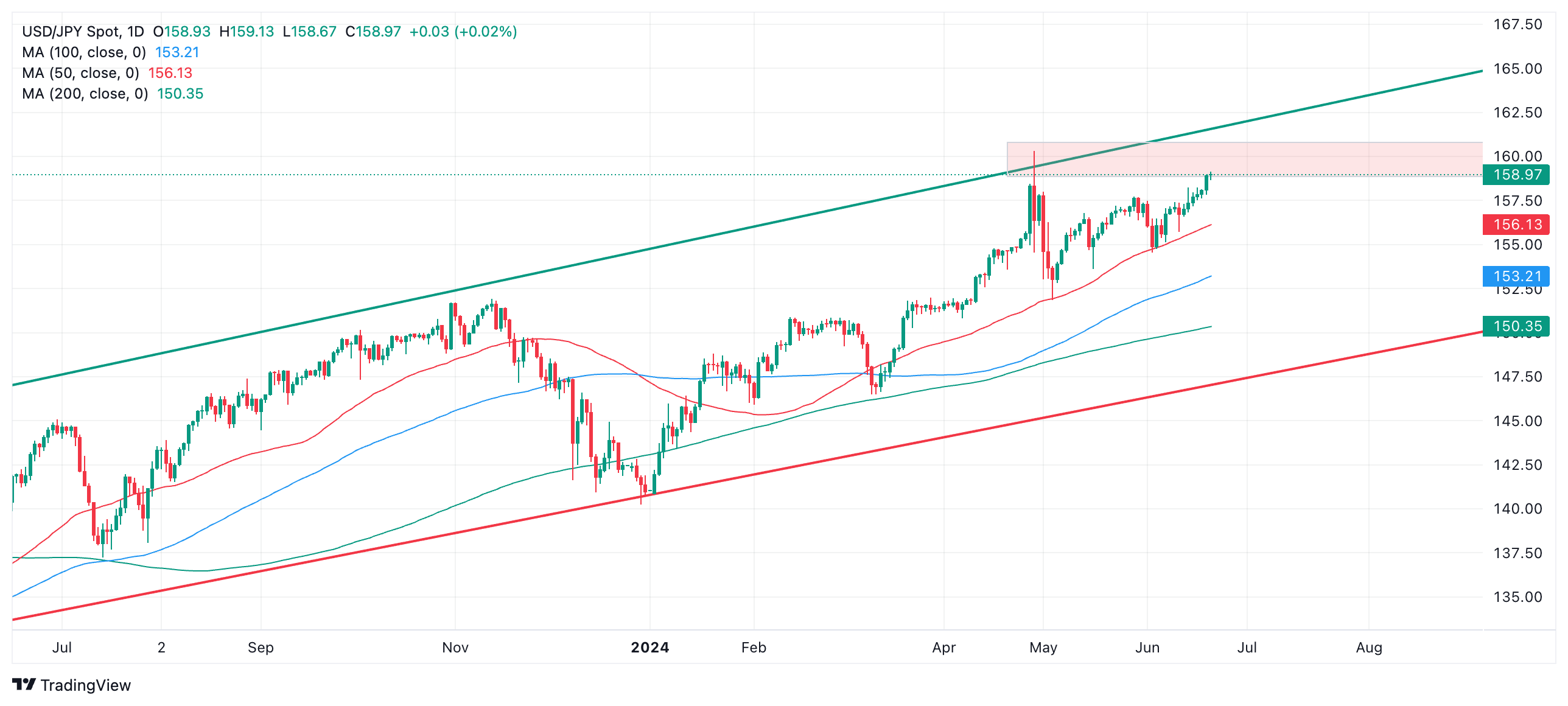
Given the increasing frequency of warnings from currency officials that further weakness will be countered by direct intervention, the chances of the same thing happening again has drastically increased. This, in turn, suggests a pullback may be in the offing.
Author
Joaquin Monfort
FXStreet
Joaquin Monfort is a financial writer and analyst with over 10 years experience writing about financial markets and alt data. He holds a degree in Anthropology from London University and a Diploma in Technical analysis.

















