USD/JPY Price Forecast: Stays inside Ascending Triangle formation
- USD/JPY turns upside down as the Japanese Yen gains on BoJ hawkish expectations.
- Market sentiment turns risk-averse as the US strikes at Venezuela.
- The US Dollar trades slightly higher ahead of the US ISM Manufacturing PMI data.

The USD/JPY pair gives up its intraday gains and ticks down marginally to near 156.70 during the European trading session on Monday. The pair turns upside down as the Japanese Yen (JPY) outperforms its peers amid growing expectations that the Bank of Japan (BoJ) will continue raising interest rates.
BoJ hawkish expectations are prompted by comments from Governor Kazuo Ueda pointing to hopes increase in wage growth and inflation in the near term. "Wages and prices are highly likely to rise together moderately," Ueda said earlier in the day. He added the central bank is expected to "continue raising interest rates if the economy and prices move in line with our forecast".
Though investors have underpinned the Japanese Yen (JPY) against the US Dollar (USD), the latter is outperforming its other peers as the United States (US) strike on Venezuela has increased its safe-haven demand.
As of writing, the US Dollar Index (DXY), which tracks the Greenback’s value against six major currencies, trades 0.15% higher to near 98.60.
In Monday’s session, investors will focus on the US ISM Manufacturing PMI data for December, which will be published at 15:00 GMT.
USD/JPY technical analysis
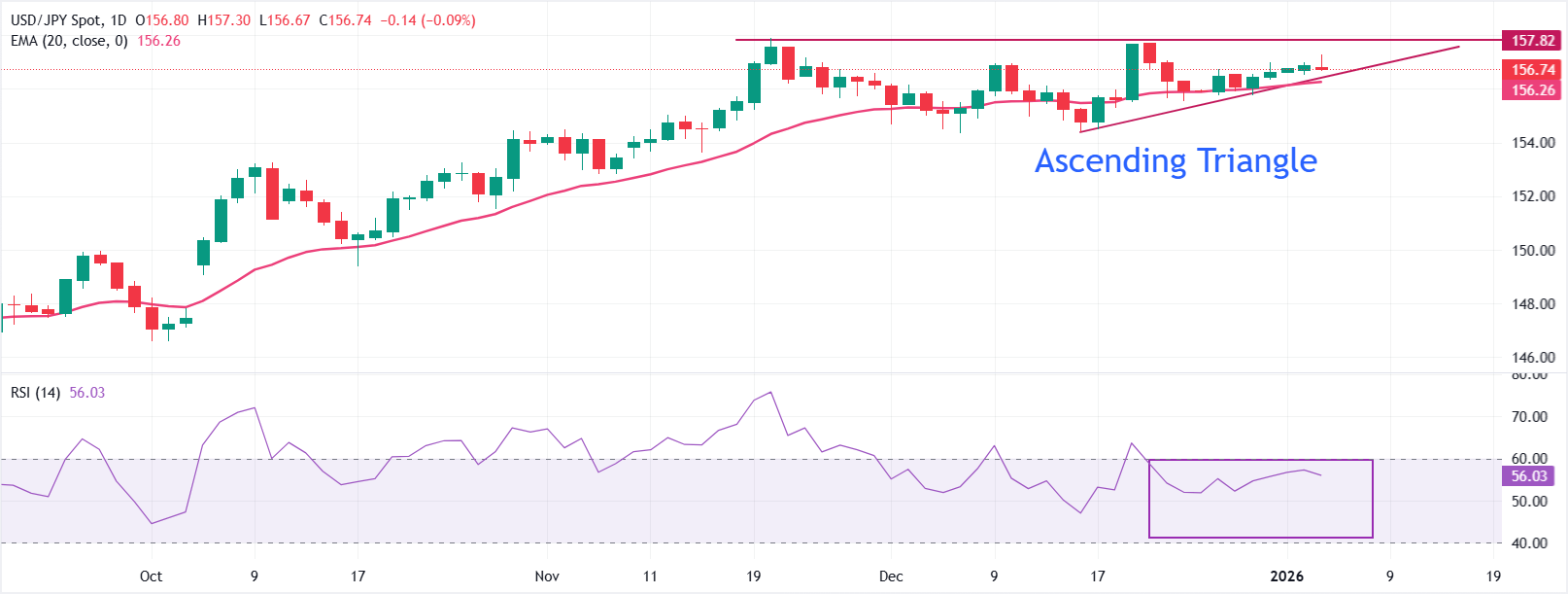
In the daily chart, USD/JPY trades at 156.74. Price holds above the 20-day EMA at 156.26, which is edging higher and supports a mild bullish bias. RSI at 55.99 remains above the 50 midline, showing steady momentum.
The rising trend line from 154.39 underpins the bullish bias, offering support near 156.56. A daily close below 156.56 would break that base and could trigger a deeper pullback towards the December low of 154.35.
Looking up, the pair could approach the psychological level of 160.00 on a decisive break above the November high of 157.90.
(The technical analysis of this story was written with the help of an AI tool.)
Bank of Japan FAQs
The Bank of Japan (BoJ) is the Japanese central bank, which sets monetary policy in the country. Its mandate is to issue banknotes and carry out currency and monetary control to ensure price stability, which means an inflation target of around 2%.
The Bank of Japan embarked in an ultra-loose monetary policy in 2013 in order to stimulate the economy and fuel inflation amid a low-inflationary environment. The bank’s policy is based on Quantitative and Qualitative Easing (QQE), or printing notes to buy assets such as government or corporate bonds to provide liquidity. In 2016, the bank doubled down on its strategy and further loosened policy by first introducing negative interest rates and then directly controlling the yield of its 10-year government bonds. In March 2024, the BoJ lifted interest rates, effectively retreating from the ultra-loose monetary policy stance.
The Bank’s massive stimulus caused the Yen to depreciate against its main currency peers. This process exacerbated in 2022 and 2023 due to an increasing policy divergence between the Bank of Japan and other main central banks, which opted to increase interest rates sharply to fight decades-high levels of inflation. The BoJ’s policy led to a widening differential with other currencies, dragging down the value of the Yen. This trend partly reversed in 2024, when the BoJ decided to abandon its ultra-loose policy stance.
A weaker Yen and the spike in global energy prices led to an increase in Japanese inflation, which exceeded the BoJ’s 2% target. The prospect of rising salaries in the country – a key element fuelling inflation – also contributed to the move.
Author

Sagar Dua
FXStreet
Sagar Dua is associated with the financial markets from his college days. Along with pursuing post-graduation in Commerce in 2014, he started his markets training with chart analysis.