|

USD/JPY Price Analysis: Bullish potential remains intact, dips could attract fresh buyers

  • USD/JPY trades with a negative bias on Thursday and snaps a three-day winning streak.
  • The divergent BoJ-Fed policy outlook might continue to act as a tailwind for the major.
  • The technical setup supports prospects for a move back towards retesting the YTD top.

The USD/JPY pair struggles to capitalize on its weekly gains registered over the past three day and comes under some selling pressure on Thursday. Spot prices remain depressed through the early European session and currently trade just below the 151.00 mark, or a one-week high touched on Wednesday.

The recent rise in the USD/JPY pair triggers speculations that Japanese authorities will intervene in the FX market, which, along with the cautious market mood, is seen lending some support to the safe-haven Japanese Yen (JPY). Apart from this, a modest US Dollar (USD) downtick, led by the recent decline in the US Treasury bond yields and the uncertainty over the Federal Reserve's (Fed) rate-hike path, exerts some pressure on the major.

The downside for the USD/JPY pair, however, remains limited in the wake of the dovish stance adopted by the Bank of Japan (BoJ). In fact, BoJ Governor Kazuo Ueda reiterated on Wednesday that the central bank will stick to ultra-loose policy until the recent cost-push inflation shifts into price rises driven more by robust domestic demand and higher wages. This marks a big divergence in comparison to a relatively hawkish Fed.

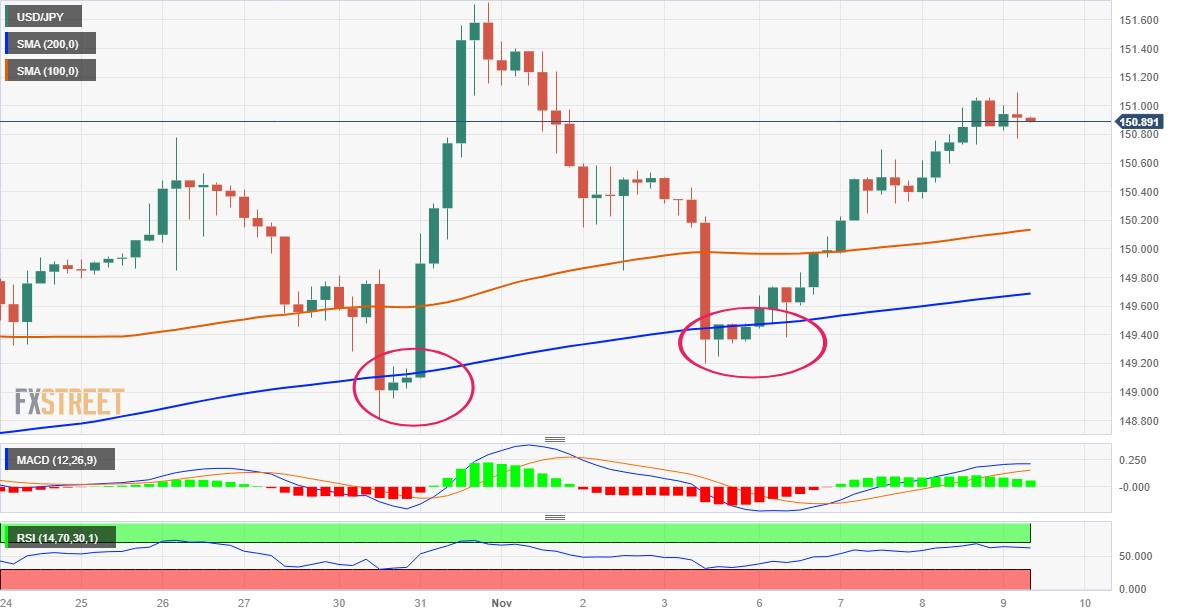
From a technical perspective, the recent repeated failures to find acceptance below the 200-period Simple Moving Average (SMA) on the 4-hour chart and the subsequent move up favours bullish traders. Moreover, oscillators on daily/4-hourly charts are holding in the positive territory, validating the positive outlook for the USD/JPY pair. Hence, any further decline might still be seen as a buying opportunity and remain limited.

Some follow-through buying beyond the 151.00 mark will reaffirm the constructive outlook and allow spot prices to retest the YTD peak, around the 151.70 area set last week. The next relevant resistance is pegged near the multi-decade top touched in October 2022, above which the USD/JPY pair will enter an uncharted territory and could prolong its well-established bullish trend witnessed since the beginning of the current year.

On the flip side, weakness below the 150.70-150.65 region could attract fresh buyers near the 100-period SMA on the 4-hour chart, currently pegged just ahead of the 150.00 psychological mark. The latter might now act as a key pivotal point, which if broken decisively could drag the USD/JPY pair back towards the 200-period SMA on the 4-hour chart, around the 149.70-149.65 region. Some follow-through selling will expose the 149.20-149.15 area, or the post-NFP swing low, before spot prices weaken further below the 149.00 round figure.

USD/JPY 4-hour chart
fxsoriginal

Technical levels to watch

USD/JPY

Overview
Today last price150.92
Today Daily Change-0.08
Today Daily Change %-0.05
Today daily open151
 
Trends
Daily SMA20150.06
Daily SMA50148.89
Daily SMA100146.01
Daily SMA200140.69
 
Levels
Previous Daily High151.06
Previous Daily Low150.33
Previous Weekly High151.72
Previous Weekly Low148.81
Previous Monthly High151.72
Previous Monthly Low147.32
Daily Fibonacci 38.2%150.78
Daily Fibonacci 61.8%150.61
Daily Pivot Point S1150.53
Daily Pivot Point S2150.07
Daily Pivot Point S3149.8
Daily Pivot Point R1151.26
Daily Pivot Point R2151.53
Daily Pivot Point R3151.99

Author

Haresh Menghani

Haresh Menghani is a detail-oriented professional with 10+ years of extensive experience in analysing the global financial markets.


More from Haresh Menghani
Share:

Editor's Picks

AUD/USD remains depressed near 0.6950 after RBA minutes

AUD/USD attracts follow-through selling during Tuesday’s Asian session, looking to extend the overnight rejection slide from 0.7000, or a two-week top, following the release of RBA meeting Minutes. The US Dollar retains a bullish undertone near its highest level since April 2025 as energy-driven inflation risks keep December Fed rate hike bets firmly on the table. Adding to this, geopolitical risks further underpin the safe-haven USD.

USD/JPY extends retreat below 158.50 as intervention risks loom

USD/JPY is dropping below 158.50 in the Asian session on Tuesday, snapping a two-day winning streak and pulling back from an over two-week top touched the previous day, despite Japan's soft PPI inflation print. Bulls turn cautious amid speculation that authorities will step in to prop up the Japanese Yen, which, in turn, weighs on the pair.

Gold advances to $4,200 amid retreating USD; Fed hike bets to cap further gains

Gold builds on its modest intraday move up and hits a fresh daily high around the $4,200 neighborhood during the Asian session. The US Dollar retreats from its highest level since April 2025 amid some profit-taking, offering support to the commodity. However, the US Federal Reserve's hawkish stance and escalating Middle East conflicts could limit deeper losses for the safe-haven buck.

Cardano: Retail support wanes as ADA tests a make-or-break level

Cardano price is up nearly 2% at press time on Tuesday, holding above its 50-day Exponential Moving Average (EMA) at $0.2302 and a near-term rising support trendline at $0.2264. ADA is losing retail demand in the derivatives market as its futures Open Interest declines and funding rates flip negative.

Indian Rupee gains further on RBI’s fresh measures to lower US Dollar’s demand

The Indian Rupee extends the Monday’s advance against the US Dollar on Tuesday, driven by the announcement of fresh Reserve Bank of India’s US Dollar-related measures to shore up the domestic currency. In the opening session, the USD/INR pair tumbles 0.6% to near 95.00, the lowest level seen in over a month.

Has Bitcoin really escaped the macro forces it was built to fight?
Over 17 years ago, Satoshi Nakamoto designed Bitcoin (BTC) on the back of a global financial crisis as an alternative to the global monetary system outside the control of central banks, governments and traditional intermediaries. This raises a key question: has Bitcoin really become independent of the macroeconomic forces it was built to challenge?















