|

USD/JPY Price Analysis: 200-day SMA back in focus

  • USD/JPY snaps four-day winning streak.
  • 111.50 holds the key to February high.
  • Repeated failures to dip below 110.00 signal intermediate pullback.
  • The monthly support trend line follows the 200-day SMA.

Despite repeated failures to take out 110.00, USD/JPY registers 0.54% loss while declining to 110.32 during early Monday.

In doing so, the pair snaps the four-day winning streak while also highlighting 200-day SMA for the bears.

However, a sustained break below 110.00 becomes necessary for the sellers to aim for a 200-day SMA level of 108.28 whereas an upward sloping trend line since March 09, 2020, around 107.50, could question the bears afterward.

Meanwhile, buyers will take entry beyond the monthly top surrounding 111.50, a break of which could challenge February month high near 112.20/25.

USD/JPY daily chart
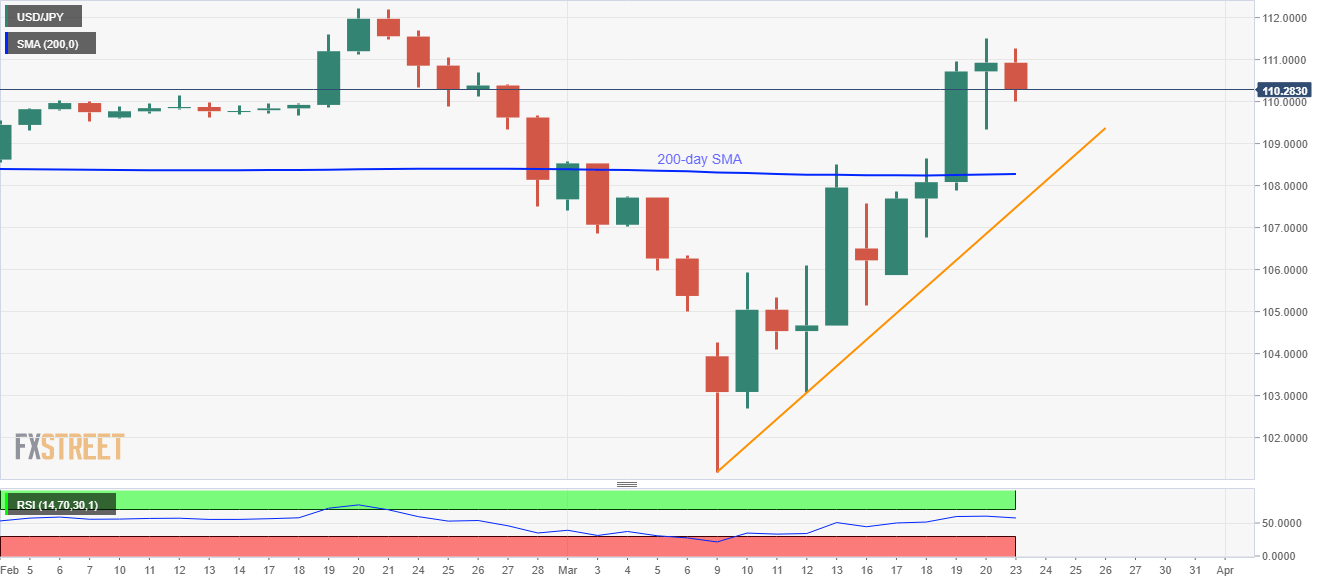
Trend: Pullback expected

Additional important levels

Overview
Today last price110.21
Today Daily Change-0.71
Today Daily Change %-0.64%
Today daily open110.92
 
Trends
Daily SMA20107.61
Daily SMA50108.94
Daily SMA100108.96
Daily SMA200108.27
 
Levels
Previous Daily High111.51
Previous Daily Low109.33
Previous Weekly High111.51
Previous Weekly Low105.15
Previous Monthly High112.23
Previous Monthly Low107.51
Daily Fibonacci 38.2%110.68
Daily Fibonacci 61.8%110.16
Daily Pivot Point S1109.67
Daily Pivot Point S2108.41
Daily Pivot Point S3107.49
Daily Pivot Point R1111.84
Daily Pivot Point R2112.76
Daily Pivot Point R3114.02

Author

Anil Panchal

Anil Panchal

FXStreet

Anil Panchal has nearly 15 years of experience in tracking financial markets. With a keen interest in macroeconomics, Anil aptly tracks global news/updates and stays well-informed about the global financial moves and their implications.


More from Anil Panchal
Share:

Editor's Picks

AUD/USD looks weaker, focus is back to 0.7100

AUD/USD reverses Tuesday’s gains and retreats markedly toward four-day troughs in the low 0.7100s ahead of the opening bell in Asia. The firmer tone in the Greenback weighs on the risk complex amid unabated tensions on the US-Iran front, prompting the Aussie to shed part of recent gains and refocus on the downside. Moving forward, Australian trade balance results should entertain investors early on Thursday.

Japanese Yen bounces up from lows after Japan PM Takaichi’s intervention warnings

The Japanese Yen bounced up from five-week lows against the US Dollar, turning positive on the daily chart, as Japan’s Prime Minister Sanae Takaichi warned that Tokyo is ready to take action against Yen weakness. The USD/JPY pair has pulled back from the 160.00 level, considered a line in the sand for Japanese authorities, to hit session lows at 159.55.

Gold slumps to near $4,450 as strong US jobs data reinforce higher-rate bets

Gold price falls to around $4,450 during the early Asian session on Thursday. The precious metal attracts some sellers amid rising expectations that the US Federal Reserve will raise interest rates this year.


Grayscale launches Hyperliquid staking ETF, undercutting rival fees

Grayscale announced the launch of its Hyperliquid Staking ETF on Wednesday, now trading on Nasdaq. The fund offers investors direct exposure to HYPE and incorporates staking rewards, which the company claims have historically ranged from 2.2% to 2.3% annually. "HYPG represents an opportunity to provide efficient exposure to HYPE in an ETP wrapper," Grayscale noted on its website.

The upside-down math of debt
In 2010, Professors Carmen Reinhart and Kenneth Rogoff published a paper, Growth in a Time of Debt, which instantly went viral. The main thesis of the paper was that once a government's debt-to-GDP ratio crosses above 90%, a financial crisis and default are around the corner.
Recession on paper: What really moves the Canadian Loonie now?

Statistics Canada handed the headline writers a gift and the analysts a headache. Real GDP shrank 0.1% on an annualized basis in the first quarter, and with the fourth quarter of 2025 revised down to a 1.0% contraction, that is two negative quarters in a row, the textbook definition of a technical recession and Canada's first since the pandemic.