Dow Jones Industrial Average edges higher as PCE inflation cools, rate cut hopes solidify
- The Dow Jones gained slim ground on Friday, rising around 150 points.
- Equities are ending the week on a high note after backdated US PCE inflation showed cooling core pressures.
- Market expectations for a threepeat interest rate cut in December remain pinned to the ceiling.

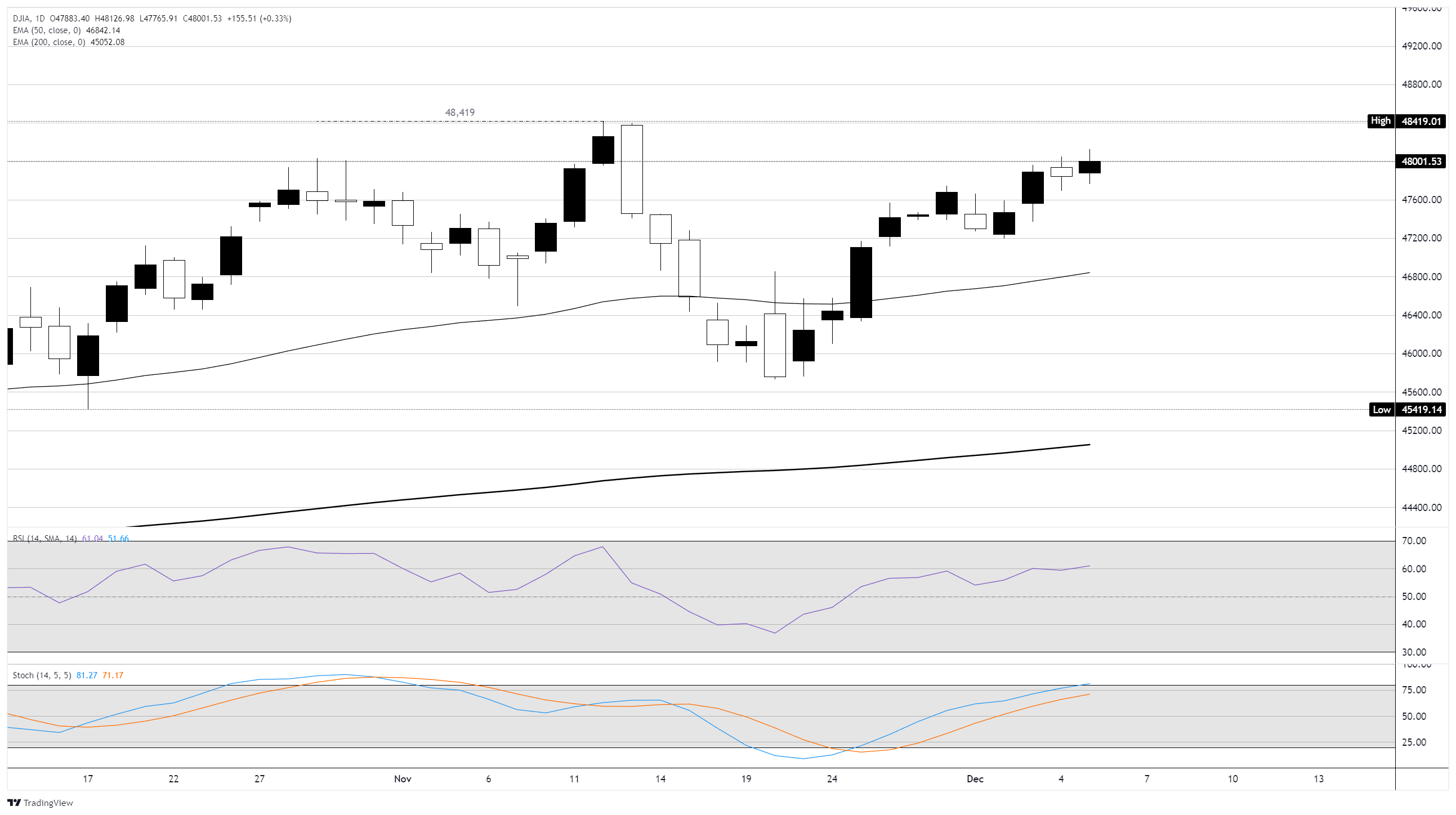
The Dow Jones Industrial Average (DJIA) made slim gains on Friday, climbing another 150 points and ending a moderately bullish week near the 48,000 handle. US Personal Consumption Expenditures Price Index (PCE) data, despite being from September, helped bolster market confidence that the Federal Reserve (Fed) will be delivering a third straight interest rate cut on December 10.
The Standard & Poor’s 500 (SP500) also climbed around 0.3% on Friday, putting the broad-market index on pace to challenge all-time highs.
PCE inflation cools slightly, bolsters Fed rate cut hopes
Core PCE inflation ticked down to 2.8% YoY in September, while the monthly figure held steady at 0.2% from August. The figures are well backdated as federal agencies struggle to play catch-up following the longest US government shutdown in history, but any sign of not-runaway inflation is being taken in stride by markets that are aching for a third straight rate cut before the end of the year.
The University of Michigan (UoM) Consumer Sentiment and Expectations Indexes for December both rose faster than expected. UoM 1-year and 5-year Consumer Inflation Expectations also ticked lower.
Coming up next week: Fed threepeat?
Market momentum will likely flatten heading into next week’s Fed rate call, slated for Wednesday. December’s Fed rate meeting will also include an update to the Summary of Economic Projections (SEP), which includes the dot plot of interest rate expectations from Fed policymakers, a key tool used by markets to gauge Fed appetite for interest rate moves looking forward.
Dow Jones daily chart
Economic Indicator
Core Personal Consumption Expenditures - Price Index (YoY)
The Core Personal Consumption Expenditures (PCE), released by the US Bureau of Economic Analysis on a monthly basis, measures the changes in the prices of goods and services purchased by consumers in the United States (US). The PCE Price Index is also the Federal Reserve’s (Fed) preferred gauge of inflation. The YoY reading compares the prices of goods in the reference month to the same month a year earlier. The core reading excludes the so-called more volatile food and energy components to give a more accurate measurement of price pressures." Generally, a high reading is bullish for the US Dollar (USD), while a low reading is bearish.
Read more.Last release: Fri Dec 05, 2025 15:00
Frequency: Monthly
Actual: 2.8%
Consensus: 2.9%
Previous: 2.9%
Source: US Bureau of Economic Analysis
After publishing the GDP report, the US Bureau of Economic Analysis releases the Personal Consumption Expenditures (PCE) Price Index data alongside the monthly changes in Personal Spending and Personal Income. FOMC policymakers use the annual Core PCE Price Index, which excludes volatile food and energy prices, as their primary gauge of inflation. A stronger-than-expected reading could help the USD outperform its rivals as it would hint at a possible hawkish shift in the Fed’s forward guidance and vice versa.
Author

Joshua Gibson
FXStreet
Joshua joins the FXStreet team as an Economics and Finance double major from Vancouver Island University with twelve years' experience as an independent trader focusing on technical analysis.