USD/JPY plunges on another possible ‘Yentervention’ alongside cooling US CPI inflation
- USD/JPY plummeted 2.6% top-to-bottom after US CPI inflation eased in June.
- Strong signs of direct market invention in Yen markets, but no confirmation.
- Market anticipation for a September Fed rate cut is pinned to the ceiling.

USD/JPY plummeted on Thursday, declining 2.6% in a sharp reaction to cooling US Consumer Price Index (CPI) inflation and a broadly suspected “Yentervention” by the Bank of Japan (BoJ) to prop up the floundering JPY.
June’s US CPI inflation broadly fell below forecasts, with annualized headline CPI inflation easing to 3.0% YoY from the previous 3.3% and falling even lower than the forecast 3.1%. CPI inflation actually contracted -0.1% MoM in June, falling back from the previous month’s flat 0.0% and below the forecast 0.1%.
US Initial Jobless Claims fell to 222K for the week ended July 5, down from the previous week’s revised 239K and improving from the forecast 236K. Thursday’s Initial Jobless Claims figure helped to push the four-week average down to 233.5K from the previous 238.75K.
With US CPI inflation cooling at an accelerated pace, market expectations for a rate hike from the Federal Reserve (Fed) are pricing in the possibility of three quarter-point rate cuts in 2024. According to the CME’s FedWatch Tool, rate market bets of a September rate cut have soared to 95%.
According to unconfirmed rumors citing unnamed officials within the Japanese government, a ‘Yentervention’ was timed with the release of US CPI inflation figures, sending the Yen broadly higher across the board on Thursday. In a repeat of previous Yenterventions, any official confirmation or denial is unlikely to come from BoJ or Ministry of Finance officials for several weeks.
USD/JPY technical outlook
USD/JPY took a steep dive on Thursday, briefly testing below the 50-day Exponential Moving Average (EMA) at 157.97 before a half-hearted recovery. The pair is still sharply down from the day’s opening bids, but a long-running bull trend that has dragged USD/JPY to multi-decade highs has left the pair buried deep in bull country.
USD/JPY is still trading well above the 200-day EMA at 151.81, and Thursday’s bearish plunge is unlikely to cause a meaningful shift in the long-term trend.
USD/JPY daily chart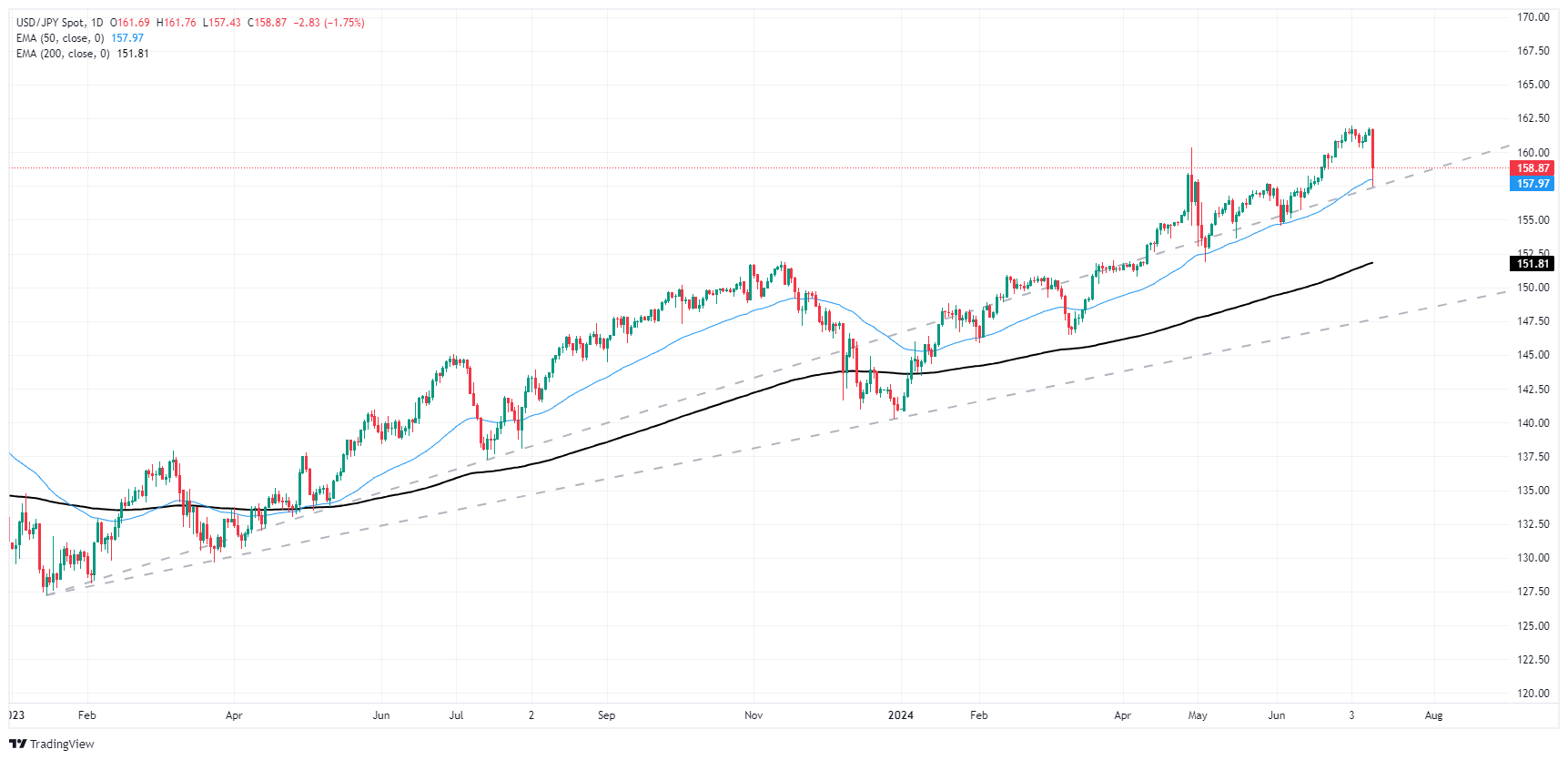
Japanese Yen FAQs
The Japanese Yen (JPY) is one of the world’s most traded currencies. Its value is broadly determined by the performance of the Japanese economy, but more specifically by the Bank of Japan’s policy, the differential between Japanese and US bond yields, or risk sentiment among traders, among other factors.
One of the Bank of Japan’s mandates is currency control, so its moves are key for the Yen. The BoJ has directly intervened in currency markets sometimes, generally to lower the value of the Yen, although it refrains from doing it often due to political concerns of its main trading partners. The current BoJ ultra-loose monetary policy, based on massive stimulus to the economy, has caused the Yen to depreciate against its main currency peers. This process has exacerbated more recently due to an increasing policy divergence between the Bank of Japan and other main central banks, which have opted to increase interest rates sharply to fight decades-high levels of inflation.
The BoJ’s stance of sticking to ultra-loose monetary policy has led to a widening policy divergence with other central banks, particularly with the US Federal Reserve. This supports a widening of the differential between the 10-year US and Japanese bonds, which favors the US Dollar against the Japanese Yen.
The Japanese Yen is often seen as a safe-haven investment. This means that in times of market stress, investors are more likely to put their money in the Japanese currency due to its supposed reliability and stability. Turbulent times are likely to strengthen the Yen’s value against other currencies seen as more risky to invest in.
Author

Joshua Gibson
FXStreet
Joshua joins the FXStreet team as an Economics and Finance double major from Vancouver Island University with twelve years' experience as an independent trader focusing on technical analysis.