USD/JPY backslides into 150.00 as Fed lays out scenario for September rate cut
- USD/JPY backslid 1.5% after the BoJ snuck in a quarter-point rate hike.
- The BoJ has chalked in its second rate hike since 2007.
- The US Fed’s latest rate call laid out the stipulations needed for a September cut.


USD/JPY tumbled 1.5% on Wednesday, extending a recent bearish downturn after the Bank of Japan (BoJ) delivered a surprise rate hike in the early hours of the Wednesday market session. It’s the second rate hike from the BoJ since 2007, and Japanese interest rates are above zero for the first time since September of 2010.
The Federal Reserve’s (Fed) latest rate call held rates steady for the July meeting as markets broadly expected, with Fed Chairman Jerome Powell highlighting what needs to happen in US data before the US central bank will begin delivering rate cuts.
Daily digest market movers: USD/JPY churns below 151.00 as investors weigh rate cut hopes
- The BoJ surprised markets with a second quarter-point rate hike for the year, lifting interest rates above zero to 0.25%.
- The Fed’s July rate call held steady at 5.25% - 5.5%.
- Read more: Jerome Powell comments on policy outlook after keeping policy settings unchanged
- Rate markets have fully pinned September rate cut forecasts to the ceiling, 100% odds of at least a quarter-point rate trim on September 18.
- Despite the rate hike from the BoJ, the Japanese central bank also trimmed its asset purchasing program less than expected, limiting upside potential from the rate hike.
Technical analysis: USD/JPY continues to ease for now
USD/JPY tumbled back to the 150.00 major price handle for the first time since March, shedding 1.5% on Wednesday and diving below the 200-day Exponential Moving Average (EMA) after a steady drift into the bullish side since January. The pair is down 7.6% peak-to-trough after hitting multi-decade highs earlier this month, driven lower by a series of suspected “Yenterventions” from the BoJ and the Japanese Ministry of Finance.
Markets will be waiting to sniff out the lay of the land moving forward, but it won’t take much buying pressure for markets to push USD/JPY back into the north side of the 200-day EMA at 152.40. A technical floor is priced in near 147.50 at March’s swing low, with 2024’s early low bids just north of 140.00 waiting further below.
USD/JPY daily chart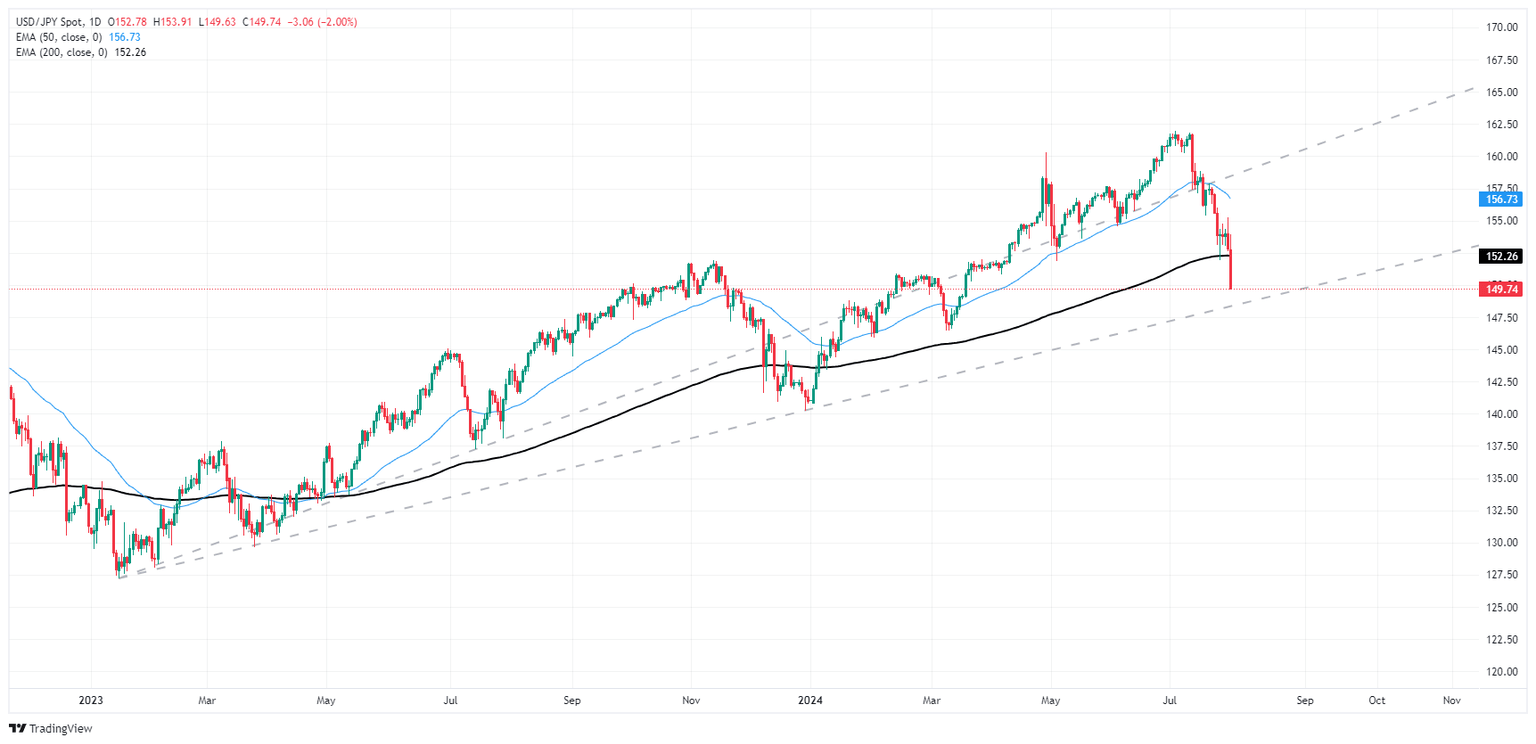
Fed FAQs
Monetary policy in the US is shaped by the Federal Reserve (Fed). The Fed has two mandates: to achieve price stability and foster full employment. Its primary tool to achieve these goals is by adjusting interest rates. When prices are rising too quickly and inflation is above the Fed’s 2% target, it raises interest rates, increasing borrowing costs throughout the economy. This results in a stronger US Dollar (USD) as it makes the US a more attractive place for international investors to park their money. When inflation falls below 2% or the Unemployment Rate is too high, the Fed may lower interest rates to encourage borrowing, which weighs on the Greenback.
The Federal Reserve (Fed) holds eight policy meetings a year, where the Federal Open Market Committee (FOMC) assesses economic conditions and makes monetary policy decisions. The FOMC is attended by twelve Fed officials – the seven members of the Board of Governors, the president of the Federal Reserve Bank of New York, and four of the remaining eleven regional Reserve Bank presidents, who serve one-year terms on a rotating basis.
In extreme situations, the Federal Reserve may resort to a policy named Quantitative Easing (QE). QE is the process by which the Fed substantially increases the flow of credit in a stuck financial system. It is a non-standard policy measure used during crises or when inflation is extremely low. It was the Fed’s weapon of choice during the Great Financial Crisis in 2008. It involves the Fed printing more Dollars and using them to buy high grade bonds from financial institutions. QE usually weakens the US Dollar.
Quantitative tightening (QT) is the reverse process of QE, whereby the Federal Reserve stops buying bonds from financial institutions and does not reinvest the principal from the bonds it holds maturing, to purchase new bonds. It is usually positive for the value of the US Dollar.
Author
Joshua Gibson
FXStreet
Joshua joins the FXStreet team as an Economics and Finance double major from Vancouver Island University with twelve years' experience as an independent trader focusing on technical analysis.