USD/JPY edges lower as US-Japan trade deal supports flows to the Yen
- USD/JPY extends losses as Japanese trade prospects overshadow interest rate differentials.
- US-Japan trade agreement eases tensions and increases flows into the Yen.
- USD/JPY finds temporary support above 146.00 as momentum turns neutral.

USD/JPY is experiencing its third consecutive day of losses on Wednesday as traders reassess positioning in the wake of a newly announced trade agreement between the US and Japan.
At the time of writing, the pair is trading slightly above the 146.00 mark as the Yen finds renewed support despite interest rate differentials remaining in favour of the US Dollar.
US-Japan trade agreement eases tensions and increases flows into the Yen
US President Donald Trump unveiled what he called a “massive deal” with Japan on Wednesday, describing it as a major breakthrough in repairing strained trade relations.
A key component of the agreement includes reducing proposed tariffs on Japanese goods from 25% to 15%, with a specific focus on the automotive sector, a vital part of Japan’s export economy. The move is aimed at easing tensions and preventing a broader trade conflict between the two allies.
In return, Japan has committed to a $550 billion investment package into the US economy.
This includes funding for projects in infrastructure, semiconductor manufacturing, and supply chain development, areas considered strategically important.
The deal also improves market access for US exporters, particularly in agriculture and automotives, with several regulatory hurdles expected to be removed.
While the deal is notable for its scale, its timing is just as significant. With trade friction between the US and the European Union escalating, a strengthened alliance with Japan gives Washington a key strategic partner in the Indo-Pacific region.
Over time, this could shift capital flows and currency demand, with the Yen potentially benefiting from improved investor confidence and a stronger trade surplus outlook.
USD/JPY finds temporary support above 146.00 as momentum turns neutral
From a technical perspective, USD/JPY has pulled back sharply after failing to sustain a move above the 38.2% Fibonacci retracement of the January-to-April decline, marked at 147.14.
The pair is now shifting toward the next area of support, currently anchored by the July 10 low at 145.76 and the 50-day Simple Moving Average (SMA) at 145.16.
A confirmed break below this 145.16–145.76 support zone would open the door toward 144.37, which marks the 23.6% Fibo retracement and could act as the next downside target.
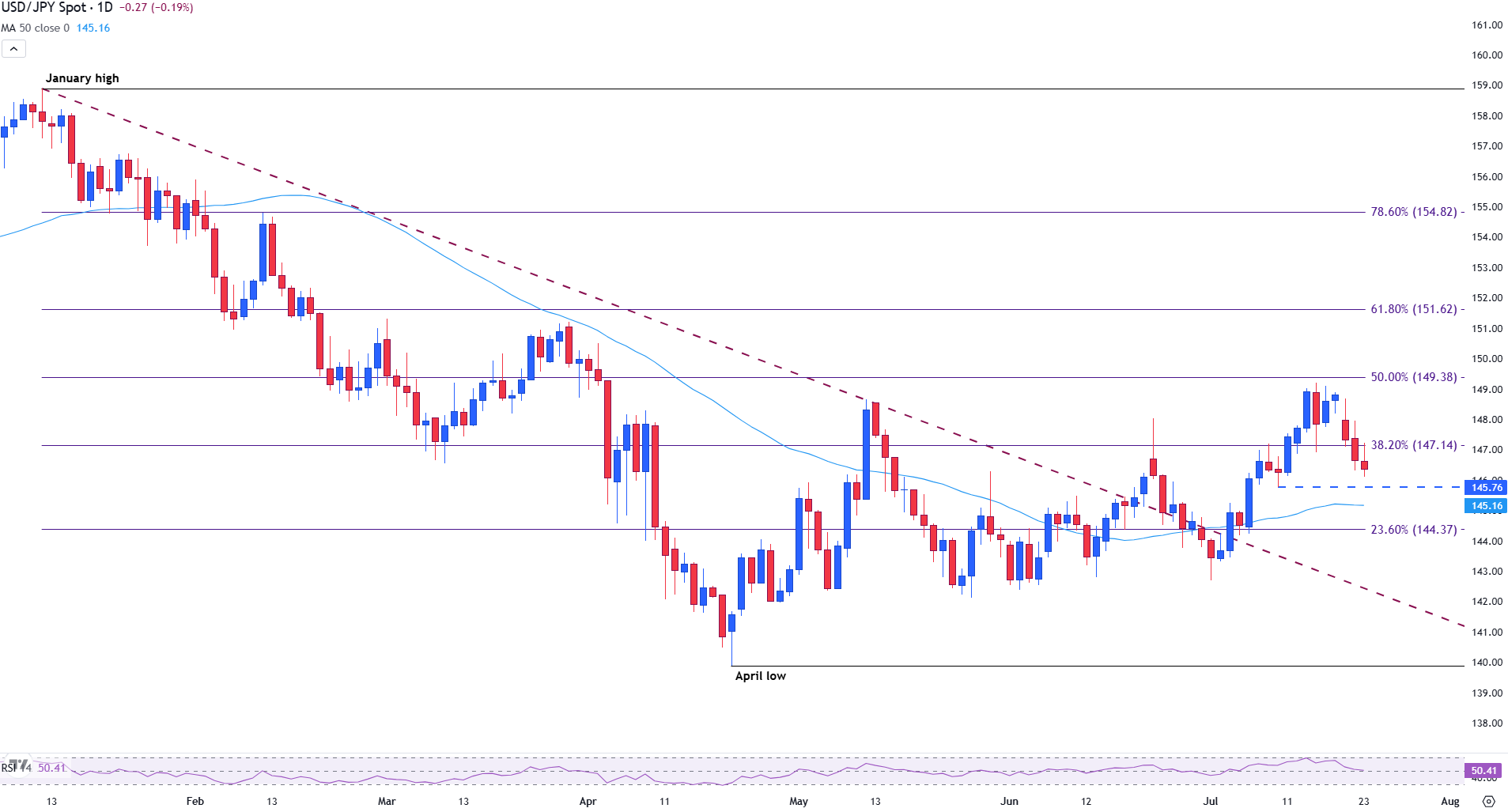
USD/JPY daily chart
To the upside, resistance now sits at 147.14, followed by the 50% Fibo level at 149.38.
A return above these levels would be required to re-establish bullish momentum.
The Relative Strength Index (RSI) is currently sitting near 50, indicating neutral momentum.
Technically, USD/JPY remains vulnerable in the short term unless bulls can defend the 145.00–145.75 zone. A breakdown below this area would likely invite deeper losses, while a recovery above 147.14 is needed to restore upward momentum.
Japanese Yen FAQs
The Japanese Yen (JPY) is one of the world’s most traded currencies. Its value is broadly determined by the performance of the Japanese economy, but more specifically by the Bank of Japan’s policy, the differential between Japanese and US bond yields, or risk sentiment among traders, among other factors.
One of the Bank of Japan’s mandates is currency control, so its moves are key for the Yen. The BoJ has directly intervened in currency markets sometimes, generally to lower the value of the Yen, although it refrains from doing it often due to political concerns of its main trading partners. The BoJ ultra-loose monetary policy between 2013 and 2024 caused the Yen to depreciate against its main currency peers due to an increasing policy divergence between the Bank of Japan and other main central banks. More recently, the gradually unwinding of this ultra-loose policy has given some support to the Yen.
Over the last decade, the BoJ’s stance of sticking to ultra-loose monetary policy has led to a widening policy divergence with other central banks, particularly with the US Federal Reserve. This supported a widening of the differential between the 10-year US and Japanese bonds, which favored the US Dollar against the Japanese Yen. The BoJ decision in 2024 to gradually abandon the ultra-loose policy, coupled with interest-rate cuts in other major central banks, is narrowing this differential.
The Japanese Yen is often seen as a safe-haven investment. This means that in times of market stress, investors are more likely to put their money in the Japanese currency due to its supposed reliability and stability. Turbulent times are likely to strengthen the Yen’s value against other currencies seen as more risky to invest in.
Author

Tammy Da Costa, CFTe®
FXStreet
Tammy is an economist and market analyst with a deep passion for financial markets, particularly commodities and geopolitics.