USD/JPY dips as attention shifts to US-Japan trade talks
- The USD/JPY faces pressure due to weakness in the US Dollar as trade talks remain in focus.
- Japan enters its eighth round of negotiations with US officials ahead of the August 1 deadline.
- The USD/JPY dips below 147.00 as momentum indicators signal a waning of bullish momentum.


The Japanese Yen (JPY) is extending gains against the US Dollar (USD) on Tuesday. Investors are closely monitoring high-level US–Japan trade talks and assessing recent developments in Japan’s domestic politics.
USD/JPY is trading below 147.00 at the time of writing with markets focused on the outcome of ongoing tariff negotiations in Washington.
US-Japan trade talks enter a critical stage ahead of the tariff deadline
Japan’s chief negotiator, Ryosei Akazawa, is in Washington this week. He’s meeting with Treasury Secretary Scott Bessent, Commerce Secretary Howard Lutnick, and US Trade Representative Jamieson Greer.
This is the eighth round of talks between the two countries. Akazawa is pushing hard to strike a deal before August 1, when the next review cycle for tariffs begins.
The US is threatening to extend its 25% tariff on autos to a broader range of Japanese exports. Tariffs already in place include 50% on steel and aluminum. Discussions now encompass additional sectors, such as semiconductors and pharmaceuticals, with a blanket tariff of 25%.
Japan wants sector-specific exemptions and a phased rollback of auto tariffs. US officials say that any easing of trade terms would require concessions on digital services and agriculture.
Political uncertainty in Japan is temporarily overshadowed by US Dollar weakness
The Yen gained modestly on Monday after a better-than-expected outcome in Japan’s upper house elections. Prime Minister Ishiba’s ruling Liberal Democratic Party (LDP) lost its majority by three seats, but he is likely to stay in power with support from smaller parties.
Markets welcomed the result. It suggested that a low-tax opposition platform would be avoided, and Ishiba would continue leading trade negotiations.
Still, the loss has weakened his standing. A slimmer margin could make it harder to pass economic reforms, especially if US demands escalate or talks break down.
The added political uncertainty may keep USD/JPY supported, particularly if safe-haven flows into the Yen fade.
USD/JPY dips below 147.00 as bullish momentum fades
From a technical standpoint, USD/JPY is currently trading below the 38.2% Fibonacci retracement level of the January-April decline, providing near-term resistance at 147.14.
The pair is now trading around 146.78, showing signs of weakening momentum after a strong rally earlier this month. With the 146.00 psychological level emerging as the next level of support, a move lower could see bears attempting a retest of the 50-day Simple Moving Average (SMA) at 145.17.
Meanwhile, a rebound and a clear hold above the 10-day SMA at 147.60 may pave the way for the 148.00 psychological level. Above that is the July 16 high of 149.19 and the 50% Fibo level at 149.38.
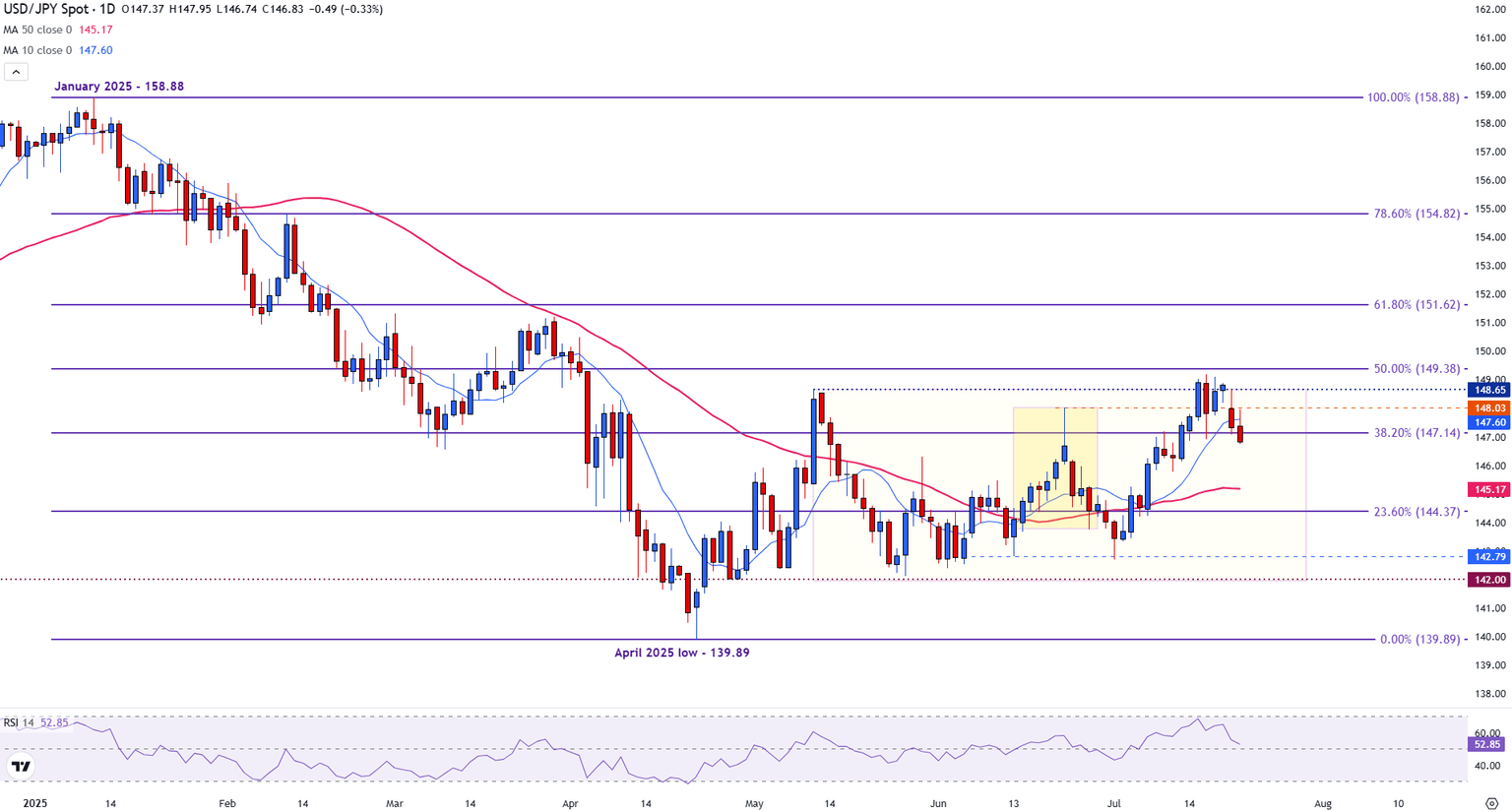
USD/JPY daily chart
With the Relative Strength Index (RSI) near 52 at the time of writing, bullish momentum is continuing to fade, as the pair trades near neutral territory.
Tariffs FAQs
Tariffs are customs duties levied on certain merchandise imports or a category of products. Tariffs are designed to help local producers and manufacturers be more competitive in the market by providing a price advantage over similar goods that can be imported. Tariffs are widely used as tools of protectionism, along with trade barriers and import quotas.
Although tariffs and taxes both generate government revenue to fund public goods and services, they have several distinctions. Tariffs are prepaid at the port of entry, while taxes are paid at the time of purchase. Taxes are imposed on individual taxpayers and businesses, while tariffs are paid by importers.
There are two schools of thought among economists regarding the usage of tariffs. While some argue that tariffs are necessary to protect domestic industries and address trade imbalances, others see them as a harmful tool that could potentially drive prices higher over the long term and lead to a damaging trade war by encouraging tit-for-tat tariffs.
During the run-up to the presidential election in November 2024, Donald Trump made it clear that he intends to use tariffs to support the US economy and American producers. In 2024, Mexico, China and Canada accounted for 42% of total US imports. In this period, Mexico stood out as the top exporter with $466.6 billion, according to the US Census Bureau. Hence, Trump wants to focus on these three nations when imposing tariffs. He also plans to use the revenue generated through tariffs to lower personal income taxes.
Author
Tammy Da Costa, CFTe®
FXStreet
Tammy is an economist and market analyst with a deep passion for financial markets, particularly commodities and geopolitics.