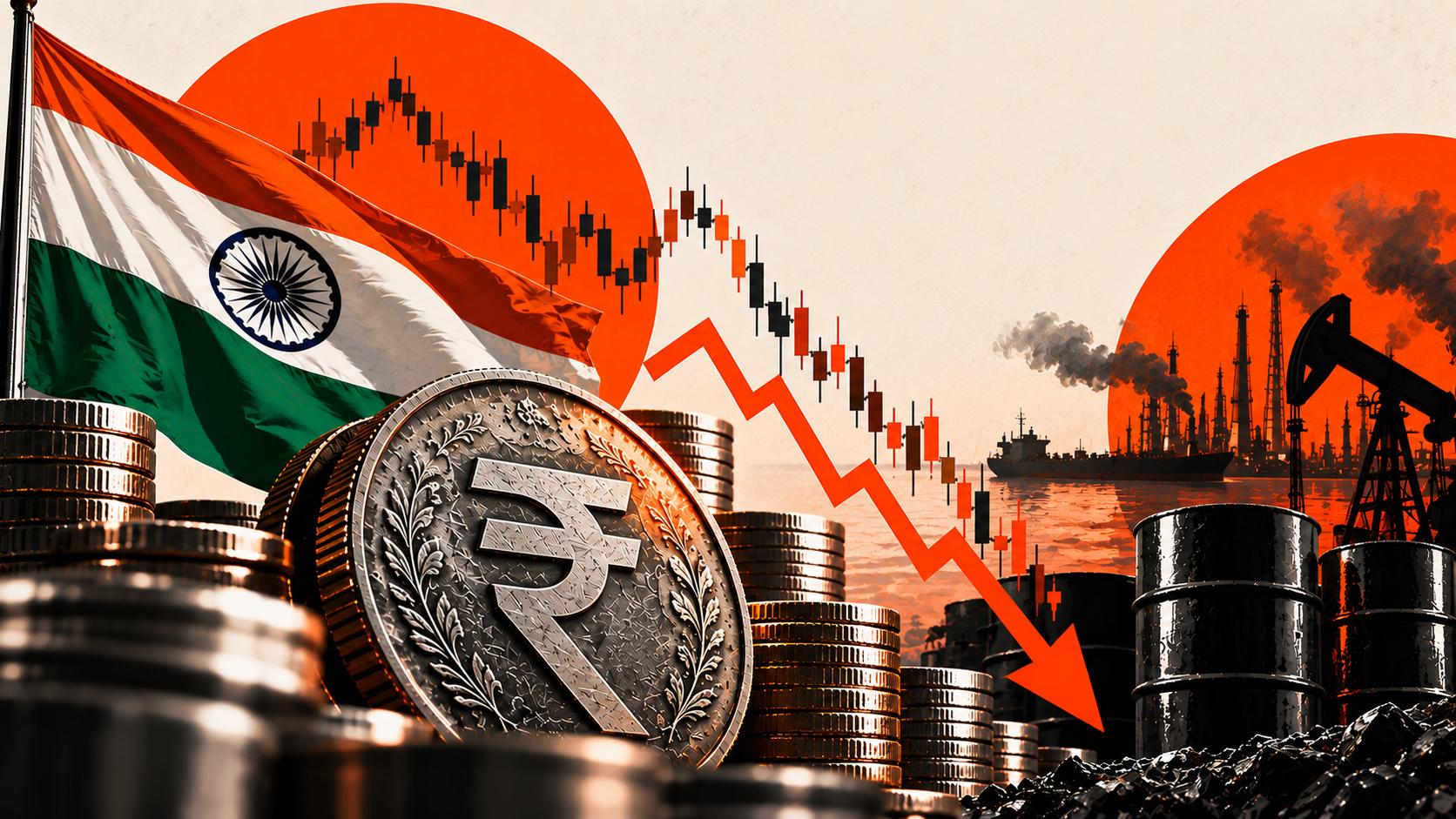
USD/INR tumbles ahead of US Retail Sales release, Fed’s Powell speech
- The Indian Rupee gathers strength in Wednesday’s early European session.
- The softer US Dollar and lower crude oil prices continue to underpin the INR.
- The US March Retail Sales report and speech by Fed Chair Powell will be the highlights later on Wednesday.

The Indian Rupee (INR) trades in positive territory for the fifth consecutive day on Wednesday. The weakening of the US Dollar (USD) and the extended decline in crude oil prices eased the Indian currency’s losses. It’s worth noting that India is the world's third-largest oil consumer, and lower crude oil prices tend to have a positive impact on the Indian currency value.
On the other hand, US President Donald Trump said on Monday that he was considering temporary exemptions to tariffs on imported vehicles and parts to allow automakers additional time to establish manufacturing operations in the US. Nonetheless, tensions between the US and China are escalating, which might weigh on the Asian currencies, including the INR.
Looking ahead, investors will keep an eye on the US March Retail Sales later on Wednesday, which is expected to rise 1.3% MoM in March. Also, the speech of Federal Reserve (Fed) Chair Jerome Powell will be in the spotlight.
Indian Rupee drifts higher on a weaker US Dollar
- Indian stocks climbed as trading resumed after an extended weekend, with the benchmark indices recovering all losses sparked by Trump’s reciprocal tariffs earlier this month. The nation’s big domestic economy is seen able to withstand a potential global recession better than many peers, who face higher tariffs.
- The Reserve Bank of India (RBI) will buy bonds worth 400 billion rupees ($4.67 billion) and will also conduct a 43-day repo for 1.50 trillion rupees on Thursday, per Reuters.
- India’s Consumer Price Index (CPI) rose by 3.34% YoY in March, compared to 3.61% in February, according to the Ministry of Statistics and Programme Implementation. This reading came in softer than the 3.60% expected.
- Fed Governor Christopher Waller said on Monday that the Trump administration's tariff policies were a major shock to the US economy that could lead the central bank to cut rates to head off recession even if inflation remained high.
- Atlanta Fed Bank President Raphael Bostic said that the uncertainty surrounding the Trump administration’s tariff and other policies has put the economy into a "big pause," and he suggested that the Fed bank should stay on hold until there is more clarity.
- The markets are now pricing in nearly 85 basis points (bps) worth of monetary policy easing by the end of the year, with most expecting the Fed to hold rates next month, according to the CME FedWatch tool.
USD/INR resumes its downside journey below the 100-day EMA
The Indian Rupee trades stronger on the day. The USD/INR pair resumes its downside as the pair crosses below the key 100-day Exponential Moving Average (EMA) on the daily timeframe. The downward momentum is supported by the 14-day Relative Strength Index (RSI), which stands below the midline near 42.60, indicating the longer-term bearish bias isn’t completely over yet.
The initial support level for USD/INR is located at 85.48, the low of March 24. Further south, the next contention level to watch is 85.20, the low of April 3, followed by 84.93, the low of April 4.
In the bullish case, the 85.90-86.00 zone acts as an immediate resistance level for the pair, representing the 100-day EMA and the psychological level. Bullish candlesticks and consistent trading above the mentioned level could see a rally to 86.61, the high of April 10.
(This story was corrected on April 16 at 08:33 GMT to say that the support is the April 4 low of 84.93, not April 3.)
Indian Rupee FAQs
The Indian Rupee (INR) is one of the most sensitive currencies to external factors. The price of Crude Oil (the country is highly dependent on imported Oil), the value of the US Dollar – most trade is conducted in USD – and the level of foreign investment, are all influential. Direct intervention by the Reserve Bank of India (RBI) in FX markets to keep the exchange rate stable, as well as the level of interest rates set by the RBI, are further major influencing factors on the Rupee.
The Reserve Bank of India (RBI) actively intervenes in forex markets to maintain a stable exchange rate, to help facilitate trade. In addition, the RBI tries to maintain the inflation rate at its 4% target by adjusting interest rates. Higher interest rates usually strengthen the Rupee. This is due to the role of the ‘carry trade’ in which investors borrow in countries with lower interest rates so as to place their money in countries’ offering relatively higher interest rates and profit from the difference.
Macroeconomic factors that influence the value of the Rupee include inflation, interest rates, the economic growth rate (GDP), the balance of trade, and inflows from foreign investment. A higher growth rate can lead to more overseas investment, pushing up demand for the Rupee. A less negative balance of trade will eventually lead to a stronger Rupee. Higher interest rates, especially real rates (interest rates less inflation) are also positive for the Rupee. A risk-on environment can lead to greater inflows of Foreign Direct and Indirect Investment (FDI and FII), which also benefit the Rupee.
Higher inflation, particularly, if it is comparatively higher than India’s peers, is generally negative for the currency as it reflects devaluation through oversupply. Inflation also increases the cost of exports, leading to more Rupees being sold to purchase foreign imports, which is Rupee-negative. At the same time, higher inflation usually leads to the Reserve Bank of India (RBI) raising interest rates and this can be positive for the Rupee, due to increased demand from international investors. The opposite effect is true of lower inflation.
Author

Lallalit Srijandorn
FXStreet
Lallalit Srijandorn is a Parisian at heart. She has lived in France since 2019 and now becomes a digital entrepreneur based in Paris and Bangkok.