USD/INR gathers strength as Trump 2.0 era begins
- The Indian Rupee loses momentum in Tuesday’s early European session.
- Renewed USD demand could weigh on the INR, but routine RBI intervention and lower crude oil prices might cap its downside.
- Investors will take more cues from Trump’s policy announcements this week.

The Indian Rupee (INR) tumbles on Tuesday after reaching a one-week high in the previous session. The US Dollar (USD) might continue its upward trajectory due to demand from importers and a reversal of global financial flows toward the United States. Nonetheless, the Reserve Bank of India (RBI) could prevent the local currency from significantly depreciating through active interventions in the foreign exchange markets. Additionally, the decline in crude oil prices supports the INR as India is the world's third-largest oil consumer.
Investors will closely watch the development surrounding policy announcements this week, which might offer fresh catalysts for the pair. On Friday, the preliminary reading of HSBC India’s Purchasing Managers Index (PMI) for January will be in the spotlight. On the US docket, the flash estimate of S&P PMI data will be released.
Indian Rupee remains fragile amid multiple global cues
- Four traders told Reuters that the RBI is expected to conduct mid- to far-tenor buy/sell dollar/rupee swaps, prompting a pullback in forward premiums.
- Moody's on Monday slashed India's economic growth forecast to 7.0% for the fiscal year ending March 2025, down from 8.2% recorded in the previous fiscal year.
- The Indian Rupee is likely to make a strong comeback once the euphoria over Donald Trump’s assuming the US presidency settles, according to the State Bank of India (SBI) on Monday.
- “There will be the risk of a correction in the dollar should it look like Trump will be more selective on tariffs after all – but that should probably come at a later stage,” noted ING Bank.
- Foreign investors have sold a net total of about $6.5 billion of local stocks and bonds in January so far, the steepest monthly outflow since October 2023.
- Trump stated on Monday that he is thinking of imposing 25% tariffs on Canada and Mexico as soon as early February, per CNBC.
- Trump said on Monday that he would immediately declare a national energy emergency, promising to fill up strategic reserves and use the authority to rapidly approve new oil, gas, and electricity projects that would normally take years to get permits.
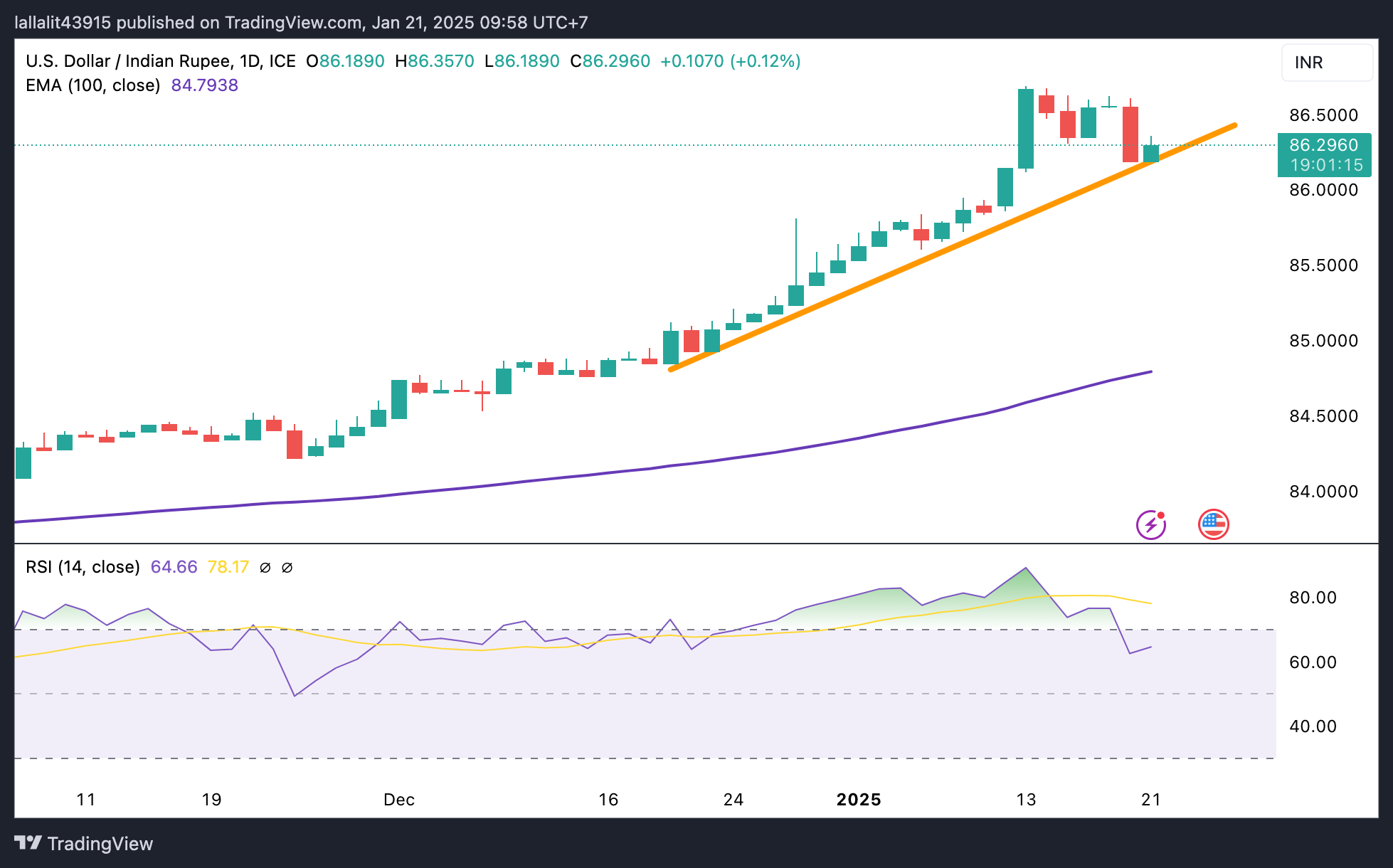
USD/INR maintains bullish trend in the longer term
The key upside barrier for USD/INR emerges at an all-time high of 86.69. A sustained move above this level could see a rally to the 87.00 psychological level.
On the downside, the low of January 20 at 86.18 acts as an initial support level for the pair. Extended losses could expose 85.85, the low of January 10. Further south, the next contention level to watch is 85.65, the low of January 7.
Indian Rupee FAQs
The Indian Rupee (INR) is one of the most sensitive currencies to external factors. The price of Crude Oil (the country is highly dependent on imported Oil), the value of the US Dollar – most trade is conducted in USD – and the level of foreign investment, are all influential. Direct intervention by the Reserve Bank of India (RBI) in FX markets to keep the exchange rate stable, as well as the level of interest rates set by the RBI, are further major influencing factors on the Rupee.
The Reserve Bank of India (RBI) actively intervenes in forex markets to maintain a stable exchange rate, to help facilitate trade. In addition, the RBI tries to maintain the inflation rate at its 4% target by adjusting interest rates. Higher interest rates usually strengthen the Rupee. This is due to the role of the ‘carry trade’ in which investors borrow in countries with lower interest rates so as to place their money in countries’ offering relatively higher interest rates and profit from the difference.
Macroeconomic factors that influence the value of the Rupee include inflation, interest rates, the economic growth rate (GDP), the balance of trade, and inflows from foreign investment. A higher growth rate can lead to more overseas investment, pushing up demand for the Rupee. A less negative balance of trade will eventually lead to a stronger Rupee. Higher interest rates, especially real rates (interest rates less inflation) are also positive for the Rupee. A risk-on environment can lead to greater inflows of Foreign Direct and Indirect Investment (FDI and FII), which also benefit the Rupee.
Higher inflation, particularly, if it is comparatively higher than India’s peers, is generally negative for the currency as it reflects devaluation through oversupply. Inflation also increases the cost of exports, leading to more Rupees being sold to purchase foreign imports, which is Rupee-negative. At the same time, higher inflation usually leads to the Reserve Bank of India (RBI) raising interest rates and this can be positive for the Rupee, due to increased demand from international investors. The opposite effect is true of lower inflation.
Author

Lallalit Srijandorn
FXStreet
Lallalit Srijandorn is a Parisian at heart. She has lived in France since 2019 and now becomes a digital entrepreneur based in Paris and Bangkok.

















