USD/INR holds ground despite foreign outflows, India FX Reserves eyed
- India's FX Reserves (USD) will be eyed on Friday.
- Foreign Institutional Investors (FIIs) reallocate funds to China in response to stimulus measures and more appealing valuations.
- The US Dollar gains support from growing bets of a second term for former President Donald Trump.
The Indian Rupee (INR) remains steady against the US Dollar (USD) on Friday, with the USD/INR pair trading in the 84.00-84.10 range. The Rupee faced challenges from sustained foreign outflows from Indian equities, but potential market interventions by the Reserve Bank of India (RBI) helped mitigate further declines. Traders will likely observe India's FX Reserves (USD) for the week ending October 14, due to be released later in the day.
The INR experienced downward pressure as Foreign Institutional Investors (FIIs) were net sellers of Indian stocks for the 19th consecutive session on Thursday, reallocating funds to China in response to stimulus measures and more appealing valuations. Both the Nifty 50 and BSE Sensex have depreciated this week, heading toward their fourth consecutive weekly loss.
The US Dollar gains support due to an increasing expectation that the Federal Reserve (Fed) will adopt a less aggressive stance on interest rate cuts than previously anticipated. Furthermore, the Greenback is bolstered by growing speculation about a possible second term for former President Donald Trump in the upcoming US presidential election in November, particularly in light of inflationary policies such as higher tariffs and lower taxes.
Daily Digest Market Movers: Indian Rupee receives downward pressure from foreign outflows
- According to the CME FedWatch Tool, there is a 97% probability of a 25-basis-point rate cut by the Fed in November, with no expectation of a larger 50-basis-point cut.
- The preliminary estimates of S&P Global US Composite PMI came in at 54.3, up from the previous 54.0. The Services PMI exceeded expectations at 55.3, compared to the forecasted 55.0, and saw a slight increase from the previous 55.2. Meanwhile, the Manufacturing PMI also came in stronger at 47.8, above the expected 47.5, and improving from the prior reading of 47.3.
- Indian Prime Minister Narendra Modi and Chinese President Xi Jinping held their first formal talks in five years on the sidelines of the BRICS summit in Russia. On Wednesday, the two leaders agreed to enhance communication and cooperation between India and China, aiming to resolve ongoing conflicts and improve relations that were strained following a deadly military clash in 2020, according to Reuters.
- The preliminary estimates reveal that India’s HSBC Composite Purchasing Managers Index (PMI) increased to 58.6 in October, up from 58.3 in the previous month. Manufacturing PMI rose to 57.4 in October, up from 56.5 in the previous month. Meanwhile, the Services PMI edged higher to 57.9 in October, recovering from a one-year low of 57.7 in September. This marks the 39th consecutive month of expansion in services activity.
- Jim O'Neill, the former Goldman Sachs economist who coined the term BRIC in 2001, told Reuters that the notion of the BRICS group challenging the US Dollar is unrealistic as long as China and India remain divided and unwilling to cooperate on trade.
- In the minutes from the October meeting, members of the rate-setting panel stated that the Monetary Policy Committee (MPC) must take a cautious approach to lowering interest rates, as India cannot afford to face another bout of inflation.
- In a speech at the New York Fed Central Banking Seminar, RBI Deputy Governor Michael Patra stated, "We believe that the best defense against global risks is to strengthen the macroeconomic fundamentals and build adequate buffers, supported by prudent macroeconomic policies." He highlighted that India’s central bank has been strategically increasing its foreign exchange reserves, which are now equivalent to or nearly equal to 12 months' worth of imports.
- On Wednesday, the Fed Beige Book indicated that economic activity was "little changed in nearly all Districts," in contrast to August's report, in which three Districts reported growth and nine showed flat activity.
Technical Analysis: USD/INR tests the lower boundary of the ascending channel near 84.00
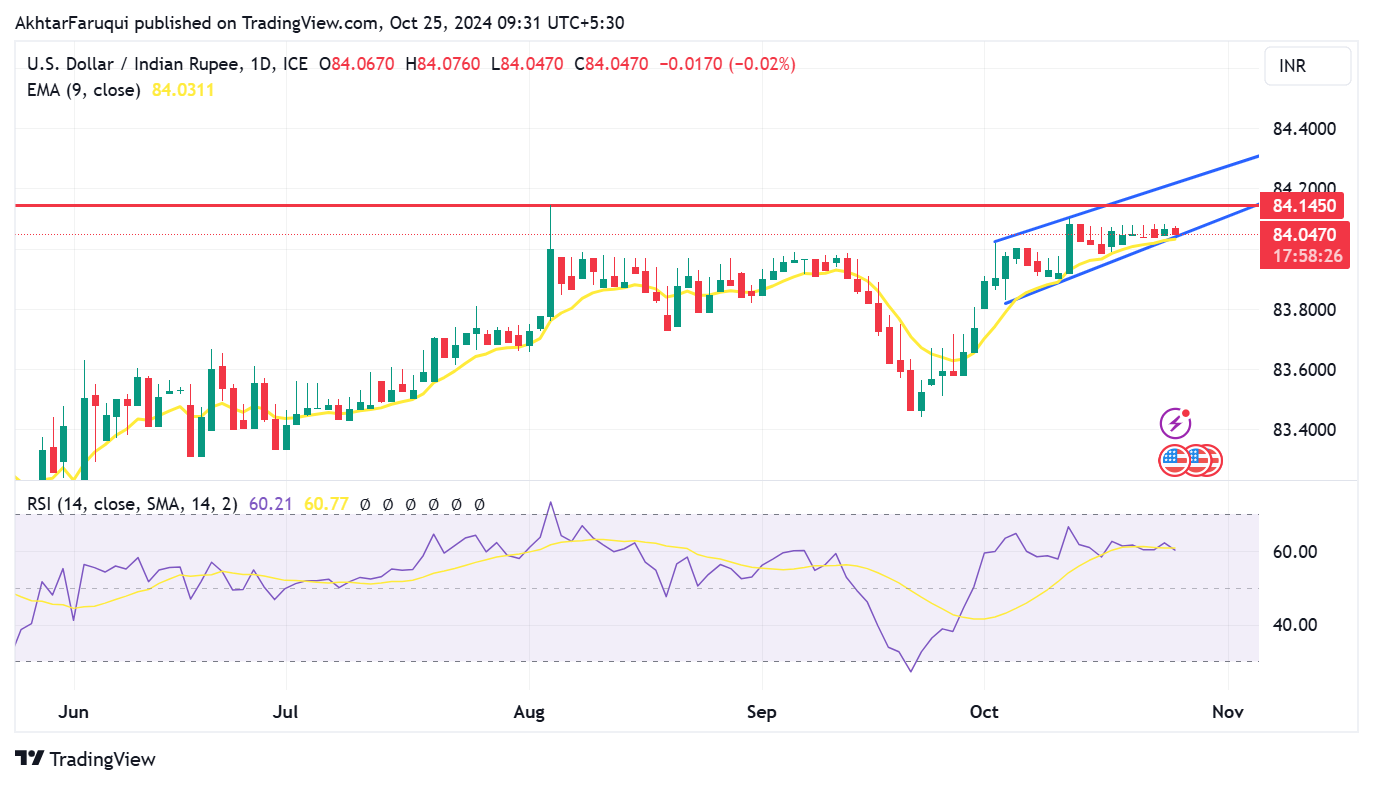
The USD/INR pair remains steady above 84.00 on Friday. An analysis of the daily chart indicates that the pair is testing the lower boundary of an ascending channel pattern. A breakdown below this channel could signal a potential weakening of a bullish bias. The 14-day Relative Strength Index (RSI) is positioned below the 70 level, further supporting the current bullish trend.
Regarding resistance, the USD/INR pair may encounter challenges at its all-time high of 84.14, reached on August 5. A breakout above this level could allow the pair to test the upper boundary of the ascending channel, situated around 84.20.
On the support side, immediate support is found at the nine-day Exponential Moving Average (EMA) near the 84.03 level, which aligns with the lower boundary of the ascending channel near the psychological level of 84.00.
USD/INR: Daily Chart
Indian Rupee FAQs
The Indian Rupee (INR) is one of the most sensitive currencies to external factors. The price of Crude Oil (the country is highly dependent on imported Oil), the value of the US Dollar – most trade is conducted in USD – and the level of foreign investment, are all influential. Direct intervention by the Reserve Bank of India (RBI) in FX markets to keep the exchange rate stable, as well as the level of interest rates set by the RBI, are further major influencing factors on the Rupee.
The Reserve Bank of India (RBI) actively intervenes in forex markets to maintain a stable exchange rate, to help facilitate trade. In addition, the RBI tries to maintain the inflation rate at its 4% target by adjusting interest rates. Higher interest rates usually strengthen the Rupee. This is due to the role of the ‘carry trade’ in which investors borrow in countries with lower interest rates so as to place their money in countries’ offering relatively higher interest rates and profit from the difference.
Macroeconomic factors that influence the value of the Rupee include inflation, interest rates, the economic growth rate (GDP), the balance of trade, and inflows from foreign investment. A higher growth rate can lead to more overseas investment, pushing up demand for the Rupee. A less negative balance of trade will eventually lead to a stronger Rupee. Higher interest rates, especially real rates (interest rates less inflation) are also positive for the Rupee. A risk-on environment can lead to greater inflows of Foreign Direct and Indirect Investment (FDI and FII), which also benefit the Rupee.
Higher inflation, particularly, if it is comparatively higher than India’s peers, is generally negative for the currency as it reflects devaluation through oversupply. Inflation also increases the cost of exports, leading to more Rupees being sold to purchase foreign imports, which is Rupee-negative. At the same time, higher inflation usually leads to the Reserve Bank of India (RBI) raising interest rates and this can be positive for the Rupee, due to increased demand from international investors. The opposite effect is true of lower inflation.
Author

Akhtar Faruqui
FXStreet
Akhtar Faruqui is a Forex Analyst based in New Delhi, India. With a keen eye for market trends and a passion for dissecting complex financial dynamics, he is dedicated to delivering accurate and insightful Forex news and analysis.