USD/INR loses momentum on MSCI rebalancing and softer US Dollar
- The Indian Rupee gains momentum in Monday’s early European session.
- Expected inflows from MSCI's index rebalancing support the INR, but portfolio outflows and a stronger USD might cap its gains.
- The US Chicago Fed National Activity Index and Dallas Fed Manufacturing Business Index are due later on Monday.

The Indian Rupee (INR) extends the rally on Monday, bolstered by the weakening of the Greenback and expected inflows from MSCI's index changes. However, continuous foreign outflows, renewed strength in the US Dollar (USD) and higher crude oil prices might create a headwind for the local currency and cap its upside.
Traders will keep an eye on the US Chicago Fed National Activity Index and Dallas Fed Manufacturing Business Index, which will be published on Monday. Later this week, the US Core Personal Consumption Expenditures (PCE) Price Index and preliminary Gross Domestic Product (GDP) Annualized for the third quarter (Q3) will be in the spotlight.
Indian Rupee recovers as MSCI rebalancing draws billions
- The rebalancing of MSCI's equity indexes, effective after the markets close on Monday, is estimated to attract $2.5 billion of passive inflows into Indian stocks, according to estimates by Nuvama Alternative & Quantitative Research.
- The HSBC Flash India Composite Output Index rose to 59.5 in November from a final reading of 59.1 in October.
- The HSBC Flash India Manufacturing Purchasing Managers Index (PMI) eased to 57.3 in November from the previous reading of 57.5. The Services PMI improved to 59.2 in November from 58.5 in October.
- "Services saw a pick-up in growth, while the manufacturing sector managed to outperform expectations, despite a marginal slowdown from its October final PMI reading...Meanwhile, price pressures are rising for raw materials used by manufacturers, as well as food and wage costs in the services sector," noted Pranjul Bhandari, chief India economist at HSBC.
- The US S&P Global Composite PMI climbed to 55.3 in November's flash estimate from 54.1 in October. Meanwhile, the Manufacturing PMI improved to 48.8 in November versus 48.5 in October. The Services PMI rose to 57.0 in November from 55.0 in the previous reading, beating the estimation of 55.3.
USD/INR paints a positive picture in the longer term
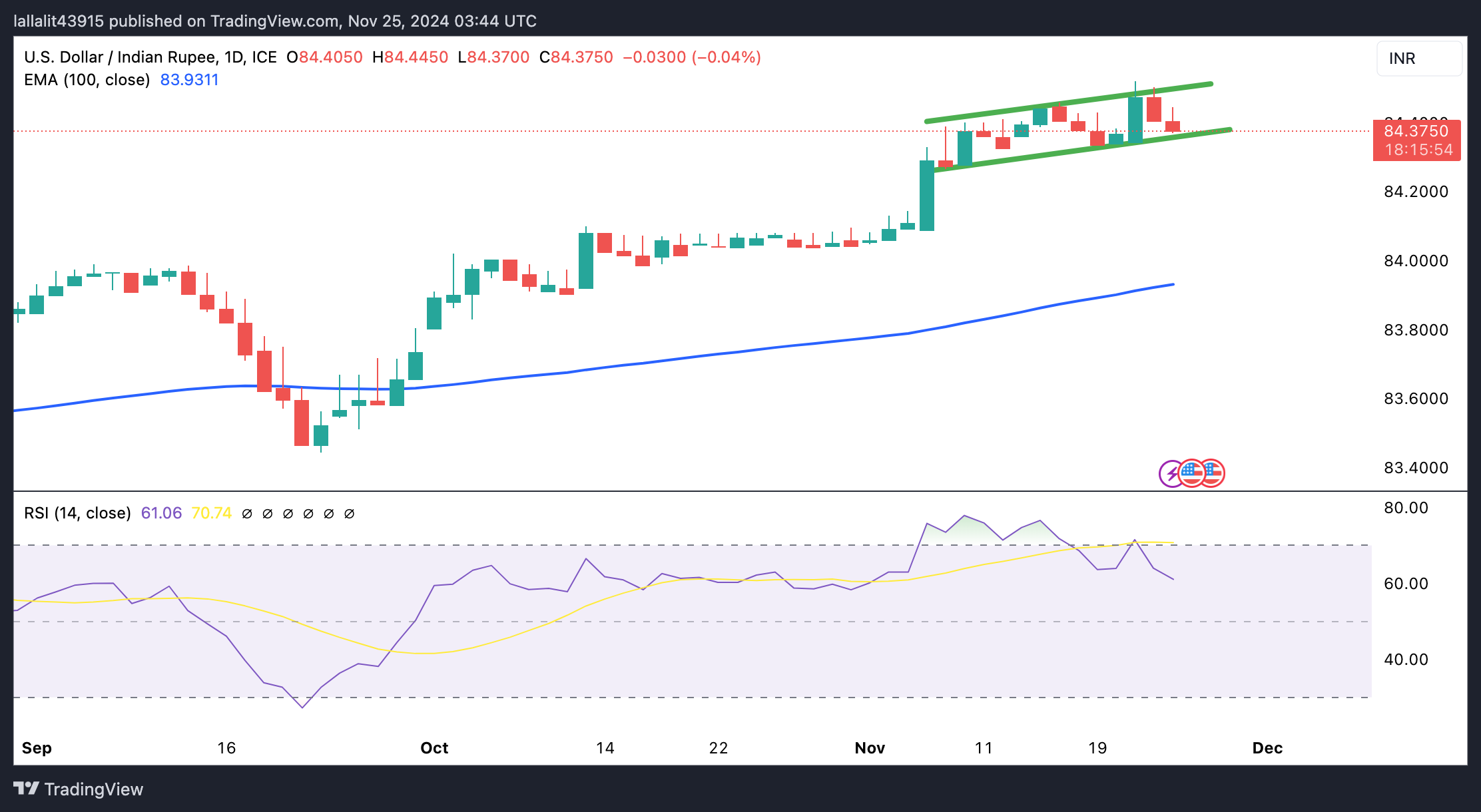
The Indian Rupee trades on a stronger note on the day. However, the USD/INR remains stuck within an ascending trend channel. Nonetheless, the constructive view of the USD/INR pair prevails as the price holds above the key 100-day Exponential Moving Average (EMA) on the daily time frame, suggesting that the rally is more likely to resume than to reverse. Additionally, the 14-day Relative Strength Index stands above the midline near 59.50, indicating that the further upside looks favorable.
The all-time high and the upper boundary of the trend channel of 84.52 act as an immediate resistance level for USD/INR. Sustained bullish momentum above this level could see a rally to the 85.00 psychological level.
On the other hand, a break below the lower limit of the trend channel of 84.35 could set off a drop to the next potential floor at the 84.00-83.90 region, representing the round mark and the 100-day EMA.
Indian Rupee FAQs
The Indian Rupee (INR) is one of the most sensitive currencies to external factors. The price of Crude Oil (the country is highly dependent on imported Oil), the value of the US Dollar – most trade is conducted in USD – and the level of foreign investment, are all influential. Direct intervention by the Reserve Bank of India (RBI) in FX markets to keep the exchange rate stable, as well as the level of interest rates set by the RBI, are further major influencing factors on the Rupee.
The Reserve Bank of India (RBI) actively intervenes in forex markets to maintain a stable exchange rate, to help facilitate trade. In addition, the RBI tries to maintain the inflation rate at its 4% target by adjusting interest rates. Higher interest rates usually strengthen the Rupee. This is due to the role of the ‘carry trade’ in which investors borrow in countries with lower interest rates so as to place their money in countries’ offering relatively higher interest rates and profit from the difference.
Macroeconomic factors that influence the value of the Rupee include inflation, interest rates, the economic growth rate (GDP), the balance of trade, and inflows from foreign investment. A higher growth rate can lead to more overseas investment, pushing up demand for the Rupee. A less negative balance of trade will eventually lead to a stronger Rupee. Higher interest rates, especially real rates (interest rates less inflation) are also positive for the Rupee. A risk-on environment can lead to greater inflows of Foreign Direct and Indirect Investment (FDI and FII), which also benefit the Rupee.
Higher inflation, particularly, if it is comparatively higher than India’s peers, is generally negative for the currency as it reflects devaluation through oversupply. Inflation also increases the cost of exports, leading to more Rupees being sold to purchase foreign imports, which is Rupee-negative. At the same time, higher inflation usually leads to the Reserve Bank of India (RBI) raising interest rates and this can be positive for the Rupee, due to increased demand from international investors. The opposite effect is true of lower inflation.
Due to the importance of trade to the economy, the Reserve Bank of India (RBI) actively intervenes in FX markets to maintain the exchange rate within a limited range. It does this to ensure Indian importers and exporters are not exposed to unnecessary currency risk during periods of FX volatility. The RBI buys and sells Rupees in the spot market at key levels, and uses derivatives to hedge its positions.
Author

Lallalit Srijandorn
FXStreet
Lallalit Srijandorn is a Parisian at heart. She has lived in France since 2019 and now becomes a digital entrepreneur based in Paris and Bangkok.