USD/INR drifts lower, India Services PMI hits 10-month low in September
- Indian Rupee holds positive ground in Friday’s early European session.
- The Indian HSBC Services PMI came in at 57.7 in September vs. 60.9 prior, weaker than expected.
- Higher crude oil prices and Foreign Portfolio Investors (FPI) outflows weigh on the INR.
- Investors await the US employment data, which is due later on Friday.

The Indian Rupee (INR) recovers some lost ground on Friday. The rise in crude oil prices amid escalating geopolitical tensions in the Middle East, the significant outflow from domestic equities and regional currency downtrends could undermine the INR.
The latest data released on Friday showed that the HSBC India Services Purchasing Managers Index (PMI) declined to 57.7 in September from 60.9 in August, below the market consensus of 58.9. This figure registered the lowest level in 10 months. The local currency remains strong against the USD despite the downbeat Services PMI report.
Looking ahead, the US employment data for September will take center stage, including Nonfarm Payrolls (NFP) and Unemployment Rate. The US economy is expected to see 140K jobs added in September. While the Unemployment Rate is expected to remain unchanged at 4.2% in the same period. If the report shows a weaker-than-expected outcome, this could weigh on the Greenback.
Daily Digest Market Movers: Indian Rupee trades firmer, potential upside seems limited
- "The headline business activity index fell below 60 for the first time in 2024, but we note that at 57.7, it was still much above the long-term average," noted Pranjul Bhandari, chief India economist at HSBC.
- According to the World Bank’s latest report, the Indian economy continues to grow at a healthy pace despite global challenges, but to reach its $1 trillion merchandise exports goal by 2030, India needs to diversify its export basket and leverage global value chains.
- The Reserve Bank of India (RBI) is expected to hold its key repo rate at 6.50% next week, but reduce it by 25 basis points (bps) in December.
- The US Services PMI climbed to 54.9 in September from 51.5 in August, the Institute for Supply Management (ISM) showed on Thursday. This figure came in stronger than the market forecast of 51.7.
- The US weekly Initial Jobless Claims in the US rose by 6,000 to 225,000 in the week ending September 28. This figure followed the previous week's print of 219,000 (revised from 218,000) and was worse than the market expectation of 220,000.
- Federal Reserve Bank of Chicago President Austan Goolsbee reiterated on Thursday that the interest rates need to come down over the next year by “a lot.” Goolsbee further stated that he’d like to keep the unemployment rate at 4.2% and prevent it from rising any further.
- The markets have priced in nearly 68.9% odds of a 25 bps Fed rate cut, while the chance of 50 bps reductions stands at 31.1%, according to the CME FedWatch Tool.
Technical Analysis: USD/INR keeps the positive picture in the longer term
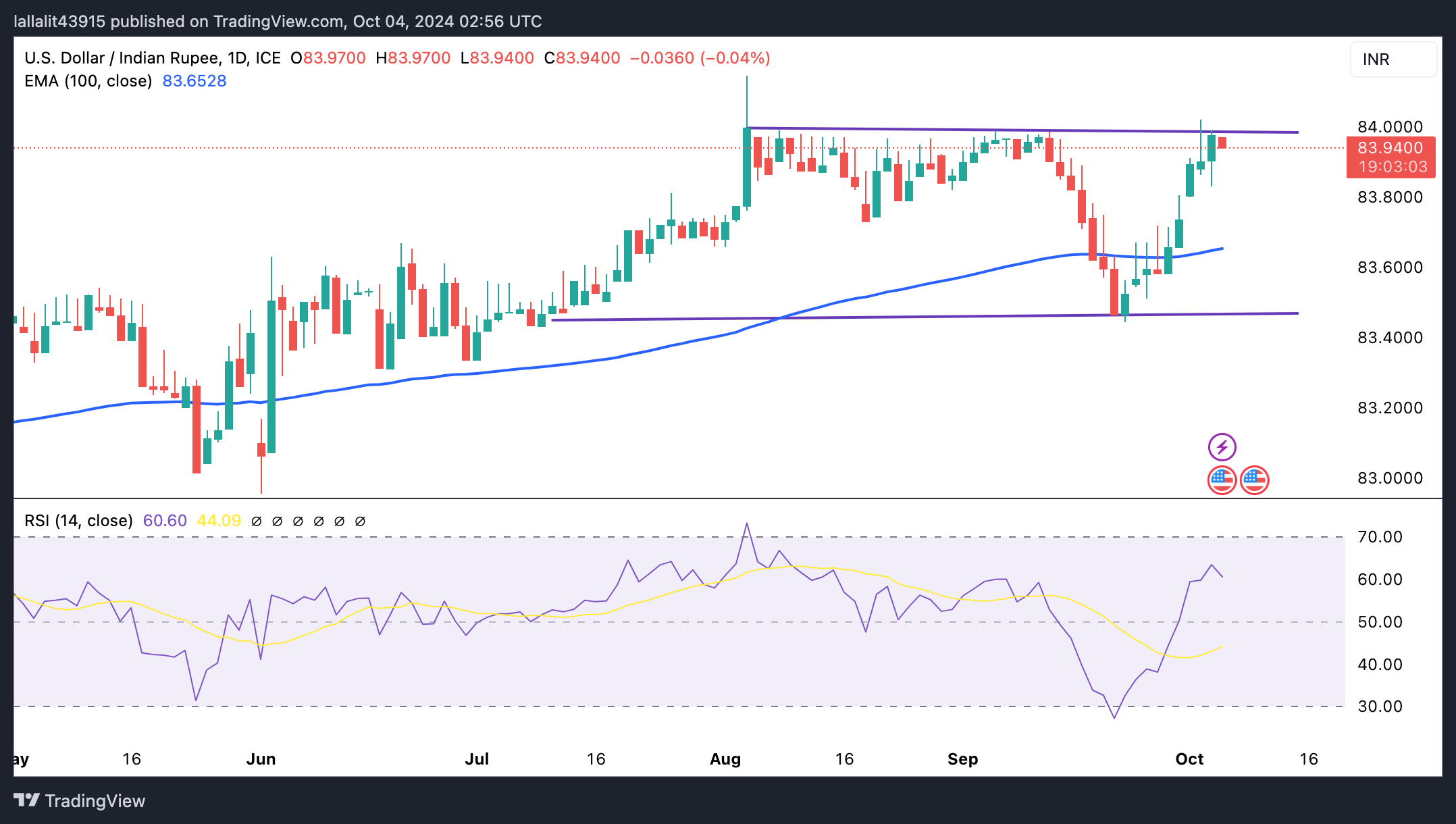
The key upside barrier for USD/INR emerges at the 84.00 level, representing the upper boundary of the rectangle and psychological mark. A decisive break above this level could attract some buyers to 84.15 (the high of August 5), followed by 84.50.
On the downside, the low of October 1 at 83.80 acts as an initial support level for the pair. A breach of this level could lead to the 100-day EMA at 83.65. Further south, the additional downside filter to watch is 83.00, representing the round mark and the low of May 24.
Indian economy FAQs
The Indian economy has averaged a growth rate of 6.13% between 2006 and 2023, which makes it one of the fastest growing in the world. India’s high growth has attracted a lot of foreign investment. This includes Foreign Direct Investment (FDI) into physical projects and Foreign Indirect Investment (FII) by foreign funds into Indian financial markets. The greater the level of investment, the higher the demand for the Rupee (INR). Fluctuations in Dollar-demand from Indian importers also impact INR.
India has to import a great deal of its Oil and gasoline so the price of Oil can have a direct impact on the Rupee. Oil is mostly traded in US Dollars (USD) on international markets so if the price of Oil rises, aggregate demand for USD increases and Indian importers have to sell more Rupees to meet that demand, which is depreciative for the Rupee.
Inflation has a complex effect on the Rupee. Ultimately it indicates an increase in money supply which reduces the Rupee’s overall value. Yet if it rises above the Reserve Bank of India’s (RBI) 4% target, the RBI will raise interest rates to bring it down by reducing credit. Higher interest rates, especially real rates (the difference between interest rates and inflation) strengthen the Rupee. They make India a more profitable place for international investors to park their money. A fall in inflation can be supportive of the Rupee. At the same time lower interest rates can have a depreciatory effect on the Rupee.
India has run a trade deficit for most of its recent history, indicating its imports outweigh its exports. Since the majority of international trade takes place in US Dollars, there are times – due to seasonal demand or order glut – where the high volume of imports leads to significant US Dollar- demand. During these periods the Rupee can weaken as it is heavily sold to meet the demand for Dollars. When markets experience increased volatility, the demand for US Dollars can also shoot up with a similarly negative effect on the Rupee.
Author

Lallalit Srijandorn
FXStreet
Lallalit Srijandorn is a Parisian at heart. She has lived in France since 2019 and now becomes a digital entrepreneur based in Paris and Bangkok.