USD/INR holds ground after upbeat US Non-farm payrolls
- The Indian Rupee strengthens after the RBI delivers a surprise 50 basis points interest-rate cut, larger than expected.
- USD/INR retreats from 86.00 but holds above its key 100-day EMA near 85.63.
- The RBI lowers fiscal year 2026 inflation forecast to 3.7% and maintains GDP growth at 6.5%.
- The US economy added 139,000 jobs in May, slightly above forecasts, with the unemployment rate remaining steady at 4.2%.

The Indian Rupee (INR) strengthens slightly against the United States Dollar (USD) on Friday, despite a surprise 50-basis-point (bps) interest-rate cut by the Reserve Bank of India (RBI). The rate trim, which exceeded market expectations, briefly weighed on USD/INR before the pair found support near 85.62. Following the US Nonfarm Payrolls (NFP) release, USD/INR ticks up modestly and trades around 85.75 at the start of the American session.
The Reserve Bank of India (RBI) surprised markets on Friday by cutting its benchmark repo rate by 50 basis points to 5.50%, opting for a stronger dose of monetary easing than the widely expected 25 bps move.
This is the third straight rate cut this year, signaling the central bank’s growing urgency to revive domestic demand and support the economy. Alongside the repo rate cut, the RBI also reduced the Cash Reserve Ratio (CRR) by 100 bps to 3%, injecting fresh liquidity into the banking system.
During the press briefing, RBI Governor Sanjay Malhotra emphasized that frontloading monetary easing is the best way to cushion the economy while inflation stays well within target.
The RBI’s updated projections showed a downward revision in inflation expectations, giving the central bank more flexibility to lower borrowing costs. Even with a shift from “accommodative” to a “neutral” stance, the overall tone suggested that the central bank is prepared to act again if needed.
Market Movers: RBI’s growth push, US data signals cooling labor market
- The Indian central bank maintained its GDP growth forecast for fiscal year 2026 at 6.5%, citing robust domestic demand and a favorable investment climate. Quarterly CPI projections suggest that inflation will gradually rise over the year, remaining within the 2-6% target range, at 2.9% in Q1, 3.4% in Q2, 3.9% in Q3, and 4.4% in Q4.
- In addition to the repo rate and CRR adjustments, the RBI reduced the Standing Deposit Facility (SDF) rate to 5.25%, and trimmed both the Marginal Standing Facility (MSF) rate and the Bank Rate to 5.75%, encouraging banks to reduce lending rates and improve credit flow in the economy.
- On the equity front, Indian stock markets surged following the announcement as investors cheered the central bank’s growth-supportive policy tone and liquidity boost. The BSE Sensex jumped 746 points to close at 82,188, while the Nifty 50 rallied 252 points to end above the 25,000 mark.
- Recent data from the United States (US) suggests the economy may be losing some momentum. The ISM Services PMI declined to 49.9 in May, indicating a slight contraction in the services sector. Meanwhile, weekly jobless claims rose to 247,000 — the highest reading since October — indicating early signs of strain in the labor market.
- The US Nonfarm Payrolls report for May showed a net gain of 139,000 jobs, slightly beating market expectations of 130,000. The unemployment rate remained steady at 4.2%, indicating a still resilient labor market. Gains were led by healthcare, leisure and hospitality, and social assistance, though government hiring fell. Notably, March and April job growth figures were revised down by a combined 95,000, tempering the overall tone of the report.
- The US Dollar Index (DXY) edged slightly higher following the data release, trading near 99.24 after touching an intraday low of 98.66, as markets reacted to stronger-than-expected job gains alongside downward revisions to previous months. While the report confirms continued labor market resilience, the softer revisions and uneven sectoral performance suggest the Federal Reserve (Fed) is likely to stay cautious in the near term, with policymakers monitoring signs of slowing momentum.
Technical analysis: USD/INR holds above trendline, 100-day EMA as market awaits NFP
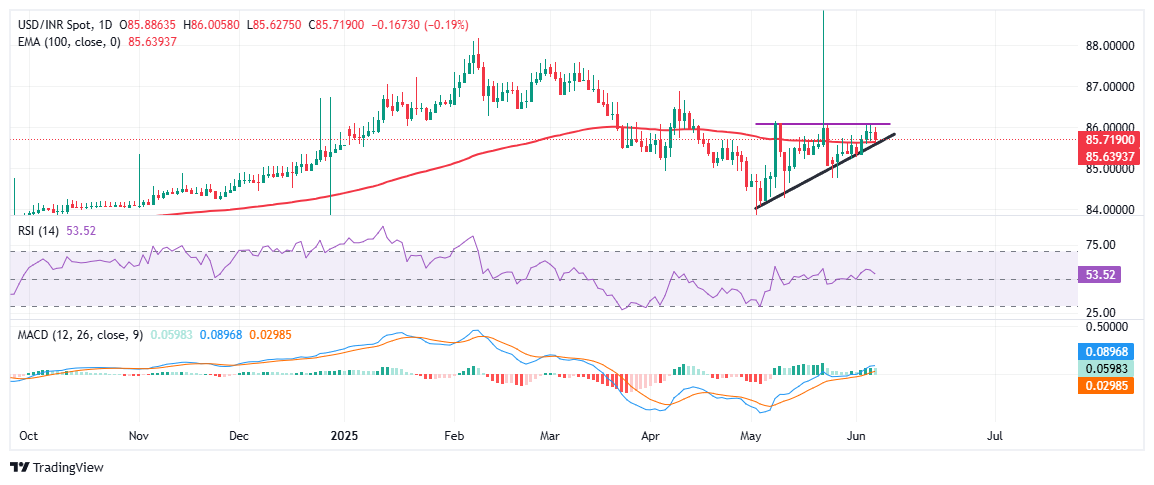
Following the Reserve Bank of India’s surprise 50-basis-point interest rate cut, USD/INR pulled back from the 86.00 mark and is now trading near 85.75.
The pair is trading just below the key resistance zone near 86.00 after multiple failed attempts to break higher. The pair remains supported by a short-term ascending trendline, which has been respected since early May, indicating persistent buying interest on dips. The 100-day Exponential Moving Average (EMA), currently at 85.63, is providing additional support. A daily close below this EMA could open the door for a deeper pullback toward 85.30 and possibly 85.00.
On the momentum side, the Relative Strength Index (RSI) holds steady around 53.5, suggesting that there is still room for either direction without signaling overbought or oversold conditions.
The Moving Average Convergence Divergence (MACD) remains in bullish territory, with the MACD line above the signal line, hinting at underlying upward bias. A confirmed breakout above 86.00 could expose the April highs below 87.00, while a failure to hold above the rising trendline may shift the near-term bias back in favor of INR strength.
Indian Rupee FAQs
The Indian Rupee (INR) is one of the most sensitive currencies to external factors. The price of Crude Oil (the country is highly dependent on imported Oil), the value of the US Dollar – most trade is conducted in USD – and the level of foreign investment, are all influential. Direct intervention by the Reserve Bank of India (RBI) in FX markets to keep the exchange rate stable, as well as the level of interest rates set by the RBI, are further major influencing factors on the Rupee.
The Reserve Bank of India (RBI) actively intervenes in forex markets to maintain a stable exchange rate, to help facilitate trade. In addition, the RBI tries to maintain the inflation rate at its 4% target by adjusting interest rates. Higher interest rates usually strengthen the Rupee. This is due to the role of the ‘carry trade’ in which investors borrow in countries with lower interest rates so as to place their money in countries’ offering relatively higher interest rates and profit from the difference.
Macroeconomic factors that influence the value of the Rupee include inflation, interest rates, the economic growth rate (GDP), the balance of trade, and inflows from foreign investment. A higher growth rate can lead to more overseas investment, pushing up demand for the Rupee. A less negative balance of trade will eventually lead to a stronger Rupee. Higher interest rates, especially real rates (interest rates less inflation) are also positive for the Rupee. A risk-on environment can lead to greater inflows of Foreign Direct and Indirect Investment (FDI and FII), which also benefit the Rupee.
Higher inflation, particularly, if it is comparatively higher than India’s peers, is generally negative for the currency as it reflects devaluation through oversupply. Inflation also increases the cost of exports, leading to more Rupees being sold to purchase foreign imports, which is Rupee-negative. At the same time, higher inflation usually leads to the Reserve Bank of India (RBI) raising interest rates and this can be positive for the Rupee, due to increased demand from international investors. The opposite effect is true of lower inflation.
Author

Vishal Chaturvedi
FXStreet
I am a macro-focused research analyst with over four years of experience covering forex and commodities market. I enjoy breaking down complex economic trends and turning them into clear, actionable insights that help traders stay ahead of the curve.

















