USD/INR gains ground as Indian importers rush to softer US Dollar
- The Indian Rupee struggles to extend its recovery move against the US Dollar.
- FIIs offloaded a little stake on Monday after remaining net buyers in the previous three trading days.
- Investors await the US flash Q3 GDP data for fresh cues on the US Dollar’s outlook.

The Indian Rupee (INR) continues to struggle to extend its last week’s reversal move against the US Dollar (USD) on Tuesday. The USD/INR pair regains ground after posting a fresh over three-week low near 89.25 as Indian importers catch the pullback to add US Dollars at attractive levels.
Last week, the Indian Rupee bounced back strongly against the US Dollar after sliding to record lows near 91.55, following the Reserve Bank of India’s (RBI) intervention in the spot and Non-Deliverable Forward (NDF) markets to support the Indian currency against one-way depreciation from speculators.
In the December 17-19 period, buying interest seen in the Foreign Institutional Investors (FIIs) activity also led to some cushion for the Indian Rupee. FIIs turned out net buyers, and increased stake worth Rs. 3,598.38 crore in the Indian equity market. However, overseas investors have turned net sellers on Monday and have offloaded a nominal stake worth Rs. 457.34 crore.
The demand for US Dollars by Indian importers has remained strong due to the absence of a trade deal announcement between the United States (US) and India. Negotiators from both economies have signaled that they are close to reaching a consensus, but have not signed a trade pact despite several bilateral meetings over the past six months.
On the domestic front, the monthly bulletin report from the Reserve Bank of India (RBI) released on Monday showed that economic growth remained strong in November due to robust rural and urban demand. “Demand conditions remained robust, with indicators of urban demand strengthening further," the RBI report said. The RBI stated, “Coordinated fiscal, monetary and regulatory policies have helped to build resilience over the year," Reuters reported.
The table below shows the percentage change of Indian Rupee (INR) against listed major currencies today. Indian Rupee was the weakest against the Japanese Yen.
| USD | EUR | GBP | JPY | CAD | AUD | INR | CHF | |
|---|---|---|---|---|---|---|---|---|
| USD | -0.15% | -0.22% | -0.59% | -0.09% | -0.20% | 0.20% | -0.20% | |
| EUR | 0.15% | -0.04% | -0.42% | 0.07% | -0.05% | 0.36% | -0.04% | |
| GBP | 0.22% | 0.04% | -0.36% | 0.12% | 0.01% | 0.41% | 0.03% | |
| JPY | 0.59% | 0.42% | 0.36% | 0.50% | 0.41% | 0.84% | 0.41% | |
| CAD | 0.09% | -0.07% | -0.12% | -0.50% | -0.09% | 0.31% | -0.12% | |
| AUD | 0.20% | 0.05% | -0.01% | -0.41% | 0.09% | 0.41% | 0.00% | |
| INR | -0.20% | -0.36% | -0.41% | -0.84% | -0.31% | -0.41% | -0.41% | |
| CHF | 0.20% | 0.04% | -0.03% | -0.41% | 0.12% | -0.01% | 0.41% |
The heat map shows percentage changes of major currencies against each other. The base currency is picked from the left column, while the quote currency is picked from the top row. For example, if you pick the Indian Rupee from the left column and move along the horizontal line to the US Dollar, the percentage change displayed in the box will represent INR (base)/USD (quote).
Daily digest market movers: The Fed is unlikely to cut interest rates in January
- The US Dollar regains ground against the Indian Rupee, even as the former faces intense selling pressure ahead of the flash US Q3 Gross Domestic Product (GDP) data release at 13:30 GMT.
- As of writing, the US Dollar Index (DXY), which tracks the Greenback’s value against six major currencies, trades 0.2% lower to near 98.00.
- The US Bureau of Economic Analysis (BEA) is expected to show that the economy expanded at an annualized pace of 3.2%, slower than 3.8% in the second quarter this year. Investors will pay close attention to the GDP report to see the contribution by consumption and the services sector activity in economic growth.
- Signs of cooling household spending, even with a strong GDP growth number, would raise concerns over the economic outlook.
- Meanwhile, a slim chance of an interest rate cut by the Federal Reserve (Fed) is failing to provide support to the US Dollar. The probability of the Fed reducing interest rates by 25 basis points (bps) to 3.25%-3.50% in the January meeting is 20%, according to the CME FedWatch tool.
- In last week’s monetary policy announcement, Fed Chair Jerome Powell also said in the press conference that the bar for another interest rate cut is very high.
Technical Analysis: USD/INR attracts bids below 20-day EMA
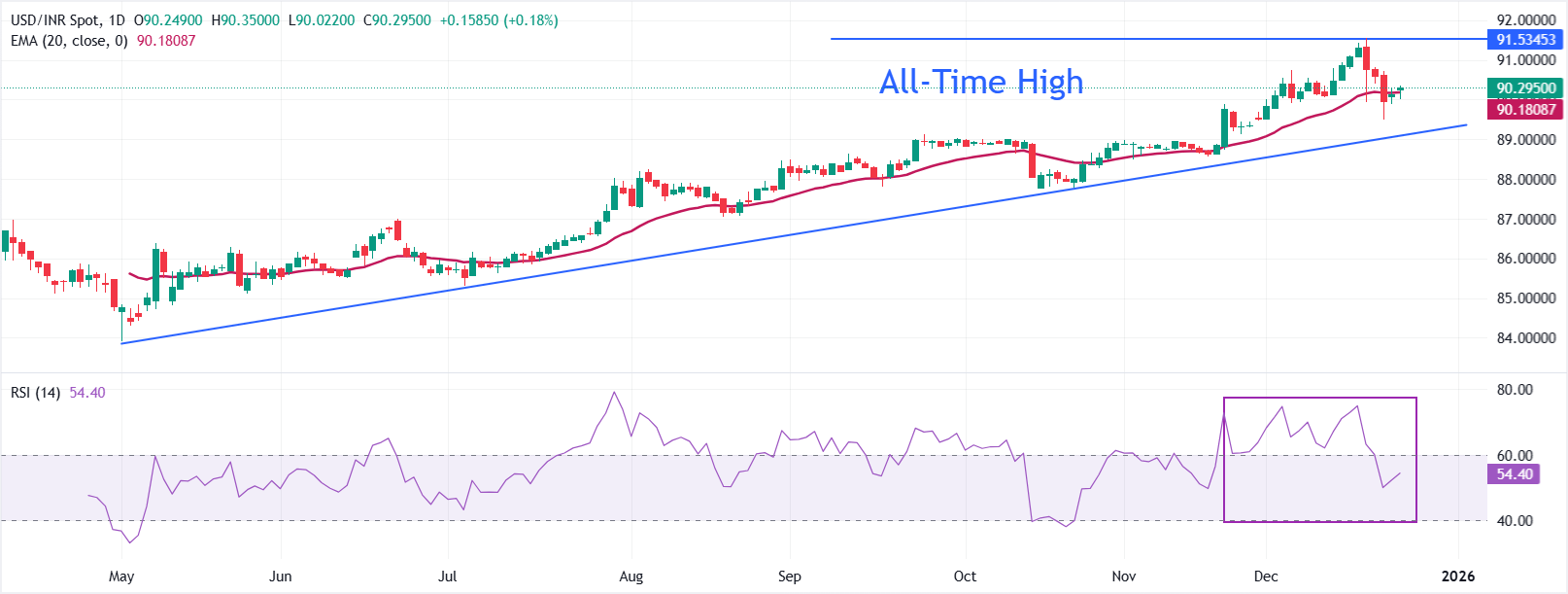
In the daily chart, USD/INR trades at 90.2950. The 20-day Exponential Moving Average (EMA) rises and stands at 90.1809, keeping the near-term bias positive as price holds above it.
The 14-day Relative Strength Index (RSI) prints 54 (neutral) after cooling from prior overbought readings, signaling balanced momentum. The rising trend line from 83.8509 underpins the advance, offering support near 89.1409. A sustained hold above the average would keep dips limited, whereas a daily close beneath it could shift focus toward the trend-line support.
The 20-day EMA has turned higher in recent sessions, with spot continuing to respect it as dynamic support. RSI near the midline corroborates a rangebound pause within the broader uptrend. Maintaining closes above the moving average would preserve bullish control and favor continuation, while a breakdown would expose the ascending support and risk a deeper pullback.
(The technical analysis of this story was written with the help of an AI tool.)
Economic Indicator
Gross Domestic Product Annualized
The real Gross Domestic Product (GDP) Annualized, released quarterly by the US Bureau of Economic Analysis, measures the value of the final goods and services produced in the United States in a given period of time. Changes in GDP are the most popular indicator of the nation’s overall economic health. The data is expressed at an annualized rate, which means that the rate has been adjusted to reflect the amount GDP would have changed over a year’s time, had it continued to grow at that specific rate. Generally speaking, a high reading is seen as bullish for the US Dollar (USD), while a low reading is seen as bearish.
Read more.Next release: Tue Dec 23, 2025 13:30 (Prel)
Frequency: Quarterly
Consensus: 3.3%
Previous: 3.8%
Source: US Bureau of Economic Analysis
The US Bureau of Economic Analysis (BEA) releases the Gross Domestic Product (GDP) growth on an annualized basis for each quarter. After publishing the first estimate, the BEA revises the data two more times, with the third release representing the final reading. Usually, the first estimate is the main market mover and a positive surprise is seen as a USD-positive development while a disappointing print is likely to weigh on the greenback. Market participants usually dismiss the second and third releases as they are generally not significant enough to meaningfully alter the growth picture.
Author

Sagar Dua
FXStreet
Sagar Dua is associated with the financial markets from his college days. Along with pursuing post-graduation in Commerce in 2014, he started his markets training with chart analysis.

















