USD/INR rebounds on hopes for softer Trump tariff stance
- The Indian Rupee edges lower in Tuesday’s early European session.
- Fresh foreign capital inflows and a weaker Dollar underpin the INR; higher crude oil prices might cap its upside.
- Investors brace for Fedspeak and CB’s Consumer Confidence report later on Tuesday.


The Indian Rupee (INR) softens on Tuesday after closing stronger for the ninth consecutive session in the previous session. The persistent US Dollar (USD) sales from foreign banks and a sign of revival in foreign inflows provide some support to the Indian currency, helping the INR claw back all of its losses in 2025 so far.
Nonetheless, a rise in crude oil prices could exert some selling pressure on the local currency. It’s worth noting that India is the world's third-largest oil consumer and higher crude oil prices tend to have a negative impact on the INR value. Traders await Fedspeak, along with the Conference Board’s Consumer Confidence gauge, New Home Sales and the Richmond Fed Manufacturing Index, which will be published later on Tuesday.
Indian Rupee loses ground on higher crude oil prices
- Indian government bond yields rose in early deals on Tuesday, after states raised the quantum of their planned borrowing to a record high.
- Indian states are expected to borrow a record 746.55 billion rupees ($8.71 billion) later in the day, higher by more than 200 billion rupees than scheduled.
- "Higher supply will definitely test the market today, but with strong flows with long-term players, it should go through without ruffling many feathers," a trader with a private bank said.
- The HSBC India Manufacturing Purchasing Managers Index (PMI) rose to 57.6 in March from 56.3 in February.
- The Indian Services PMI eased to 57.7 in March versus 59.0 prior. The Composite PMI declined to 58.6 in March from 58.8 in February.
- "India's manufacturing sector expanded at a faster pace in March ... The output index rose to its highest level since July 2024,” said Pranjul Bhandari, Chief India Economist at HSBC.
- Trump said late Monday that he will announce tariffs on automobile imports in the coming days and indicated that some countries will receive breaks from reciprocal tariffs on April 2. Trump signaled trading partners would receive possible exemptions or reductions.
- Trump also stated that he planned to proceed with sector-specific tariffs on lumber and semiconductors and repeated his threat to impose duties on pharmaceutical drugs “in the very near future”.
- Atlanta Fed President Raphael Bostic warned that economic uncertainty will continue to weigh on Fed decision-making as the US's self-styled trade war continues to build pressure on the economy.
- The US S&P Global Composite PMI rose to 53.5 (preliminary) in March from 51.6 in February. Meanwhile, the Manufacturing PMI declined to 49.8 in March versus 52.7 prior, missing the estimation of 51.9. The Services PMI climbed to 54.3 in March from 51.0 in the previous reading, above the market consensus of 51.2.
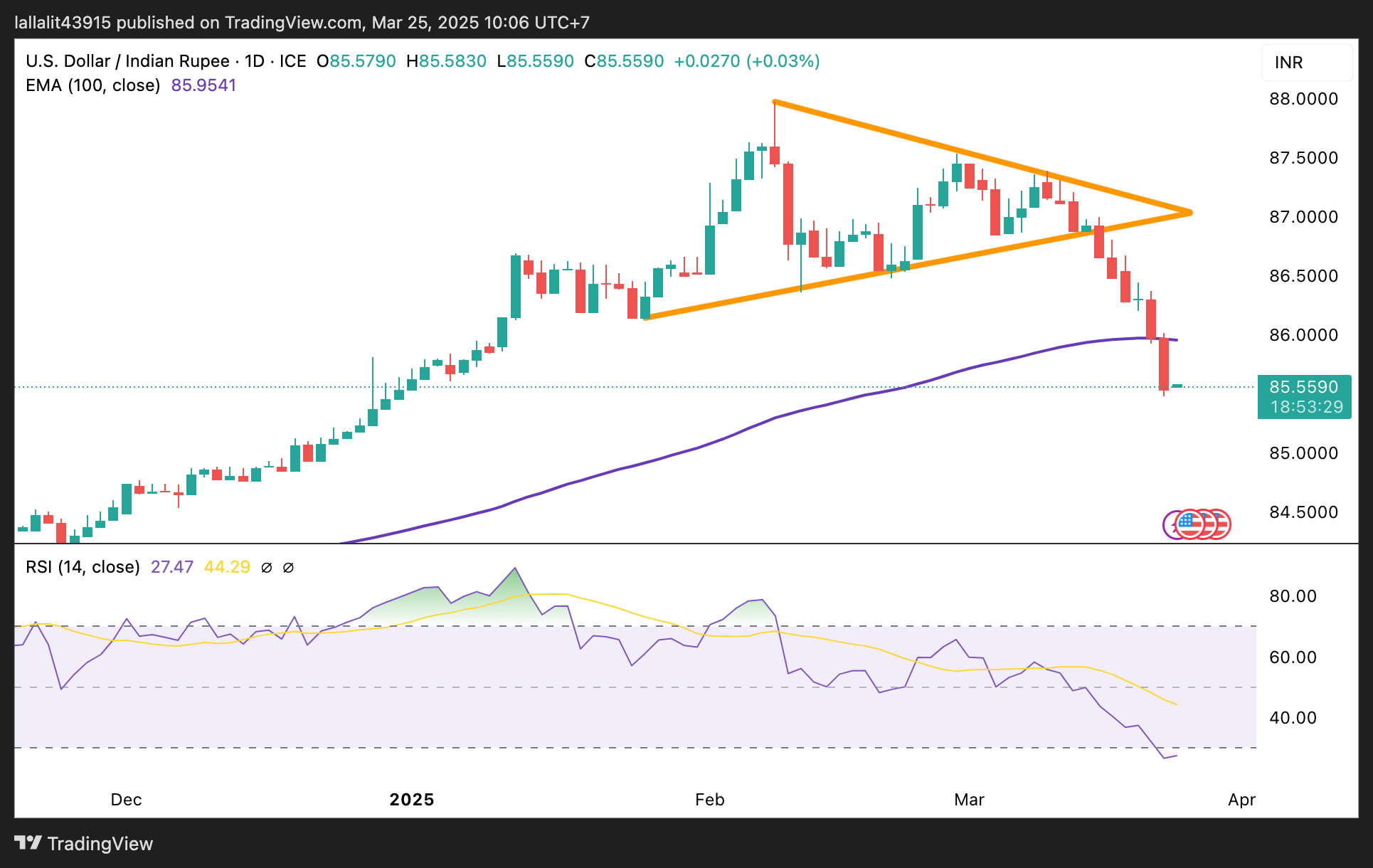
USD/INR resumes downside journey below the 100-day EMA
The Indian Rupee trades on a weaker note on the day. The USD/INR pair resumes its downside, with the price crossing below the key 100-day Exponential Moving Average on the daily chart. Nonetheless, the oversold 14-day Relative Strength Index (RSI) below the 30.00 mark warrants caution for bearish traders, potentially signaling a temporary recovery or further consolidation in the near term.
The first downside target for USD/INR is located at 85.60, the low of January 6. Extended losses could expose 84.84, the low of December 19, 2024. A breach of this level could see a drop to 84.22, the low of November 25, 2024.
On the bright side, the crucial resistance level for the pair emerges in the 85.95-86.00 zone, representing the psychological level and the 100-day EMA. The next hurdle to watch is 86.48, the low of February 21, en route to 87.00, the round figure.
Indian Rupee FAQs
The Indian Rupee (INR) is one of the most sensitive currencies to external factors. The price of Crude Oil (the country is highly dependent on imported Oil), the value of the US Dollar – most trade is conducted in USD – and the level of foreign investment, are all influential. Direct intervention by the Reserve Bank of India (RBI) in FX markets to keep the exchange rate stable, as well as the level of interest rates set by the RBI, are further major influencing factors on the Rupee.
The Reserve Bank of India (RBI) actively intervenes in forex markets to maintain a stable exchange rate, to help facilitate trade. In addition, the RBI tries to maintain the inflation rate at its 4% target by adjusting interest rates. Higher interest rates usually strengthen the Rupee. This is due to the role of the ‘carry trade’ in which investors borrow in countries with lower interest rates so as to place their money in countries’ offering relatively higher interest rates and profit from the difference.
Macroeconomic factors that influence the value of the Rupee include inflation, interest rates, the economic growth rate (GDP), the balance of trade, and inflows from foreign investment. A higher growth rate can lead to more overseas investment, pushing up demand for the Rupee. A less negative balance of trade will eventually lead to a stronger Rupee. Higher interest rates, especially real rates (interest rates less inflation) are also positive for the Rupee. A risk-on environment can lead to greater inflows of Foreign Direct and Indirect Investment (FDI and FII), which also benefit the Rupee.
Higher inflation, particularly, if it is comparatively higher than India’s peers, is generally negative for the currency as it reflects devaluation through oversupply. Inflation also increases the cost of exports, leading to more Rupees being sold to purchase foreign imports, which is Rupee-negative. At the same time, higher inflation usually leads to the Reserve Bank of India (RBI) raising interest rates and this can be positive for the Rupee, due to increased demand from international investors. The opposite effect is true of lower inflation.
Author
Lallalit Srijandorn
FXStreet
Lallalit Srijandorn is a Parisian at heart. She has lived in France since 2019 and now becomes a digital entrepreneur based in Paris and Bangkok.