|

USD/INR Price Analysis: Indian rupee buyers need validation from 79.70

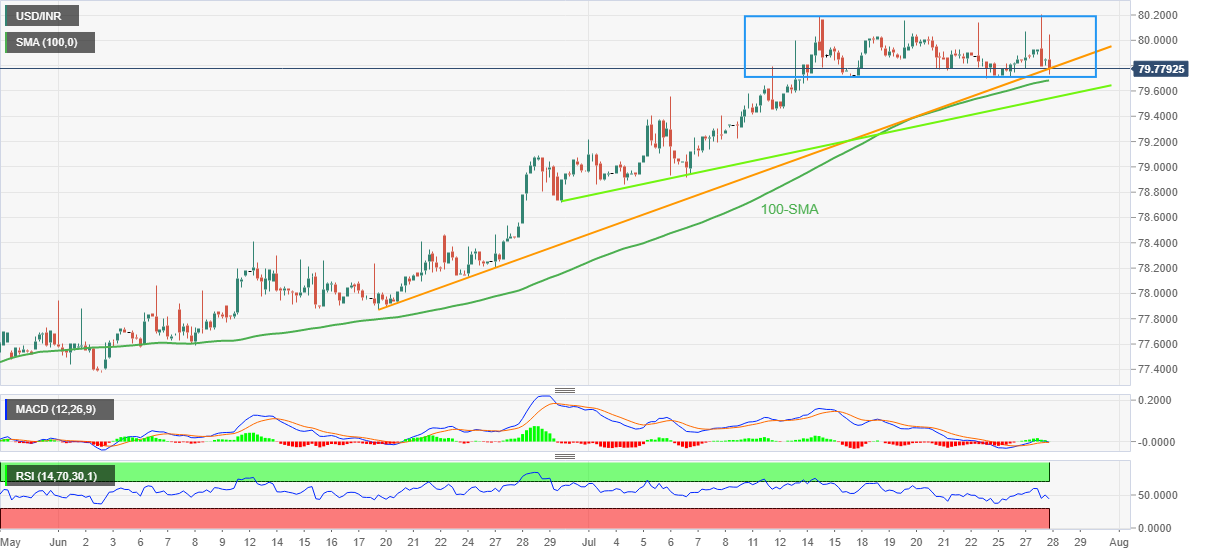
  • USD/INR remains pressured inside two-week-old trading range, pokes short-term support line of late.
  • 100-SMA, one-month-old ascending trend line adds strength to the downside filters.
  • Bulls should wait for a daily close beyond 80.20 to retake control.
  • RSI, MACD signals hint that buyers are running out of steam.

USD/INR extends the post-Fed losses as the bears attack a five-week-old rising trend line support near 79.80 during the initial hour of the Indian trading session on Thursday. Even so, the pair remains inside a fortnight-long trading range between 80.20 and 79.70.

Considering the latest weakness in the RSI, as well as an impending bear cross on the MACD< USD/INR is likely to break the 79.70 support.

Following that, an upward sloping trend line from June 29, at 79.55, will be in focus.

In a case where USD/INR prices drop below 79.55, the odds of witnessing the quote’s south-run towards 79.00 and then to the June 29 swing low near 78.80 will be in focus.

Meanwhile, recovery moves may initially aim for the 80.00 threshold before challenging the aforementioned range’s resistance, at 80.20.

In a case where the USD/INR buyers manage to keep reins past 80.20, the 81.00 round figure could flash on their radars.

USD/INR: Four-hour chart
Trend: Further weakness expected

Additional important levels

Overview
Today last price79.7792
Today Daily Change-0.0423
Today Daily Change %-0.05%
Today daily open79.8215
 
Trends
Daily SMA2079.5541
Daily SMA5078.5625
Daily SMA10077.4939
Daily SMA20076.2144
 
Levels
Previous Daily High80.208
Previous Daily Low79.7738
Previous Weekly High80.1595
Previous Weekly Low79.7208
Previous Monthly High79.091
Previous Monthly Low77.3791
Daily Fibonacci 38.2%79.9396
Daily Fibonacci 61.8%80.0421
Daily Pivot Point S179.6608
Daily Pivot Point S279.5002
Daily Pivot Point S379.2266
Daily Pivot Point R180.0951
Daily Pivot Point R280.3687
Daily Pivot Point R380.5293

Author

Anil Panchal

Anil Panchal

FXStreet

Anil Panchal has nearly 15 years of experience in tracking financial markets. With a keen interest in macroeconomics, Anil aptly tracks global news/updates and stays well-informed about the global financial moves and their implications.


More from Anil Panchal
Share:

Editor's Picks

EUR/USD clings to gains around 1.1800

EUR/USD manages to regain composure and retests the 1.1800 region in quite a positive start to the week. The pair’s bounce follows the US Dollar’s offered stance post-SCOTUS ruling ahead of important US data and Fedspeak on Tuesday.

GBP/USD looks stuck around 1.3500 amid firm gains

GBP/USD is pushing further north on Monday, revisiting the 1.3500 hurdle and beyond. Cable’s uptick is largely being fuelled by the broader softness in the Greenback, amid lingering uncertainty around tariffs.

Gold pops above $5,200, four-week highs

Gold is holding onto its bullish tone on Monday, reaching new multi-week highs just past the $5,200 mark per troy ounce. Fresh trade-war concerns, coupled with rising geopolitical tensions in the Middle East, are keeping demand for the yellow metal well on the rise.

Ethereum Price Forecast: BitMine's holdings reach 4.42 million ETH as Fundstrat predicts 87% win-ratio

Ethereum (ETH) treasury firm BitMine Immersion Technologies (BMNR) scooped up 51,162 ETH last week, marking its largest purchase since December.

Supreme Court nixes tariffs, Trump teases 15% global tariff

On February 20th, the Supreme Court ruled that Trump’s global tariffs under IEEPA authority were unconstitutional, effectively nullifying the framework. However, the relief was short-lived. Within hours, Trump floated a 15% blanket tariff under an alternative legal authority.

XRP recovers slightly as bearish sentiment dominates crypto market

Ripple is rising above $1.40 at the time of writing on Monday amid fresh tariff-triggered headwinds in the broader cryptocurrency market. The sell-off to $1.33, the token’s intraday low, can be attributed to macroeconomic uncertainty, geopolitical tensions and risk-averse sentiment among other factors.