|

USD/INR Price Analysis: Indian rupee buyers jostle with key hurdle around 77.50

  • USD/INR remains pressured around intraday low, extends Friday’s pullback.
  • Sellers attack ascending triangle’s support to retake control.
  • RSI, MACD suggests further weakness but the key SMAs may offer an intermediate halt.

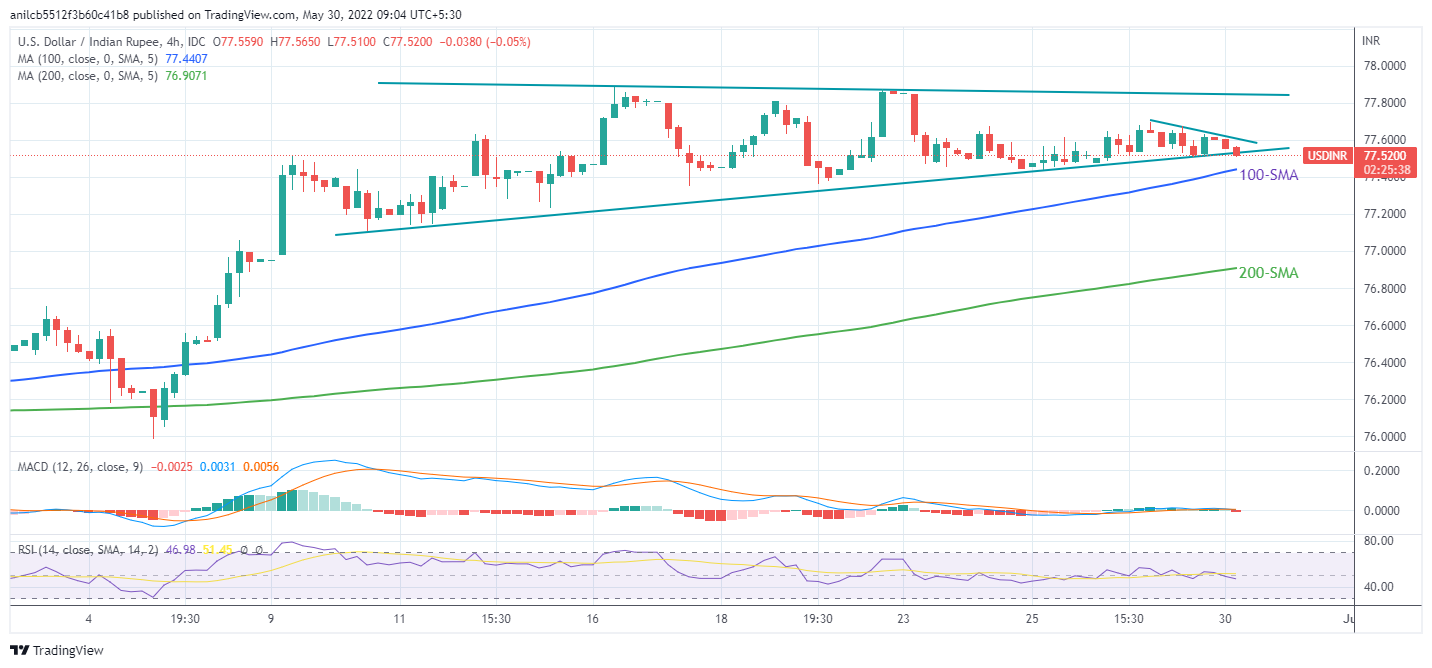
USD/INR stays depressed around the intraday low of 77.52 inside a three-week-old ascending triangle. In doing so, the Indian rupee (INR) pair stretches the previous day’s weakness as bears battle with the stated bearish chart pattern’s support line during early Monday.

Given the downbeat RSI and MACD conditions, as well as the pair’s lower-high formation in the last two days, the USD/INR prices are likely to witness further downside.

However, a clear downside break of the 77.50 support becomes necessary to convince sellers.

Even so, the 100-SMA and the 200-SMA will challenge the INR pair’s further downside around 77.40 and 76.90.

Meanwhile, recovery moves remain elusive until the quote defies the recent lower-high formation by crossing the 77.70 hurdle.

Following that, the stated triangle’s resistance around 77.85, followed by the 78.00 threshold, will please the USD/INR bulls.

Overall, USD/INR prices are likely to consolidate recent gains but the downtrend appears less convincing.

USD/INR: Four-hour chart
Trend: Further weakness expected

Author

Anil Panchal

Anil Panchal

FXStreet

Anil Panchal has nearly 15 years of experience in tracking financial markets. With a keen interest in macroeconomics, Anil aptly tracks global news/updates and stays well-informed about the global financial moves and their implications.


More from Anil Panchal
Share:

Editor's Picks

AUD/USD holds firm near 0.7000 after Chinese inflation, trade data

AUD/USD stays firm near 0.7000 in Wednesday’s Asian session, picking up some bids after China's mixed inflation and upbeat trade data. CPI rose less than expected in September, while PPI inflation picked up. Meanwhile, the Chinese trade surplus unexpectedly widened in September. The pair remains underpinned by a broadly subdued US Dollar, despite the Middle East escalation, as focus remains on US CPI data.

USD/JPY consolidates near 158.50; looks to US CPI for fresh impetus

USD/JPY stays range-bound near 158.50 in the Asian session on Wednesday, with looming intervention risks supporting the Japanese Yen and capping upside amid a softer US Dollar. However, geopolitical uncertainties act as a tailwind for the safe-haven USD and the pair. Traders also seem hesitant ahead of the release of the latest US inflation figures.

Gold looks to $4100 and US CPI inflation amid geopolitical risks

Gold falls for the third straight day on Wednesday, as the recent recovery falters ahead of US inflation. US Dollar pauses correction amid rising Oil prices and stabilizing US Treasury bond yields. The daily bearish RSI remains a headwind for Gold buyers, with $4,100 seen at risk.

Bitcoin eyes $85,000; ETH holds support, XRP stabilizes
Bitcoin (BTC), Ethereum (ETH), and Ripple (XRP) show signs of recovery on Wednesday as buyers try to regain control after their recent market weakness. BTC extends its rebound toward the $85,000 resistance, while ETH and XRP find support around key levels.
What happens after a US Treasury market crash
The global bond market is under severe pressure as US Treasury yields reach multi-decade highs, driven by persistent inflation risk, heavy government and corporate debt issuance, and expanding term premiums. Higher yields raise borrowing costs and tighten financial conditions, but a severe bond selloff can ultimately shift investor focus from inflation to growth and financial stability.
Has Bitcoin really escaped the macro forces it was built to fight?
Over 17 years ago, Satoshi Nakamoto designed Bitcoin (BTC) on the back of a global financial crisis as an alternative to the global monetary system outside the control of central banks, governments and traditional intermediaries. This raises a key question: has Bitcoin really become independent of the macroeconomic forces it was built to challenge?















