USD/INR strengthens as economic growth worries drag Indian Rupee lower to near record low
- The Indian Rupee drifts lower in Thursday’s early European session.
- Disappointing Indian economic data, portfolio outflows and a firmer USD undermine the INR.
- Investors await US weekly Initial Jobless Claims and Goods Trade Balance releases later on Thursday.

The Indian Rupee (INR) remains weak near a record low on Thursday despite interventions by the Reserve Bank of India (RBI). The strong US Dollar (USD) demand, worries over India's economic growth and significant outflows from Indian portfolios following Donald Trump's strength in the US Presidential elections exert some selling pressure on the INR.
Nonetheless, the lower crude oil prices could help limit the local currency’s losses as India is the world’s third-largest oil consumer. Investors will monitor the US weekly Initial Jobless Claims and Goods Trade Balance reports, which will be published later on Thursday. On Friday, all eyes will be on the RBI interest rate decision and the highly anticipated Nonfarm Payrolls (NFP) data.
Indian Rupee softens amid new all-time lows
- The HSBC India Services PMI arrived at 58.4 in November versus 59.2 in October. This reading came in below the market consensus of 59.5.
- "The hiring surge reflected the sector's improving business confidence, growing new orders, and vigorous international demand," noted Pranjul Bhandari, chief India economist at HSBC.
- US service sector growth slowed by more than expected in November, falling to 52.1 from 56.0 in October, according to the Institute for Supply Management (ISM) on Wednesday.
- The US S&P Global Composite PMI declined to 54.9 in November, compared to the previous reading and the expectation of 55.3. The Services PMI dropped to 56.1 in November versus 57.0 prior, below the consensus of 57.0.
- The Fed Chair Jerome Powell noted on Wednesday that the US economy is in remarkably good shape, allowing Fed officials to potentially be more cautious in cutting interest rates further. Powell added that Unemployment is still very low and the Fed made progress on inflation.
- According to the Fed’s Beige Book survey released on Wednesday, the US economic activity increased slightly in November after little change in preceding months, and US businesses grew more upbeat about demand prospects.
USD/INR’s positive picture prevails, but Bearish Divergence on RSI might cap its upside
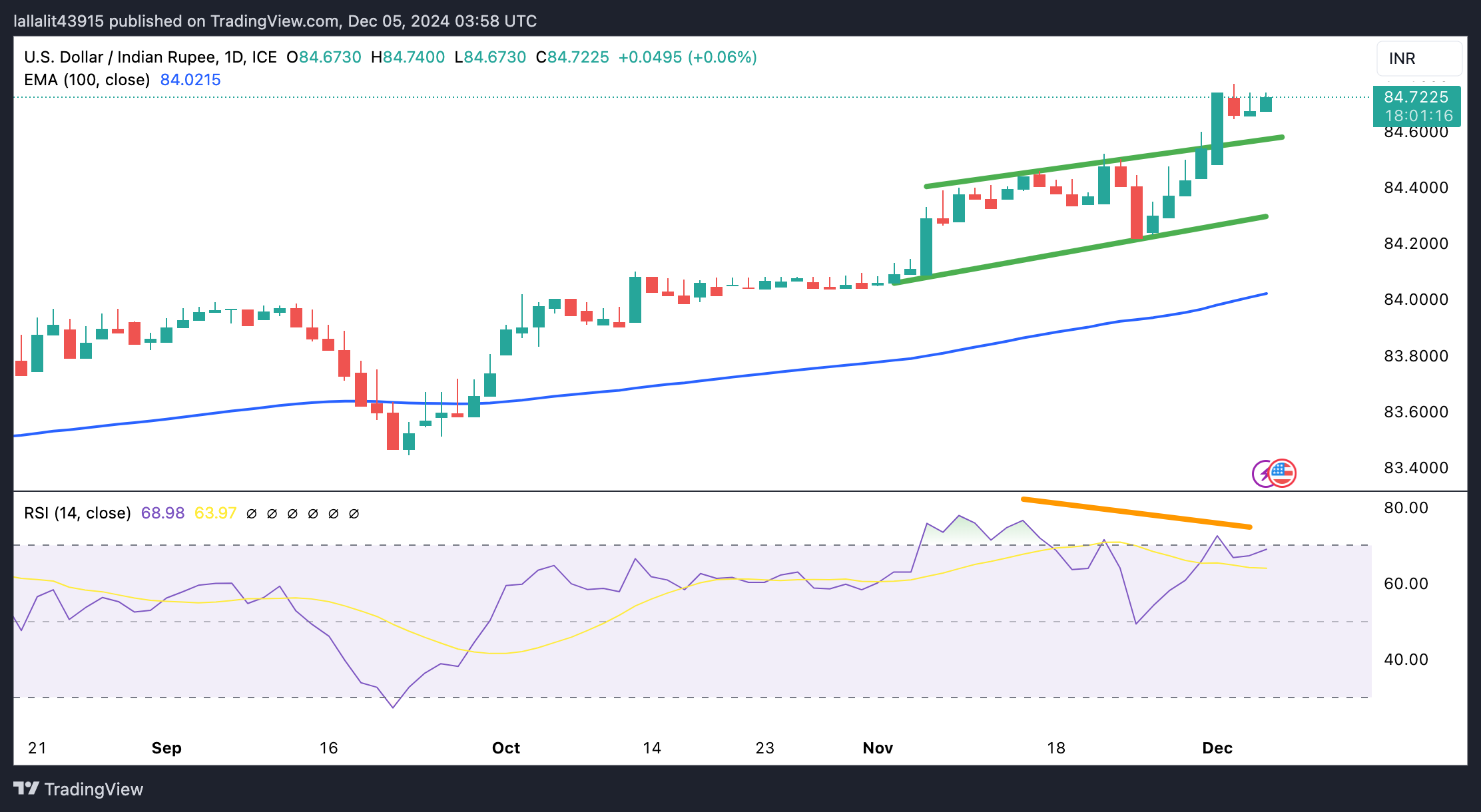
The Indian Rupee edges lower on the day. The USD/INR pair maintains the uptrend on the daily timeframe, with the pair holding above the key 100-day Exponential Moving Average (EMA). However, further consolidation cannot be ruled out as the pair makes higher highs, but the 14-day Relative Strength Index (RSI) makes lower highs, indicating bearish divergence. This suggests that the trend is weakening and the upward direction might reverse in the near term.
The first resistance level to watch is near the all-time high of 84.77. Extended bullish candlesticks could pave the way to the 85.00 psychological mark, followed by 85.50.
On the flip side, any follow-through selling below the resistance-turned-support at 84.60 could expose 84.22, the low of November 25. The potential support level is seen at 84.02, the 100-day EMA.
Indian Rupee FAQs
The Indian Rupee (INR) is one of the most sensitive currencies to external factors. The price of Crude Oil (the country is highly dependent on imported Oil), the value of the US Dollar – most trade is conducted in USD – and the level of foreign investment, are all influential. Direct intervention by the Reserve Bank of India (RBI) in FX markets to keep the exchange rate stable, as well as the level of interest rates set by the RBI, are further major influencing factors on the Rupee.
The Reserve Bank of India (RBI) actively intervenes in forex markets to maintain a stable exchange rate, to help facilitate trade. In addition, the RBI tries to maintain the inflation rate at its 4% target by adjusting interest rates. Higher interest rates usually strengthen the Rupee. This is due to the role of the ‘carry trade’ in which investors borrow in countries with lower interest rates so as to place their money in countries’ offering relatively higher interest rates and profit from the difference.
Macroeconomic factors that influence the value of the Rupee include inflation, interest rates, the economic growth rate (GDP), the balance of trade, and inflows from foreign investment. A higher growth rate can lead to more overseas investment, pushing up demand for the Rupee. A less negative balance of trade will eventually lead to a stronger Rupee. Higher interest rates, especially real rates (interest rates less inflation) are also positive for the Rupee. A risk-on environment can lead to greater inflows of Foreign Direct and Indirect Investment (FDI and FII), which also benefit the Rupee.
Higher inflation, particularly, if it is comparatively higher than India’s peers, is generally negative for the currency as it reflects devaluation through oversupply. Inflation also increases the cost of exports, leading to more Rupees being sold to purchase foreign imports, which is Rupee-negative. At the same time, higher inflation usually leads to the Reserve Bank of India (RBI) raising interest rates and this can be positive for the Rupee, due to increased demand from international investors. The opposite effect is true of lower inflation.
Author

Lallalit Srijandorn
FXStreet
Lallalit Srijandorn is a Parisian at heart. She has lived in France since 2019 and now becomes a digital entrepreneur based in Paris and Bangkok.