USD/INR drifts lower after RBI keeps repo rates unchanged at 6.50%
- The Indian Rupee trades on a stronger note in Friday’s early European session.
- RBI’s MPC decided to keep the repo rate unchanged at 6.5% in its December meeting on Friday.
- Recovery in domestic markets and lower crude oil prices may lift the INR, but renewed USD demand could limit gains.
- The US November Nonfarm Payrolls will be in the spotlight on Friday.

The Indian Rupee (INR) recovers some lost ground on Friday after bouncing off from its all-time low level in the previous session. The Reserve Bank of India (RBI) Governor Shaktikanta Das announced its fifth monetary policy of the current financial year 2024-25 (FY25). The Indian central bank maintained the status quo on the repo rate at 6.50% for the 11 consecutive meeting. The RBI Monetary Policy Committee (MPC) unanimously agreed to maintain the neutral policy stance, signaling a cautious approach to current economic conditions. The INR attracts some buyers in immediate reaction to the rate decision.
The strength in the domestic markets and the decline in crude oil prices could provide some support to the local currency. Nonetheless, broad-based US Dollar (USD) strength amid the cautious mood could undermine the INR against the Greenback.
Investors will closely monitor the US November employment report, including Nonfarm Payrolls (NFP), Unemployment Rate and Average Hourly Earnings. Additionally, the Federal Reserve’s (Fed) Michelle Bowman and Austan Goolsbee are scheduled to speak later in the day.
Indian Rupee recovers after RBI interest rate decision
- RBI Governor Das said, “The MPC believes that only with durable price stability can strong foundations be secured for high growth. The MPC remains committed to restoring the inflation growth balance in the overall interest of the economy.”
- RBI raised FY25 CPI inflation target from 4.5% to 4.8% and cuts FY25 GDP growth estimates to 6.6% from 7.2% earlier.
- The RBI on Friday allowed small finance banks to extend credit lines through UPI. Credit line on UPI was launched in September 2023 and was made available through scheduled commercial banks (SCBs)
- The Indian central bank proposes to introduce a new benchmark, the Secured Overnight Rupee Rate (SORR) to further develop the interest rate derivatives market in India and improve the credibility of interest rate benchmarks.
- RBI’s MPC slashed the Cash Reserve Ratio (CRR) by 50 basis points (bps) to 4%.
- “We expect the rupee to trade with a negative bias on the strong dollar and worries over an economic slowdown. However, weakness in crude oil prices and fresh FII outflows may support the rupee at lower levels,” noted Anuj Choudhary, Research Analyst at Mirae Asset Sharekhan.
- According to a Union Bank study, the RBI has been using its foreign reserves, resulting in a significant decline from USD 705 billion to USD 656.58 billion as of November 22, 2024.
- The US weekly Initial Jobless Claims climbed to 224K for the week ending November 29, compared to the previous week of 215K, according to the US Department of Labor (DoL) on Thursday. This reading came in above the market consensus of 215K.
- Continuing Jobless Claims declined by 23K to 1.871M for the week ending November 22.
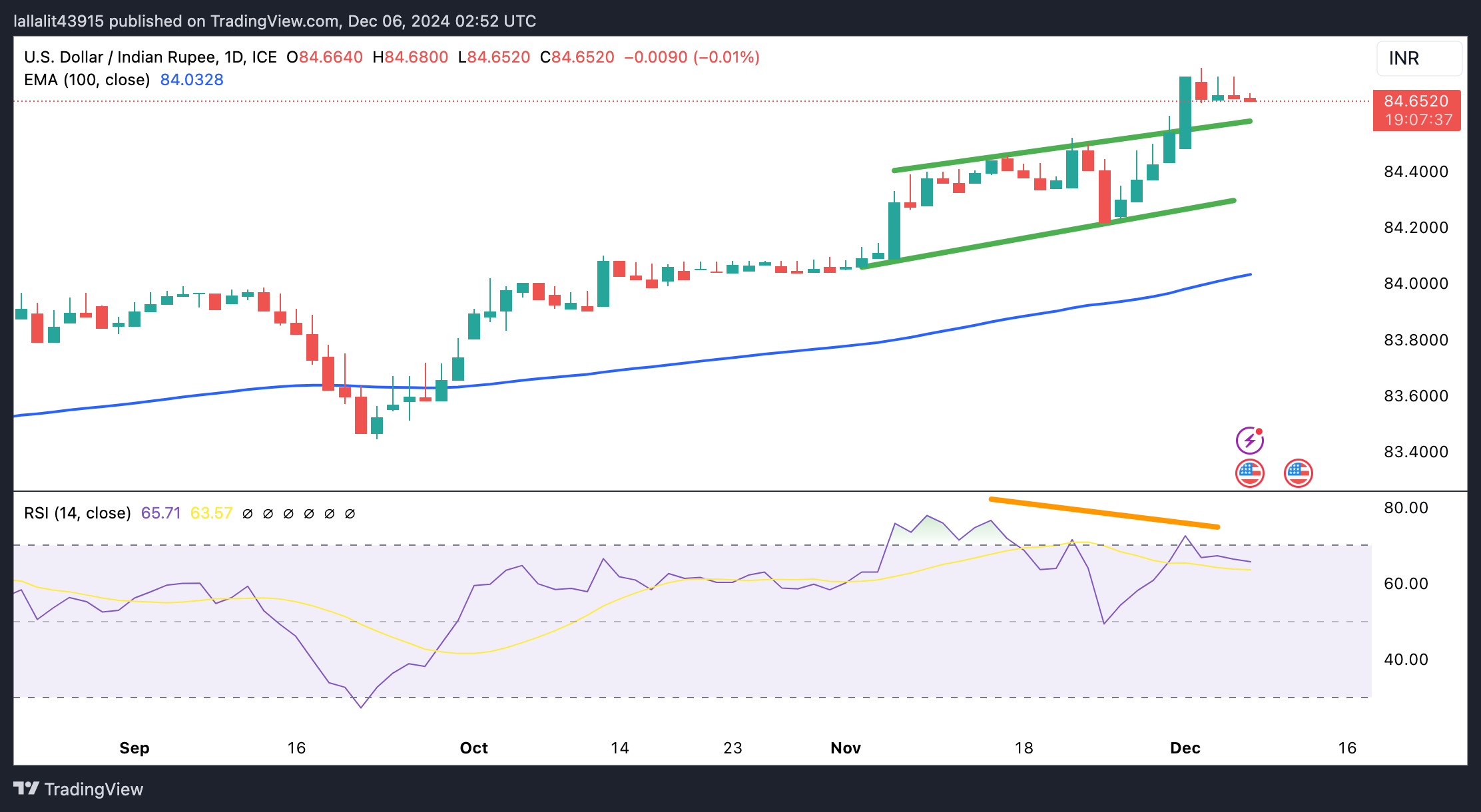
USD/INR’s long-term bias tilts bullish, but Bearish Divergence on RSI might cap its gains
The all-time high of 84.77 appears to be a tough nut to crack for the bulls. A decisive break above this level could still take the pair up to the 85.00 psychological level. Further north, the next hurdle emerges at 85.50.
On the other hand, a breach of the resistance-turned-support of 84.60 could see a drop to 84.22, the low of November 25. The key support level to watch is the 84.05-84.00 region, representing the 100-day EMA and psychological mark.
Indian economy FAQs
The Indian economy has averaged a growth rate of 6.13% between 2006 and 2023, which makes it one of the fastest growing in the world. India’s high growth has attracted a lot of foreign investment. This includes Foreign Direct Investment (FDI) into physical projects and Foreign Indirect Investment (FII) by foreign funds into Indian financial markets. The greater the level of investment, the higher the demand for the Rupee (INR). Fluctuations in Dollar-demand from Indian importers also impact INR.
India has to import a great deal of its Oil and gasoline so the price of Oil can have a direct impact on the Rupee. Oil is mostly traded in US Dollars (USD) on international markets so if the price of Oil rises, aggregate demand for USD increases and Indian importers have to sell more Rupees to meet that demand, which is depreciative for the Rupee.
Inflation has a complex effect on the Rupee. Ultimately it indicates an increase in money supply which reduces the Rupee’s overall value. Yet if it rises above the Reserve Bank of India’s (RBI) 4% target, the RBI will raise interest rates to bring it down by reducing credit. Higher interest rates, especially real rates (the difference between interest rates and inflation) strengthen the Rupee. They make India a more profitable place for international investors to park their money. A fall in inflation can be supportive of the Rupee. At the same time lower interest rates can have a depreciatory effect on the Rupee.
India has run a trade deficit for most of its recent history, indicating its imports outweigh its exports. Since the majority of international trade takes place in US Dollars, there are times – due to seasonal demand or order glut – where the high volume of imports leads to significant US Dollar- demand. During these periods the Rupee can weaken as it is heavily sold to meet the demand for Dollars. When markets experience increased volatility, the demand for US Dollars can also shoot up with a similarly negative effect on the Rupee.
Author

Lallalit Srijandorn
FXStreet
Lallalit Srijandorn is a Parisian at heart. She has lived in France since 2019 and now becomes a digital entrepreneur based in Paris and Bangkok.