USD/INR dips on Iran-Israel ceasefire relief and softer Oil prices
- The Indian Rupee gains for a second day, supported by softer crude Oil prices and a weaker US Dollar.
- US President Donald Trump announces a “complete and total" ceasefire between Iran and Israel, calming global energy markets.
- S&P Global Ratings raises India’s FY2025 growth forecast to 6.5% and sees moderate inflation ahead.

The USD/INR pair falls on Tuesday for a third consecutive day, as a pullback in global Crude Oil prices and a weaker Greenback improved the outlook for India’s trade balance. Sentiment improved after US President Donald Trump announced on social media that Iran and Israel have agreed to a ceasefire, easing the tensions that had kept energy markets on edge in the past days.
At the time of writing, USD/INR holds firm above 86.00 during the American trading hours, down around 0.50% on the day as the Rupee extends its modest winning streak.
Meanwhile, the US Dollar Index (DXY) remains under pressure, drifting lower toward 97.95 — close to its lowest level in nearly three years — as easing geopolitical tensions cap demand for the Greenback.
Global markets welcomed the ceasefire news, taking some pressure off safe-haven assets and energy prices. US President Donald Trump termed it a “complete and total" ceasefire via Truth Social, stating that Iran would halt hostilities first, with Israel to join 12 hours later — a framework he said was brokered through Qatar with input from senior US officials, including VP Vance and Secretary Rubio.
Israeli Prime Minister Netanyahu backed the plan, stating his government had “achieved military goals” and would honor the US-brokered pause.
Iran’s Foreign Minister Abbas Araghchi at first rejected talk of a formal agreement but later hinted at de-escalation, praising Iran’s armed forces for “fighting until the very last minute” and state media reporting that the truce had begun.
Despite Israel reaffirming its commitment to the truce, some officials quickly accused Iran of breaching the terms — accusations Tehran has firmly denied. While this de-escalation has tempered geopolitical risk premiums, markets remain watchful for any renewed flare-up that could quickly revive volatility in Oil and currency markets.
Market Movers: Rupee rebounds as equities firm
- The Indian Rupee, which had been under pressure since the Iran–Israel conflict erupted — slipping to a three-month low — is now staging a solid recovery. Several global and domestic factors, including easing geopolitical tensions, subdued Oil prices, and a softer US Dollar, have driven the sharp rebound.
- India’s equity benchmarks surged as investor optimism rose, driven by improved risk sentiment and lower Oil prices. The BSE Sensex jumped nearly 1% intraday, briefly adding over 1,100 points before trimming gains to close about 158 points higher at 82,744. Similarly, the NSE Nifty climbed above the 25,200 mark during the session and settled modestly higher above 25,000. Hopes for a lasting ceasefire in the Middle East and a softer Greenback supported buying across most sectors, although energy shares lagged due to weaker crude Oil prices.
- Foreign institutional investors (FIIs) offloaded shares worth Rs 5,266.01 crore on Tuesday, according to exchange data.
- Following Monday’s sharp sell-off, Oil prices extended losses early on Tuesday, with Brent briefly slipping below the $70 mark for the first time in weeks as optimism over an Iran-Israel ceasefire trimmed the geopolitical risk premium. However, prices later pared some of the intraday decline — at the time of writing, Brent is trading near $68.66 per barrel, while WTI holds around $66.50. The softer energy market continues to ease cost pressures for Oil-importing countries like India, offering support to the Rupee and broader risk sentiment, though traders remain cautious about the fragile nature of the truce.
- India’s foreign exchange reserves rose by $2.29 billion to $698.95 billion as of June 13, according to RBI data. MPC member Ram Singh said this healthy buffer should help cushion inflation risks from higher crude and fertilizer costs, though he cautioned that the Rupee may face pressure from recent $5 billion bond outflows and lingering geopolitical uncertainties.
- Reserve Bank of India (RBI) Governor Sanjay Malhotra reiterated that the RBI will continue to monitor the evolving liquidity and financial market conditions and proactively take further measures, as warranted. Reflecting this stance, the RBI has announced a 7-day Variable Rate Reverse Repo (VRRR) auction on June 27 to absorb surplus funds, with banking system liquidity standing at ₹2.43 lakh crore as of June 23.
- S&P Global Ratings raised India’s GDP growth projection for the current fiscal year to 6.5%, up from its previous estimate of 6.3%, citing supportive factors such as falling crude Oil prices, the prospect of monetary easing, and expectations of a normal monsoon season. The agency also noted that while geopolitical tensions persist, they are unlikely to create “significant pressure” on the Rupee or stoke inflation risks, offering an encouraging backdrop for the currency and the broader economy.
- S&P economist Vishrut Rana told PTI that energy costs remain lower than last year — Brent crude averaged around $85 a barrel a year ago, compared to current levels. “This will help contain both current account outflows and domestic energy price pressures — while energy prices may rise moderately, the path of food prices will have a higher impact on inflation. Overall, we do not expect significant pressure on the Indian rupee or inflation,” Rana added.
- S&P’s upgraded FY2026 growth estimate for India aligns with the Reserve Bank of India’s projection, pegging GDP expansion at 6.5%. Alongside stronger growth, S&P forecasts that India’s inflation will moderate to an average of 4% in 2025, easing from 4.6% in 2024.
- According to a new report by wealth management firm Equirus, India is set to outpace G7 economies in growth. India’s contribution to global GDP growth now far exceeds that of Japan (under 1%) and Germany (just over 1.3%). “India is no longer the world’s fastest-growing economy just on paper — it is structurally better positioned than most G7 nations. That’s a seismic shift,” said Mitesh Shah, CEO of Equirus Credence Family Office.
- Federal Reserve Chair Jerome Powell’s testimony on Tuesday reinforced a cautious yet flexible tone on US monetary policy. He reiterated that the Fed needs “more confidence that inflation is moving sustainably toward 2%” before cutting rates, but acknowledged that “many paths are possible,” leaving the door open for a potential move as early as July if conditions warrant. Powell explained, “We could see inflation come in not as strong as we expect. If that were the case, that would tend to suggest cutting sooner. We could see the labor market weaken and that would also suggest cutting sooner. On the other hand, if we see inflation coming in higher or if the labor market were to remain strong, then we would probably be moving later.”,
- Futures market pricing indicates only a 23% probability of a cut at the July 29-30 meeting, with a much higher probability of the next reduction coming in September, according to the CME Group’s FedWatch gauge.
Technical analysis: USD/INR softens after triangle breakout, EMA support in focus
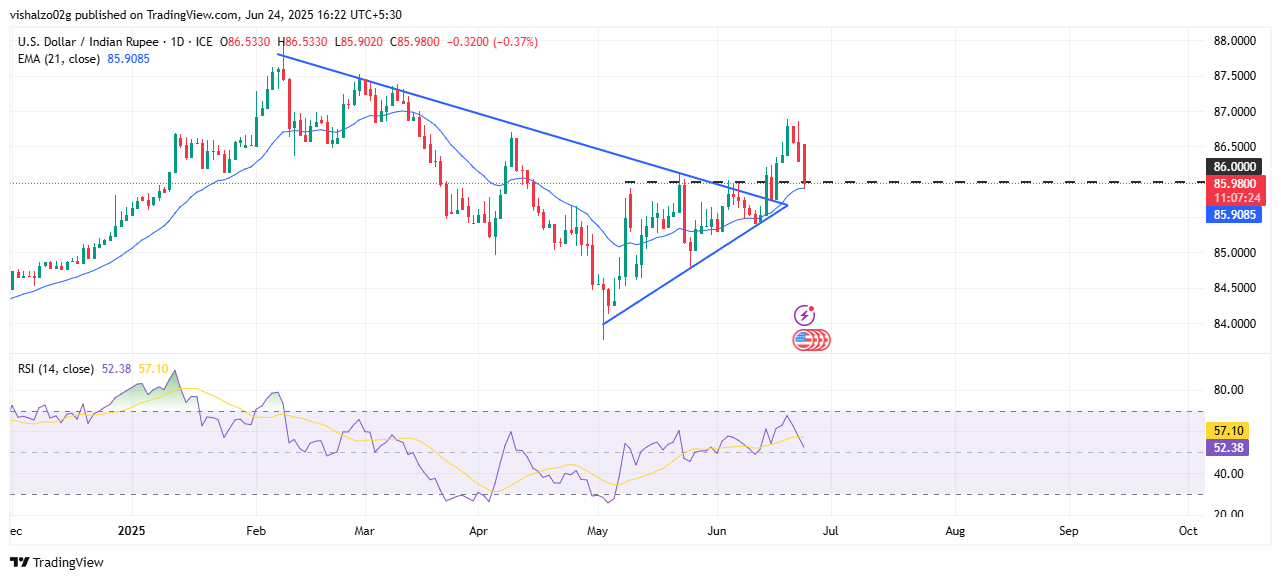
From a technical perspective, USD/INR broke out of a months-long triangle pattern earlier in June, confirming an upside bias.
The pair surged past the descending trendline resistance but quickly ran into selling pressure near 86.80–87.00. This zone has capped further gains, resulting in a modest pullback over the past three days.
The pair is now hovering just above its 21-day Exponential Moving Average (EMA), which serves as immediate support at around 85.90. Holding this level could help bulls regroup for another attempt at the recent high near 86.50, while a break below might expose the next support around 85.50 and the triangle’s upper trendline retest.
Momentum signals are showing early signs of fatigue, indicating potentially choppy price action in the near term.
The daily Relative Strength Index (RSI), which recently peaked above 67, has slipped back toward the neutral 50 zone, suggesting that the bullish momentum is losing steam but not yet fully reversing.
If buyers defend the EMA support, the pair could maintain a mild upward bias. However, a sustained drop below the 85.90–85.70 area might encourage further profit-taking, dragging USD/INR back inside the prior consolidation range.
Author

Vishal Chaturvedi
FXStreet
I am a macro-focused research analyst with over four years of experience covering forex and commodities market. I enjoy breaking down complex economic trends and turning them into clear, actionable insights that help traders stay ahead of the curve.

















