US Dollar slides as Israel-Iran ceasefire overshadows hawkish Powell’s tone
- Federal Reserve Chair Jerome Powell testified before Congress, emphasizing the Fed's data-dependent approach.
- Israel-Iran ceasefire reduces demand for safe-haven assets, contributing to a weaker US Dollar.
- The US Dollar Index drops below 98.00 as easing Middle East tensions overshadow Powell’s hawkish comments.
The US Dollar Index (DXY) is trading lower on Tuesday following news of a ceasefire agreement between Israel and Iran, which has alleviated demand for the US Dollar (USD). At the time of writing, the DXY is trading near 97.65, just above the June low of 97.61.
The Federal Reserve (Fed) Chair Jerome Powell delivered hawkish remarks at his testimony to Congress, stating that the Fed “is not in a hurry to cut rates”.
Although he reaffirmed his data-dependent stance, reducing expectations of a July rate cut, markets remained focused on easing geopolitical tensions.
Market attention quickly shifted toward the ceasefire between Israel and Iran, which spurred a risk-on sentiment and overshadowed concerns about monetary policy.
Israel-Iran ceasefire overshadows hawkish Fed Powell
After an initial attempt to retest the 100.00 level on Monday, the US Dollar Index, which tracks the USD against six other currencies, reversed course as a combination of mixed interest rate signals and geopolitical relief shifted the tone.
US President Donald Trump’s announcement of a ceasefire between Israel and Iran spurred optimism on Monday evening, but both sides launched limited retaliatory strikes in the hours that followed.
Despite this, markets interpreted the situation as broadly contained, and safe-haven flows began to unwind. On Tuesday, the ceasefire was confirmed, placing further pressure on the US Dollar Index.
The shift in focus toward risk assets has reduced short-term demand for the Greenback, at least while geopolitical stability holds.
US Dollar Index falls below 98.00
The US Dollar Index is trading below the 98.00 psychological threshold, with immediate resistance now formed at that level.
A sustained move below 97.60 would expose the Index to further losses toward the next psychological level of 97.00, a level that has not been tested since February 2022.
Dollar Index daily chart
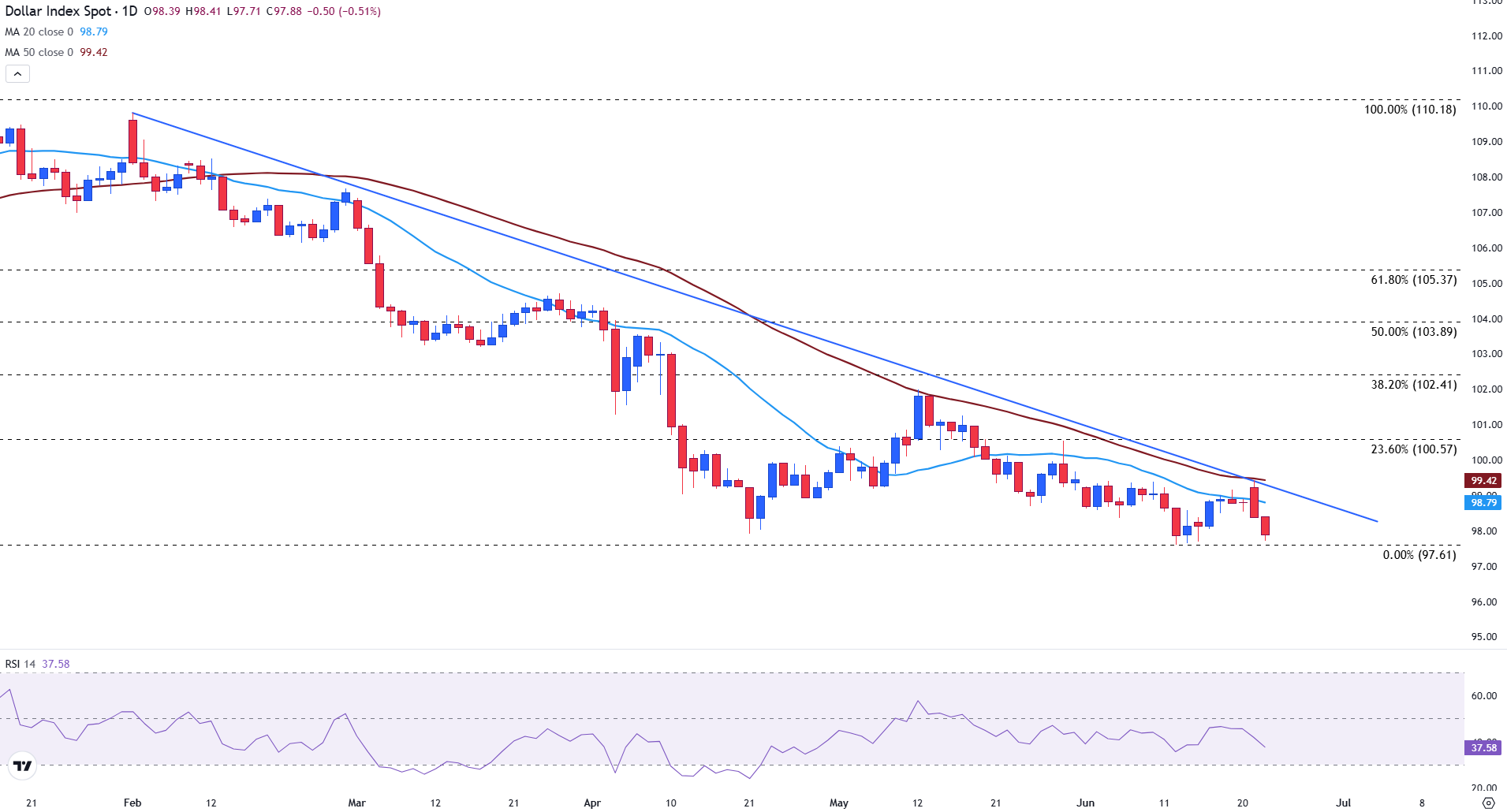
The Relative Strength Index (RSI) is nearing oversold territory, currently reading near 38.0, suggesting that short-term momentum may be stretched. On the upside, any recovery would need to clear 98.00 and 98.40 to shift the short-term bias back to neutral.
US Dollar FAQs
The US Dollar (USD) is the official currency of the United States of America, and the ‘de facto’ currency of a significant number of other countries where it is found in circulation alongside local notes. It is the most heavily traded currency in the world, accounting for over 88% of all global foreign exchange turnover, or an average of $6.6 trillion in transactions per day, according to data from 2022. Following the second world war, the USD took over from the British Pound as the world’s reserve currency. For most of its history, the US Dollar was backed by Gold, until the Bretton Woods Agreement in 1971 when the Gold Standard went away.
The most important single factor impacting on the value of the US Dollar is monetary policy, which is shaped by the Federal Reserve (Fed). The Fed has two mandates: to achieve price stability (control inflation) and foster full employment. Its primary tool to achieve these two goals is by adjusting interest rates. When prices are rising too quickly and inflation is above the Fed’s 2% target, the Fed will raise rates, which helps the USD value. When inflation falls below 2% or the Unemployment Rate is too high, the Fed may lower interest rates, which weighs on the Greenback.
In extreme situations, the Federal Reserve can also print more Dollars and enact quantitative easing (QE). QE is the process by which the Fed substantially increases the flow of credit in a stuck financial system. It is a non-standard policy measure used when credit has dried up because banks will not lend to each other (out of the fear of counterparty default). It is a last resort when simply lowering interest rates is unlikely to achieve the necessary result. It was the Fed’s weapon of choice to combat the credit crunch that occurred during the Great Financial Crisis in 2008. It involves the Fed printing more Dollars and using them to buy US government bonds predominantly from financial institutions. QE usually leads to a weaker US Dollar.
Quantitative tightening (QT) is the reverse process whereby the Federal Reserve stops buying bonds from financial institutions and does not reinvest the principal from the bonds it holds maturing in new purchases. It is usually positive for the US Dollar.
Author

Tammy Da Costa, CFTe®
FXStreet
Tammy is an economist and market analyst with a deep passion for financial markets, particularly commodities and geopolitics.