GBP/JPY Price Forecast: Resistance at 211.60 area keeps holding Pound
- The Pound is ticking higher, but remains capped below 211.60 resistance.
- The Yen struggles amid a mild risk appetite and thin trading volumes.
- UK Manufacturing PMI is expected to confirm that business activity accelerated in December.

The Sterling has opened the year in a mild bullish trend against the Japanese Yen, despite the overall New Year’s market lull, but remains capped below the top of the last two weeks’ range, at the 211.50 area.
The Yen is on its back foot on Friday amid a moderate market sentiment, with trading volumes at low levels as markets in China and Japan remain closed for the New Year festivities.
In the UK, the final S&P Manufacturing PMI release is expected to confirm that the sector’s activity accelerated to 51.2 in December from 50.2 in November. The release, however, will have a limited impact on the Pound, unless there is a significant revision of the preliminary estimations.
Technical analysis: Intraday charts show a bearish divergence
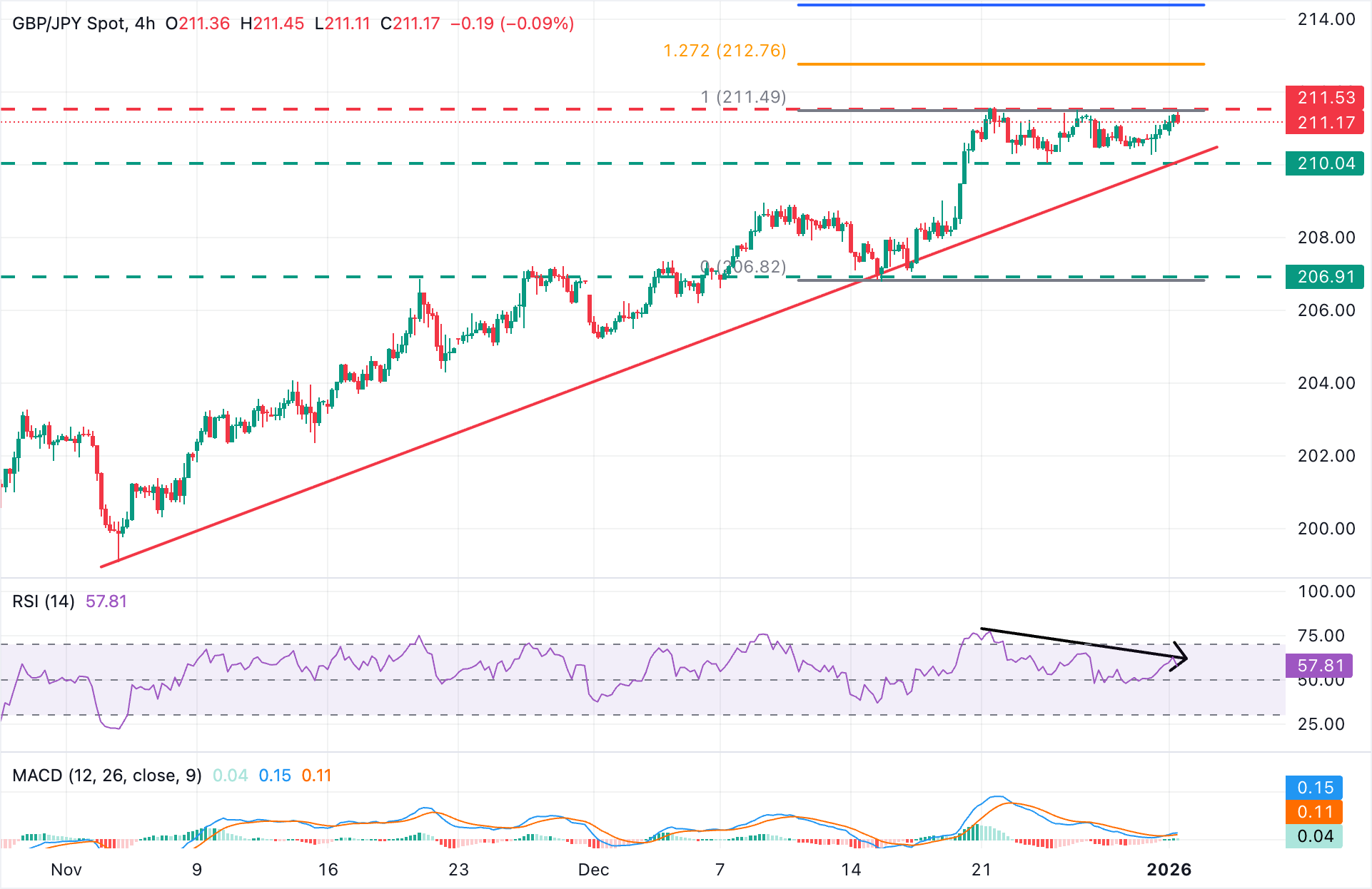
The GBP/JPY trades at 211.17, after an unsuccessful attempt to break the 211.50 area earlier on the day. The Relative Strength Index (RSI) stands at 57.50, highlighting a modestly bullish tone, añthough a bearish divergence with price action suggests the pòsibility of a bearish reversal.
Immediate support remains at the area between the trendline resistance, around 210.15, and the December 24 low, at 210.05A clear break of these levels is likely to increase pressure towards the mid-December lows, around 208.90.
Bulls, on the contrary, need to break long-term highs, at 211.59 (December 22 high). Above here, the 127.2% Fibonacci extension of the December 15-22 rally, at 212.75, and the 161.8% extension of the same cycle, at 214.38, emerge as the next potential targets.
(The technical analysis of this story was written with the help of an AI tool)
Japanese Yen Price Today
The table below shows the percentage change of Japanese Yen (JPY) against listed major currencies today. Japanese Yen was the strongest against the US Dollar.
| USD | EUR | GBP | JPY | CAD | AUD | NZD | CHF | |
|---|---|---|---|---|---|---|---|---|
| USD | -0.01% | 0.04% | 0.00% | -0.17% | -0.35% | -0.20% | -0.02% | |
| EUR | 0.01% | -0.09% | 0.04% | -0.16% | -0.40% | -0.19% | -0.00% | |
| GBP | -0.04% | 0.09% | 0.11% | -0.10% | -0.32% | -0.10% | 0.09% | |
| JPY | 0.00% | -0.04% | -0.11% | -0.17% | -0.48% | -0.27% | -0.01% | |
| CAD | 0.17% | 0.16% | 0.10% | 0.17% | -0.22% | -0.06% | 0.16% | |
| AUD | 0.35% | 0.40% | 0.32% | 0.48% | 0.22% | 0.21% | 0.40% | |
| NZD | 0.20% | 0.19% | 0.10% | 0.27% | 0.06% | -0.21% | 0.19% | |
| CHF | 0.02% | 0.00% | -0.09% | 0.01% | -0.16% | -0.40% | -0.19% |
The heat map shows percentage changes of major currencies against each other. The base currency is picked from the left column, while the quote currency is picked from the top row. For example, if you pick the Japanese Yen from the left column and move along the horizontal line to the US Dollar, the percentage change displayed in the box will represent JPY (base)/USD (quote).
Author

Guillermo Alcala
FXStreet
Graduated in Communication Sciences at the Universidad del Pais Vasco and Universiteit van Amsterdam, Guillermo has been working as financial news editor and copywriter in diverse Forex-related firms, like FXStreet and Kantox.














