USD/INR recovers possible RBI's intervention-driven early losses
- The Indian Rupee gives back early gains against the US Dollar, which came due to the RBI's intervention.
- FIIs start the November series by paring stake in the Indian stock market.
- Fed members express that the December policy is widely open.

The Indian Rupee (INR) surrenders almost all of its gains against the US Dollar (USD) during closing trading hours in India on Tuesday. The USD/INR pair claws back its early losses and is marginally down near 88.80. Earlier in the day, the Indian Rupee strengthened as the Reserve Bank of India (RBI) had intervened in the currency market to support the Indian Rupee, a report from Reuters showed.
A stealth intervention by the RBI in the local spot market came amid fears that the USD/INR pair could pass its recent all-time high around 89.10, a scenario that could build pressure on importers.
The Indian Rupee has been underperforming due to the continuous outflow of foreign funds from the Indian stock market. Foreign Institutional Investors (FIIs) have turned out to be net sellers in the last four months; however, the pace of selling has slowed down in October. The amount of stake pared by the FIIs in October came in at Rs. 2,346.89 crores, significantly lower than the average selling of Rs. 43,290.32 crores seen in the July-September period.
Meanwhile, foreign investors have also started the November series with net selling in the Indian equity market. On Monday, FIIs sold shares worth Rs. 1,883.78 crores.
Daily digest market movers: Receding Fed dovish bets strengthen US Dollar
- The US Dollar outperforms its peers as traders pare bets supporting more interest rate cuts by the Federal Reserve (Fed) this year.
- In Tuesday’s Asian session, the US Dollar Index (DXY), which tracks the Greenback’s value against six major currencies, posts a fresh three-month high near 100.00.
- According to the CME FedWatch tool, the probability of the Fed cutting interest rates by 25 basis points (bps) to 3.50%-3.75% in the December meeting has eased to 67.3% from 94.4% seen a week ago.
- Fed dovish bets started easing after Chairman Jerome Powell commented in the press conference last week that the December rate cut is “far from a foregone conclusion” as officials had “strongly different views” in the monetary policy meeting.
- Meanwhile, San Francisco Fed Bank President Mary Daly and Fed Governor Lisa Cook have expressed that the December policy will be more data-dependent. Cook stated in her prepared remarks at the Brookings Institution that “risks to both sides of the dual mandate, employment and inflation, are elevated”. Cook explained that the Fed is at a position where keeping rates too high increases the likelihood that the “labor market will deteriorate sharply”, while lowering rates too much would increase the likelihood that “inflation expectations will become unanchored”.
- Going forward, investors will focus on the ADP Employment Change data for October to get fresh cues on the current labor market status. The significance of the private employment data would be high as the Nonfarm Payrolls (NFP) data is unlikely to be released again due to the ongoing federal shutdown. The ADP report is expected to show that the private sector added 24K fresh workers against laying off 32K employees in September.
Technical Analysis: USD/INR recovers from 20-day EMA
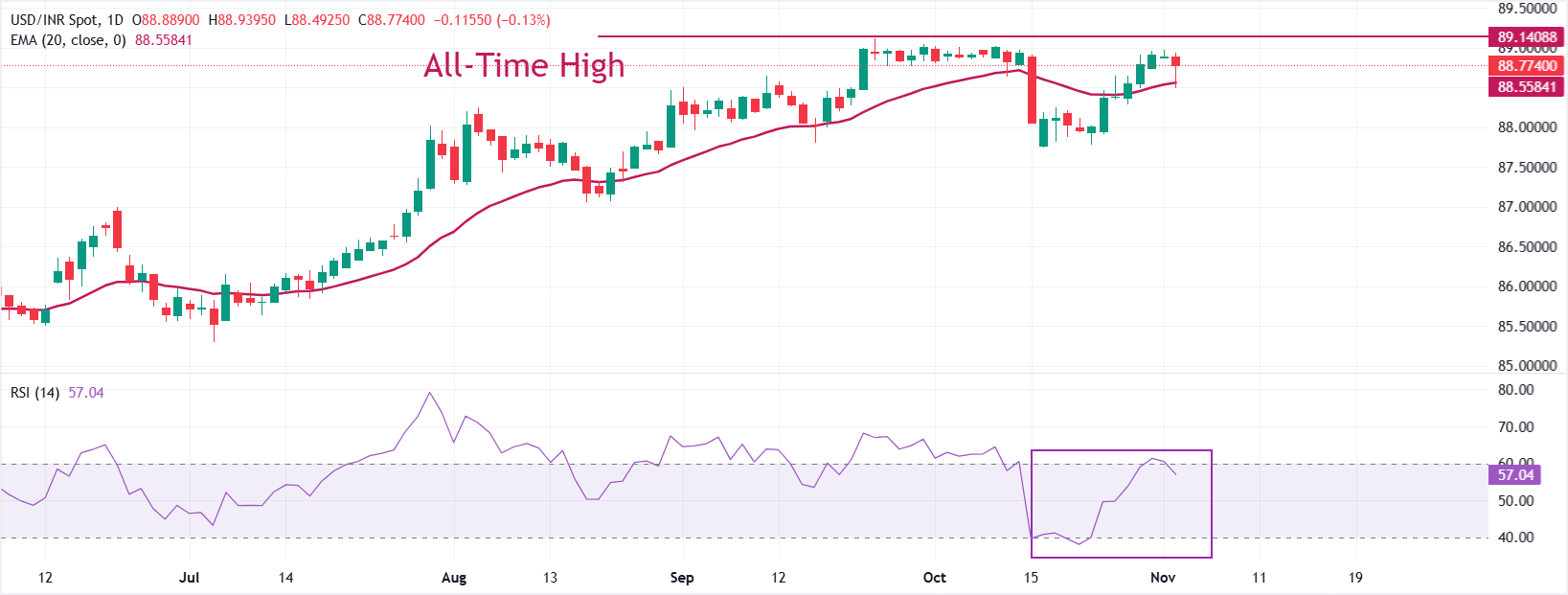
USD/INR recovers its early losses and rebounds to near 88.80 in the second half of Indian trading hours on Tuesday. The pair bounces back after attracting bids near the 20-day Exponential Moving Average (EMA), which trades around 88.54.
The 14-day Relative Strength Index (RSI) falls after failing to break above 60.00, suggesting selling pressure at higher levels.
Looking down, the August 21 low of 87.07 will act as key support for the pair. On the upside, the all-time high of 89.12 will be a key barrier.
Fed FAQs
Monetary policy in the US is shaped by the Federal Reserve (Fed). The Fed has two mandates: to achieve price stability and foster full employment. Its primary tool to achieve these goals is by adjusting interest rates. When prices are rising too quickly and inflation is above the Fed’s 2% target, it raises interest rates, increasing borrowing costs throughout the economy. This results in a stronger US Dollar (USD) as it makes the US a more attractive place for international investors to park their money. When inflation falls below 2% or the Unemployment Rate is too high, the Fed may lower interest rates to encourage borrowing, which weighs on the Greenback.
The Federal Reserve (Fed) holds eight policy meetings a year, where the Federal Open Market Committee (FOMC) assesses economic conditions and makes monetary policy decisions. The FOMC is attended by twelve Fed officials – the seven members of the Board of Governors, the president of the Federal Reserve Bank of New York, and four of the remaining eleven regional Reserve Bank presidents, who serve one-year terms on a rotating basis.
In extreme situations, the Federal Reserve may resort to a policy named Quantitative Easing (QE). QE is the process by which the Fed substantially increases the flow of credit in a stuck financial system. It is a non-standard policy measure used during crises or when inflation is extremely low. It was the Fed’s weapon of choice during the Great Financial Crisis in 2008. It involves the Fed printing more Dollars and using them to buy high grade bonds from financial institutions. QE usually weakens the US Dollar.
Quantitative tightening (QT) is the reverse process of QE, whereby the Federal Reserve stops buying bonds from financial institutions and does not reinvest the principal from the bonds it holds maturing, to purchase new bonds. It is usually positive for the value of the US Dollar.
Author

Sagar Dua
FXStreet
Sagar Dua is associated with the financial markets from his college days. Along with pursuing post-graduation in Commerce in 2014, he started his markets training with chart analysis.