|

USD/IDR Technical Analysis: Sellers look for entry below monthly trendline, 50-DMA

  • USD/IDR registers the third day of declines.
  • Mid-November lows will be on bear’s radar during further declines.
  • Buyers will wait unless clearing 50% Fibonacci retracement of August-September fall.

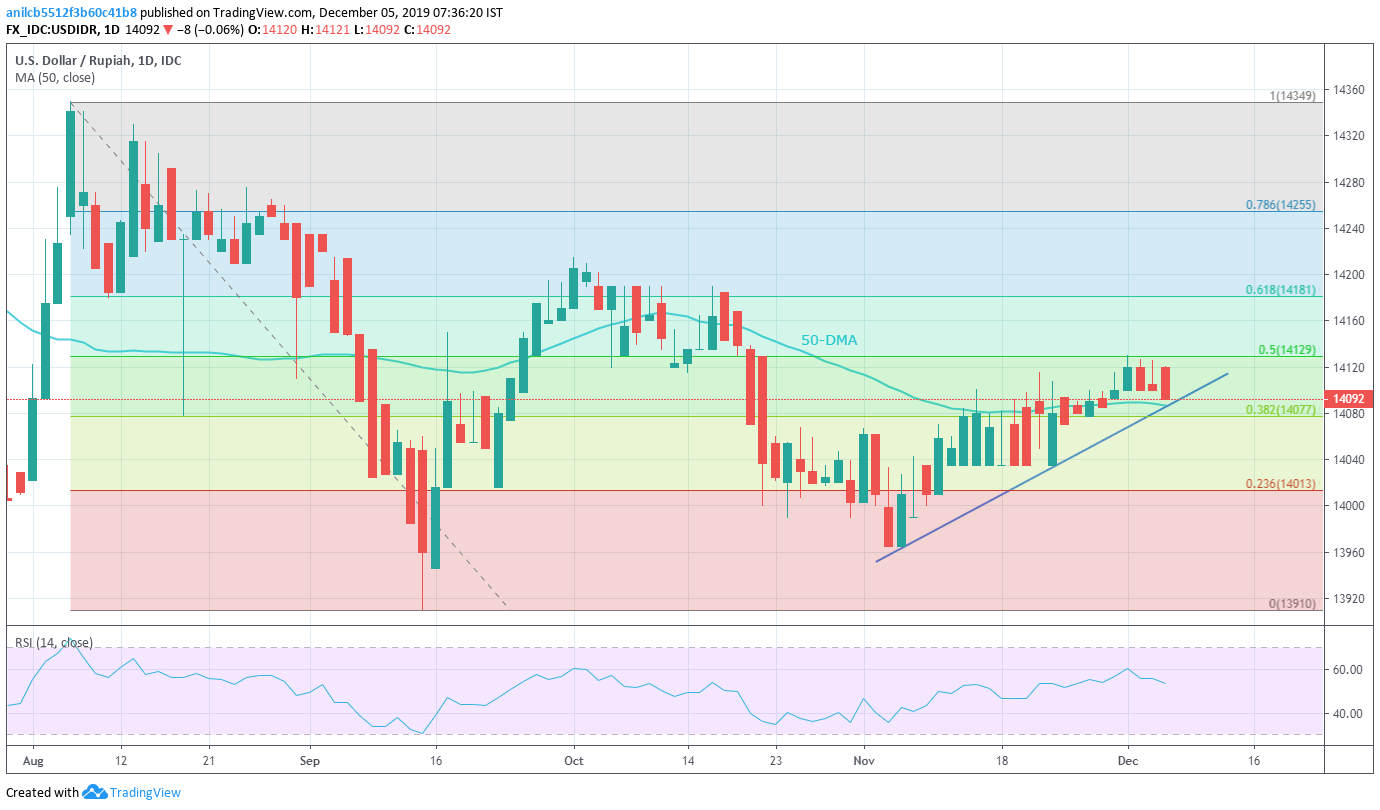
USD/IDR drops to 14,090 by the press time of early Thursday in Asia. The pair is on the third day of losing streak but stays above near-term key support confluence.

Unless providing a clear break below 14,087/85 area including a month-long rising support line and 50-Day Simple Moving Average (DMA), prices can keep the monthly upward trajectory that leads to 50% Fibonacci retracement level of 14,130.

It’s worth mentioning that 61.8% Fibonacci retracement near 14,180 and October top close to 14,215 will be the Bull’s favorite during pair’s rise past-14,130.

On the contrary, a daily closing below 14,085 could drag prices to multiple lows marked in mid-November around 14,030 ahead of shifting focus to 14,000 round-figure.

Further, the November month low near 13,965 and September bottom close to 13,910 could lure bears afterward.

USD/IDR daily chart
Trend: Pullback expected

additional imortant levels

Overview
Today last price14094.3
Today Daily Change-0.7000
Today Daily Change %-0.00%
Today daily open14095
 
Trends
Daily SMA2014088.8056
Daily SMA5014100.8462
Daily SMA10014119.5951
Daily SMA20014167.3586
 
Levels
Previous Daily High14162
Previous Daily Low14090.5
Previous Weekly High14296.292
Previous Weekly Low13896.3
Previous Monthly High14296.292
Previous Monthly Low13896.3
Daily Fibonacci 38.2%14117.813
Daily Fibonacci 61.8%14134.687
Daily Pivot Point S114069.6667
Daily Pivot Point S214044.3333
Daily Pivot Point S313998.1667
Daily Pivot Point R114141.1667
Daily Pivot Point R214187.3333
Daily Pivot Point R314212.6667

Author

Anil Panchal

Anil Panchal

FXStreet

Anil Panchal has nearly 15 years of experience in tracking financial markets. With a keen interest in macroeconomics, Anil aptly tracks global news/updates and stays well-informed about the global financial moves and their implications.


More from Anil Panchal
Share:

Editor's Picks

GBP/USD weakens below 1.3250 as UK Prime Minister Keir Starmer resigns

The GBP/USD pair loses ground to near 1.3245 during the early Asian trading hours on Tuesday. Political uncertainty in the United Kingdom continues to weigh on the British Pound against the US Dollar. The preliminary readings of the S&P Global Purchasing Managers Index from both the US and the UK are due later on Tuesday. 


EUR/USD moves little amid market caution on ongoing US-Iran talks

EUR/USD steadies after registering modest losses in the previous day, trading around 1.1430 during the Asian hours on Tuesday. The currency pair remains locked in a tight range as traders closely monitor diplomatic developments surrounding ongoing talks between Washington and Tehran in Bürgenstock, Switzerland.

Gold defends $4,100, but for how long?

Gold is back in the red early Tuesday, having faced rejection once again at $4,200. The US Dollar holds at yearly highs amid hawkish Fed outlook, scepticism over US-Iran deal progress. Gold is primed to attack $4,100 as the daily technical setup remains in favor of sellers.

Bitcoin holds steady as ETF outflows decline – DEXE and TIA extend gains

Bitcoin hovers above $64,000 at press time on Tuesday, holding steady after a roughly 4% drop last week. Data shows that institutional outflows are easing, suggesting broader market recovery potential, while DeXe and Celestia have emerged as frontrunners over the last 24 hours.

Are American consumers actually “resilient“?
A common label gets placed upon American buyers: resilient. Just last week, Marianne Lake, the CEO of Consumer and Community Banking — and a member of the JPMorganChase Operating Committee — affirmed this sentiment. While she did note some weariness regarding future inflation’s effect on consumers, she reiterated the common adjective: resilient.
Regime change: Inside Kevin Warsh's first move to make the Fed unreadable on purpose

The rate did not move. That was the least interesting thing about Kevin Warsh's first meeting in charge of the Fed. The FOMC held its benchmark at 3.50%-3.75% for the fourth straight meeting, exactly as priced, and then the new chair used his first press conference to dismantle the machinery the market has leaned on for a decade.