USD/CHF struggles to find momentum despite broad Dollar weakness
- USD/CHF continues to stubbornly hold onto chart region just below 0.8000.
- SNB continues to fight a bitter battle against negative rates, but watchers remain sceptical.
- USD market flows have drawn down sharply with the US government heading into a fiscal shutdown.

USD/CHF continues to trudge its way through familiar technical territory, with price action holding stubbornly just south of the 0.8000 major handle. The Swiss National Bank (SNB) continues to fight back against market expectations of a return to negative interest rates, with Swiss inflation already riding too close to zero to allow the SNB to make sharp policy moves.
The US federal government has hit a slight policy snag after Congress failed to pass an interim budget spending bill that would finance government operations at the start of the federal government’s fiscal year, which begins on October 1 every year. This marks the fourth government shutdown across Donald Trump’s two terms as president. Investors are largely brushing off the operational blackout, as US government shutterings tend to have a limited impact on economic factors.
Swiss Consumer Price Index (CPI) inflation is due on Thursday, and is expected to show headline Swiss inflation ticking up to 0.3% YoY from 0.2%. However, the increase in inflation is still far too low to open the door for an easy policy transition back into negative territory as a growing number of market participants expect from the SNB.
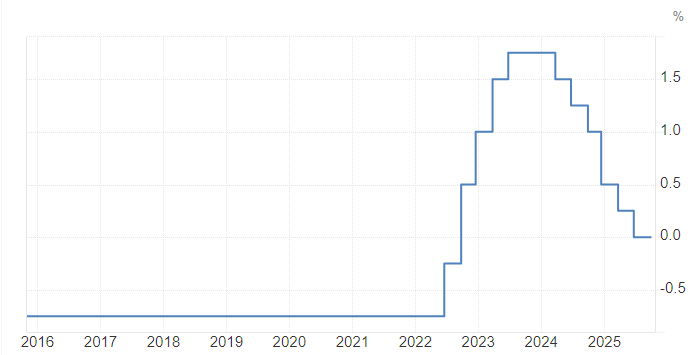
Swiss National Bank Interest Rate, via tradingeconomics.com
This week’s hotly anticipated US Nonfarm Payrolls (NFP) jobs report is at risk of being delayed or suspended. According to the US Bureau of Labor Statistics (BLS), a government shutdown will result in official dataset releases being suspended until federal operations resume.
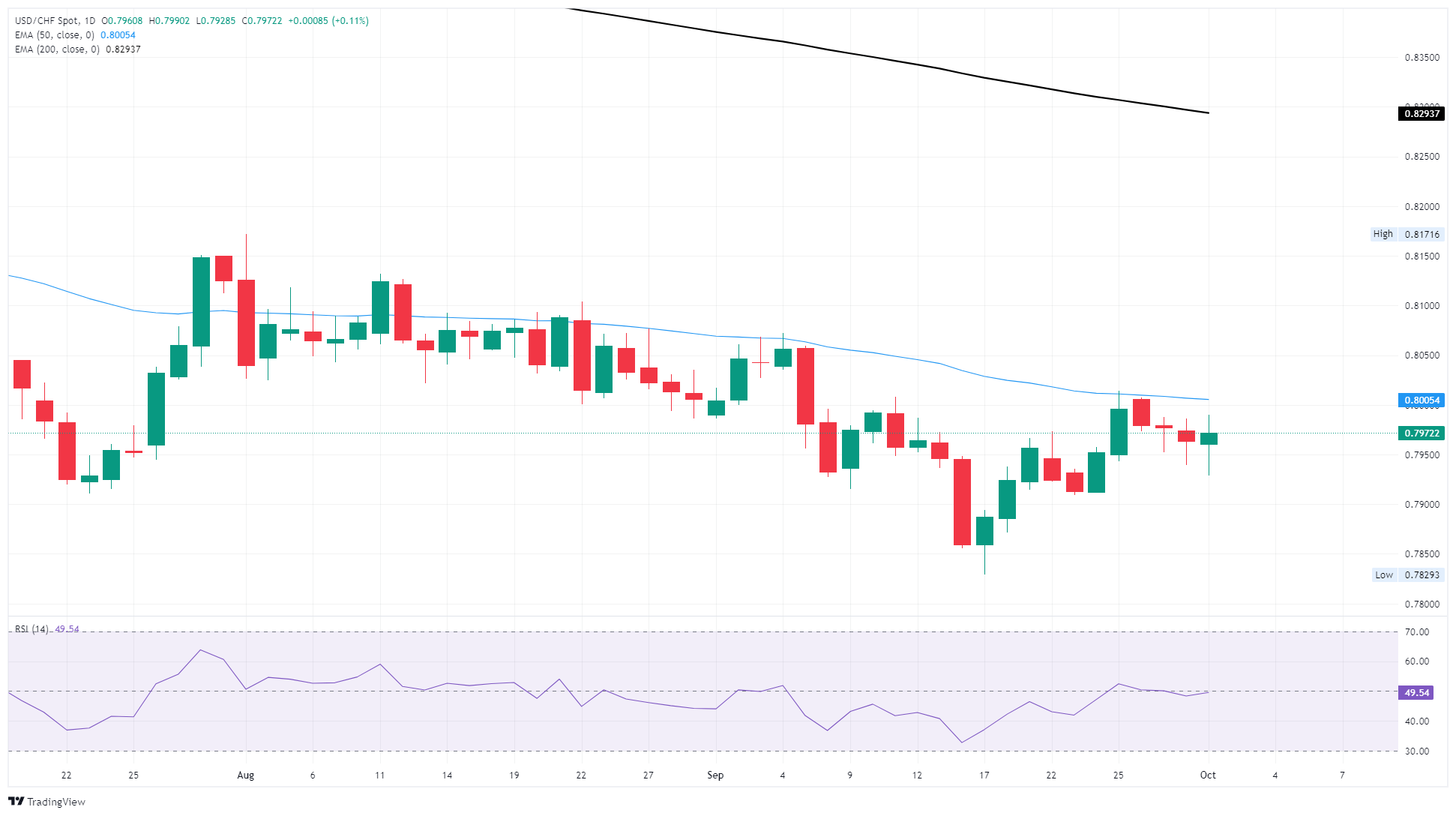
ADP Employment Change figures came in much lower than the street expected, showing a contraction of -32K in September versus the expected 50K. August’s initial print of 54K was also revised sharply lower to -3K. ADP jobs figures suffer from constant revisions, but the figure has generally missed expectations for all but three of the monthly figures published since the start of 2025.
With the NFP print in jeopardy, investors are leaning further on private data such as ADP. According to the CME’s FedWatch Tool, rate trader bets of another quarter-point interest rate cut on October 29 surged to 99% post-ADP on Wednesday. Rate markets are also pricing in nearly 90% odds of a third-straight rate trim on December 10, and a further 93% that the Fed will deliver a fourth interest rate cut by next April at the absolute latest.
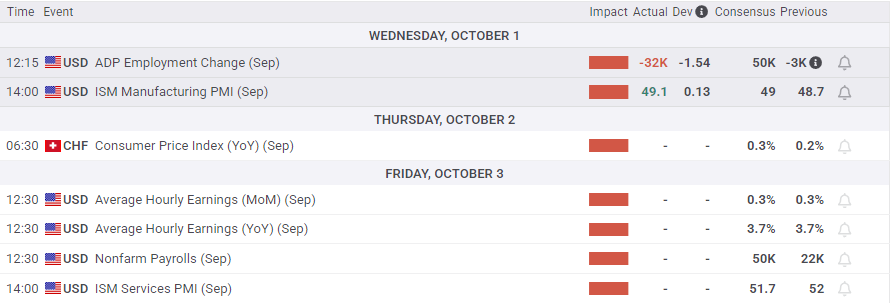
USD/CHF daily chart
Swiss Franc FAQs
The Swiss Franc (CHF) is Switzerland’s official currency. It is among the top ten most traded currencies globally, reaching volumes that well exceed the size of the Swiss economy. Its value is determined by the broad market sentiment, the country’s economic health or action taken by the Swiss National Bank (SNB), among other factors. Between 2011 and 2015, the Swiss Franc was pegged to the Euro (EUR). The peg was abruptly removed, resulting in a more than 20% increase in the Franc’s value, causing a turmoil in markets. Even though the peg isn’t in force anymore, CHF fortunes tend to be highly correlated with the Euro ones due to the high dependency of the Swiss economy on the neighboring Eurozone.
The Swiss Franc (CHF) is considered a safe-haven asset, or a currency that investors tend to buy in times of market stress. This is due to the perceived status of Switzerland in the world: a stable economy, a strong export sector, big central bank reserves or a longstanding political stance towards neutrality in global conflicts make the country’s currency a good choice for investors fleeing from risks. Turbulent times are likely to strengthen CHF value against other currencies that are seen as more risky to invest in.
The Swiss National Bank (SNB) meets four times a year – once every quarter, less than other major central banks – to decide on monetary policy. The bank aims for an annual inflation rate of less than 2%. When inflation is above target or forecasted to be above target in the foreseeable future, the bank will attempt to tame price growth by raising its policy rate. Higher interest rates are generally positive for the Swiss Franc (CHF) as they lead to higher yields, making the country a more attractive place for investors. On the contrary, lower interest rates tend to weaken CHF.
Macroeconomic data releases in Switzerland are key to assessing the state of the economy and can impact the Swiss Franc’s (CHF) valuation. The Swiss economy is broadly stable, but any sudden change in economic growth, inflation, current account or the central bank’s currency reserves have the potential to trigger moves in CHF. Generally, high economic growth, low unemployment and high confidence are good for CHF. Conversely, if economic data points to weakening momentum, CHF is likely to depreciate.
As a small and open economy, Switzerland is heavily dependent on the health of the neighboring Eurozone economies. The broader European Union is Switzerland’s main economic partner and a key political ally, so macroeconomic and monetary policy stability in the Eurozone is essential for Switzerland and, thus, for the Swiss Franc (CHF). With such dependency, some models suggest that the correlation between the fortunes of the Euro (EUR) and the CHF is more than 90%, or close to perfect.
Author

Joshua Gibson
FXStreet
Joshua joins the FXStreet team as an Economics and Finance double major from Vancouver Island University with twelve years' experience as an independent trader focusing on technical analysis.