USD/CHF strengthens as safe-haven flows decrease on upbeat NFP jobs data
- The US Dollar gains against the Swiss franc, with yield differentials supporting US yields.
- Optimistic employment and services PMI data released from the US decrease demand for safe havens, placing pressure on the Swiss franc.
- USD/CHF rebounds toward 0.8000 with the Relative Strength Index attempting to move away from oversold territory.


The Swiss Franc (CHF) is weakening against the US Dollar (USD) as traders digest the latest economic data releases from the two nations.
The Swiss Franc's status as a safe-haven asset, along with the flow of funds into risk assets, has limited its ability to extend gains against the Greenback, pushing USD/CHF toward psychological resistance at 0.8000.
Inflation data released by Switzerland on Thursday showed that the Consumer Price Index (CPI) rose in June. The monthly figure rose by 0.2%, while the annual rate rose to 0.1%, after a 0.1% contraction in May.
With the Swiss National Bank (SNB) lowering its interest rate to 0.00% from 0.25% in June, citing concerns over deflation, this report offers some optimism for Switzerland's economic growth prospects.
However, a big day of economic data releases from the United States ahead of Friday’s US Independence Day holiday dominated sentiment. Thursday’s economic agenda included key employment metrics such as the monthly Nonfarm Payrolls (NFP), weekly Jobless claims numbers, and ISM Services PMI data.
Overall, the combination of these data points alleviated concerns about the health of the US economy and reinforced expectations of a Federal Reserve (Fed) rate cut in September.
With the NFP number showing that 147K jobs were added to the US economy in June, above the 110K estimate, the unemployment rate fell to 4.1%, down from 4.2%. The weekly jobless claims numbers declined to 233K, down from 237K last week.
A strong labour market eases pressure on the Fed to cut rates in July, which helped lift demand for US yields.
The Institute of Supply Management (ISM) Services Purchasing Managers Index (PMI) rose to 50.8, reflecting an increase in economic activity in the service sector in June.
In response to the data, investor appetite for risk has improved. US equity markets continued their positive trajectory, trading near record highs.
USD/CHF rebounds toward 0.8000 as the RSI exits oversold territory
The USD/CHF pair is attempting a modest recovery after reaching a multi-year low of 0.7872 on Tuesday.
Price action has since pushed the pair back above 0.7950, showing signs of stabilization as markets digest stronger-than-expected US employment data. Technically, the pair remains in a broader downtrend. The Relative Strength Index (RSI) remains near oversold territory, reading at 33 after falling to 27 this week. This suggests that bearish momentum may be easing. Immediate resistance lies at the psychological 0.8000 level, followed by the 20-day Simple Moving Average at 0.8092.
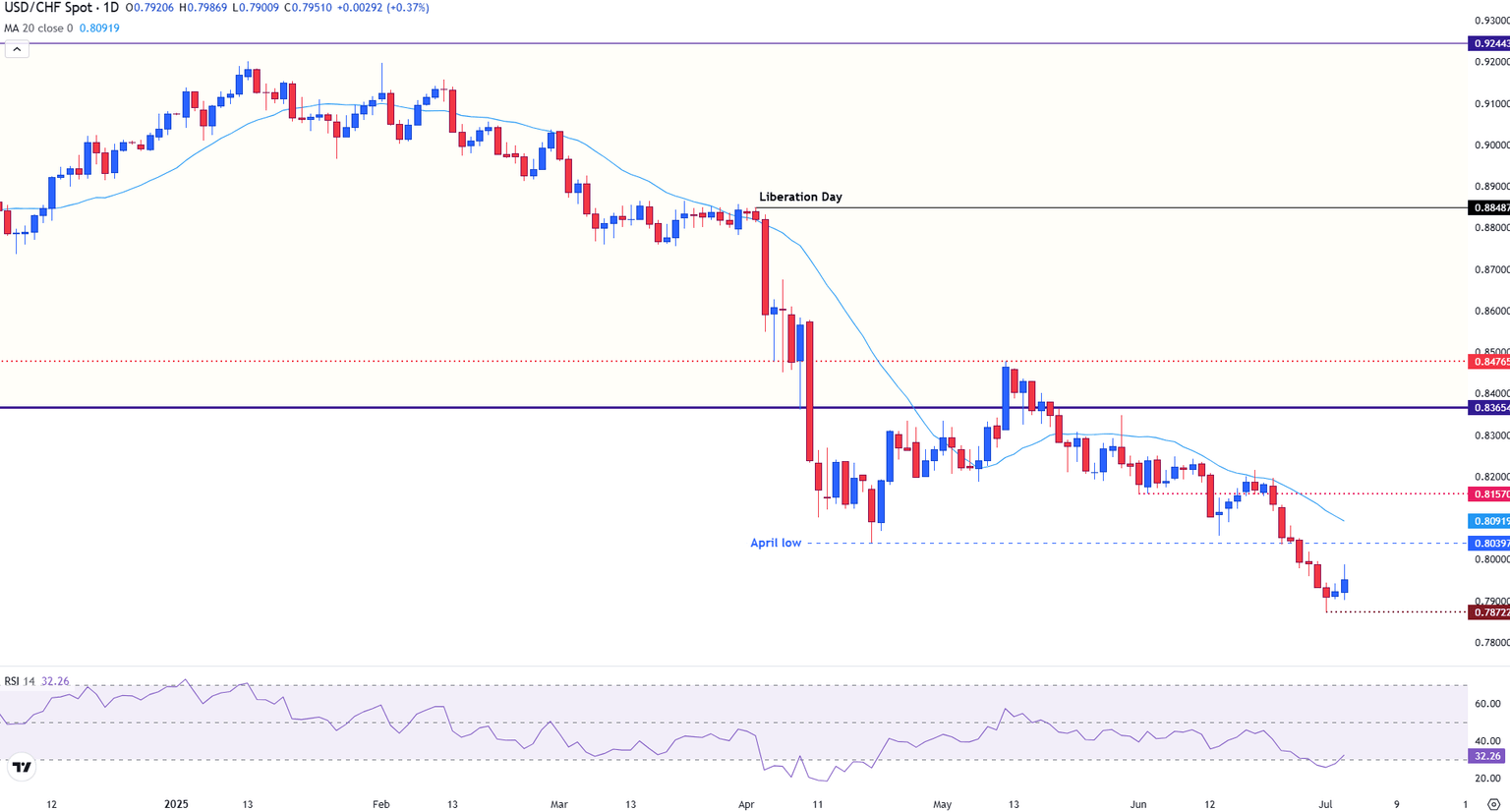
A sustained move above these levels could open the door for a deeper correction toward 0.8157. On the downside, failure to hold above 0.7900 would leave the pair vulnerable to a retest of the 0.7872 low. Overall, the outlook remains cautiously bearish unless the pair can reclaim key resistance levels and confirm a broader reversal.
Risk sentiment FAQs
In the world of financial jargon the two widely used terms “risk-on” and “risk off'' refer to the level of risk that investors are willing to stomach during the period referenced. In a “risk-on” market, investors are optimistic about the future and more willing to buy risky assets. In a “risk-off” market investors start to ‘play it safe’ because they are worried about the future, and therefore buy less risky assets that are more certain of bringing a return, even if it is relatively modest.
Typically, during periods of “risk-on”, stock markets will rise, most commodities – except Gold – will also gain in value, since they benefit from a positive growth outlook. The currencies of nations that are heavy commodity exporters strengthen because of increased demand, and Cryptocurrencies rise. In a “risk-off” market, Bonds go up – especially major government Bonds – Gold shines, and safe-haven currencies such as the Japanese Yen, Swiss Franc and US Dollar all benefit.
The Australian Dollar (AUD), the Canadian Dollar (CAD), the New Zealand Dollar (NZD) and minor FX like the Ruble (RUB) and the South African Rand (ZAR), all tend to rise in markets that are “risk-on”. This is because the economies of these currencies are heavily reliant on commodity exports for growth, and commodities tend to rise in price during risk-on periods. This is because investors foresee greater demand for raw materials in the future due to heightened economic activity.
The major currencies that tend to rise during periods of “risk-off” are the US Dollar (USD), the Japanese Yen (JPY) and the Swiss Franc (CHF). The US Dollar, because it is the world’s reserve currency, and because in times of crisis investors buy US government debt, which is seen as safe because the largest economy in the world is unlikely to default. The Yen, from increased demand for Japanese government bonds, because a high proportion are held by domestic investors who are unlikely to dump them – even in a crisis. The Swiss Franc, because strict Swiss banking laws offer investors enhanced capital protection.
Author
Tammy Da Costa, CFTe®
FXStreet
Tammy is an economist and market analyst with a deep passion for financial markets, particularly commodities and geopolitics.

















