USD/CHF steadies, Trump’s tax bill clears Senate, while Hammer Candle signals possible reversal
- US fiscal concerns loom as the Senate passes Trump’s “One Big Beautiful Bill Act”.
- USD/CHF rebounds after testing a new YTD low below 0.7900 on Tuesday.
- A hammer candle forms on the daily chart, highlighting exhaustion of the trend.


The Swiss Franc (CHF) is steadying against the US Dollar (USD) after recording a new YTD low on Tuesday.
With USD/CHF trading above 0.7900 at the time of writing, prices continue to trade near their lowest levels since September 2011.
The pressure on the US Dollar intensified on Tuesday after the Senate approved President Trump’s “One Big Beautiful” tax bill.
After hours of tense negotiations, Vice President JD Vance cast a decisive tiebreaker vote to push the bill through to the next round of voting in the House of Representatives.
The sweeping legislation extends key provisions from the 2017 tax cuts and introduces new deductions, including tax exemptions on tips and overtime. It also boosts funding for defense, border security, and space exploration.
The bill, also referred to as the GOP mega bill, has triggered unease among bond and currency investors. The budget bill is expected to increase the US deficit by $3.3 trillion over the next decade, raising concerns about the sustainability of US debt.
However, despite mounting concerns over US fiscal policy and rising government debt, technical factors have temporarily capped the downside move.
USD/CHF rebounds as a Hammer candle signals exhaustion of the bearish trend
The USD/CHF daily chart is showing signs of potential exhaustion in the prevailing downtrend.
After an extended bearish move, the latest candlestick has formed what resembles a hammer pattern, with a small real body near the top of the range and a long lower wick. This indicates strong intraday selling that was met with buying pressure by the close.
USD/CHF daily chart
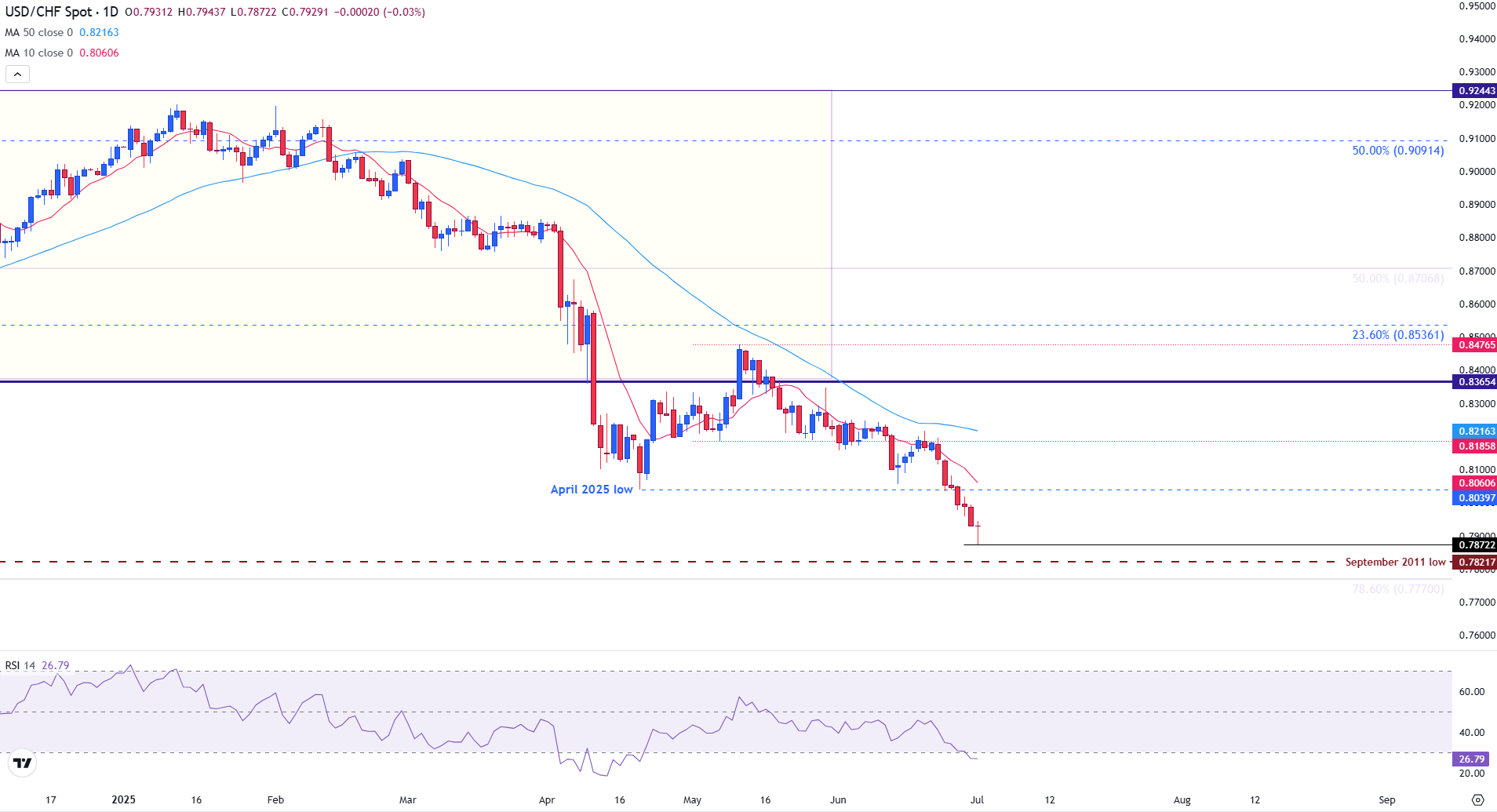
This pattern, emerging just above key support around the 0.7821–0.7827 zone, suggests a potential bullish reversal or short-term relief bounce.
The Relative Strength Index (RSI) is deeply oversold at 26, reinforcing the idea that bearish momentum may be overextended.
While the overall trend remains bearish, given that the price is well below both the 10-day and 50-day Simple Moving Averages (SMA).
The Hammer candle signals that sellers may be losing control. A bullish confirmation candle above the 0.8000 psychological level could validate a temporary recovery, potentially bringing the April low into play at 0.8060.
Swiss Franc FAQs
The Swiss Franc (CHF) is Switzerland’s official currency. It is among the top ten most traded currencies globally, reaching volumes that well exceed the size of the Swiss economy. Its value is determined by the broad market sentiment, the country’s economic health or action taken by the Swiss National Bank (SNB), among other factors. Between 2011 and 2015, the Swiss Franc was pegged to the Euro (EUR). The peg was abruptly removed, resulting in a more than 20% increase in the Franc’s value, causing a turmoil in markets. Even though the peg isn’t in force anymore, CHF fortunes tend to be highly correlated with the Euro ones due to the high dependency of the Swiss economy on the neighboring Eurozone.
The Swiss Franc (CHF) is considered a safe-haven asset, or a currency that investors tend to buy in times of market stress. This is due to the perceived status of Switzerland in the world: a stable economy, a strong export sector, big central bank reserves or a longstanding political stance towards neutrality in global conflicts make the country’s currency a good choice for investors fleeing from risks. Turbulent times are likely to strengthen CHF value against other currencies that are seen as more risky to invest in.
The Swiss National Bank (SNB) meets four times a year – once every quarter, less than other major central banks – to decide on monetary policy. The bank aims for an annual inflation rate of less than 2%. When inflation is above target or forecasted to be above target in the foreseeable future, the bank will attempt to tame price growth by raising its policy rate. Higher interest rates are generally positive for the Swiss Franc (CHF) as they lead to higher yields, making the country a more attractive place for investors. On the contrary, lower interest rates tend to weaken CHF.
Macroeconomic data releases in Switzerland are key to assessing the state of the economy and can impact the Swiss Franc’s (CHF) valuation. The Swiss economy is broadly stable, but any sudden change in economic growth, inflation, current account or the central bank’s currency reserves have the potential to trigger moves in CHF. Generally, high economic growth, low unemployment and high confidence are good for CHF. Conversely, if economic data points to weakening momentum, CHF is likely to depreciate.
As a small and open economy, Switzerland is heavily dependent on the health of the neighboring Eurozone economies. The broader European Union is Switzerland’s main economic partner and a key political ally, so macroeconomic and monetary policy stability in the Eurozone is essential for Switzerland and, thus, for the Swiss Franc (CHF). With such dependency, some models suggest that the correlation between the fortunes of the Euro (EUR) and the CHF is more than 90%, or close to perfect.
Author
Tammy Da Costa, CFTe®
FXStreet
Tammy is an economist and market analyst with a deep passion for financial markets, particularly commodities and geopolitics.