USD/CHF slides as US data paints a picture of a cooling economy
- USD/CHF is falling on US Dollar weakness as data out of the US paints a picture of a cooling US economy.
- Recent services’ sector and labor-market data hint at a softness which could lead the Federal Reserve to enact Dollar-negative policies.
- The Swiss Franc, however, remains fundamentally weak as the Swiss National Bank continues lowering interest rates in Switzerland.


USD/CHF reached a four-week high of 0.9050 on July 3 before proceeding to roll over and fall. It is currently trading in the 0.8980s. The decline has been put down to US Dollar weakness more than Swiss Franc (CHF) strength. A run of poor data from the US has made it more likely the Federal Reserve (Fed) will start to ease monetary policy – a move that would weaken the US Dollar.
USD/CHF 4-hour Chart
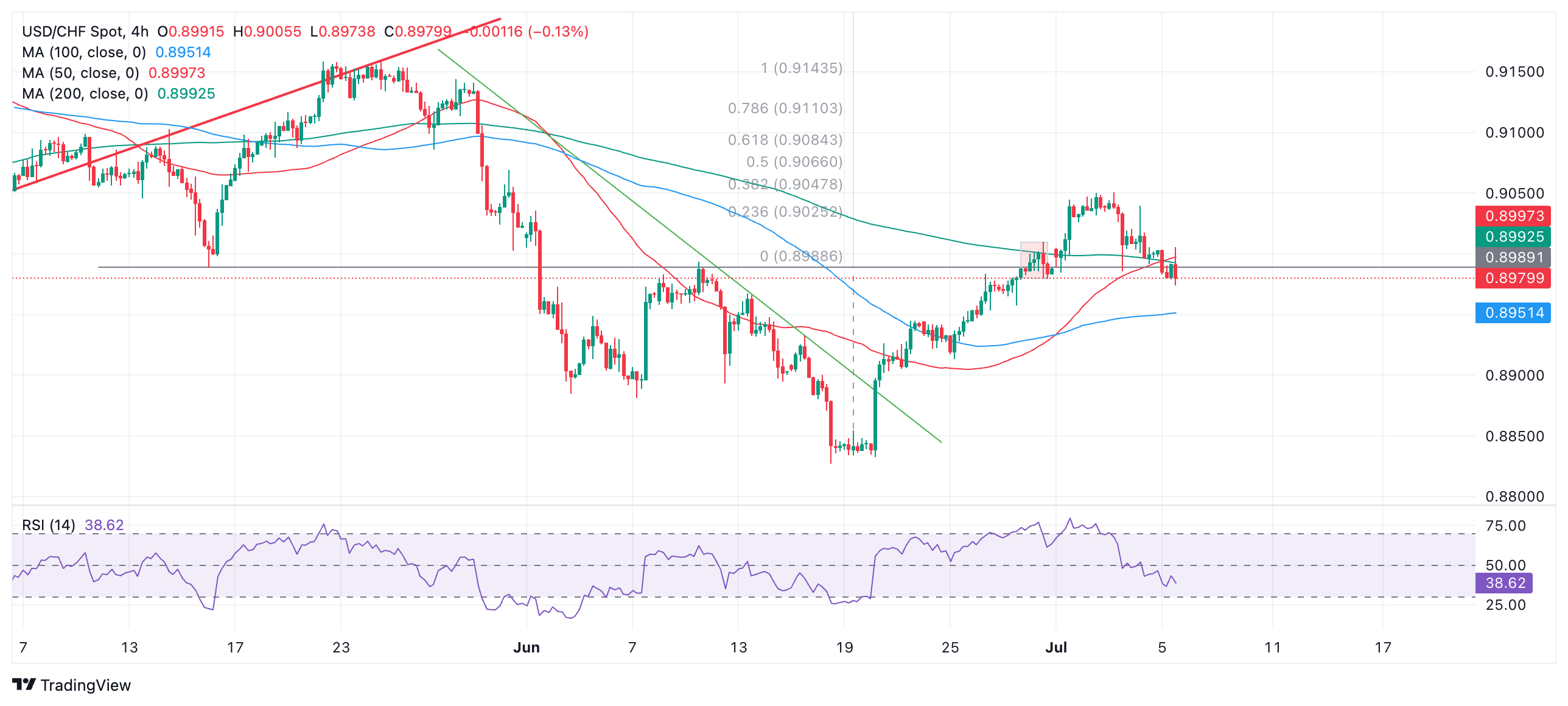
The poor data that has started weighing on the US Dollar includes the ISM Services PMI data for June which came out at 48.8 from 53.8 previously. This was significant because the services’ sector has been singled out as a key contributing factor to the stubbornly high inflation in the US economy, which in turn has prevented the US Federal Reserve (Fed) from lowering interest rates.
However, the weak ISM Services PMI data in June indicates the sector might be beginning to cool down which could further bring down inflation more generally and allow the Fed to cut interest rates. Although lower interest rates are positive for businesses because they reduce borrowing costs, they are negative for a currency because they make it less attractive to foreign investors as a place to park their capital. Thus the data weighed on the US Dollar and USD/CHF.
Signs of a softening labor market are also weighing on the US Dollar. The Nonfarm Payrolls (NFP) report for June has shown a rise in the Unemployment Rate to 4.1% from 4.0% when no-change was expected. This is its highest since November 2021 just after the pandemic. Additionally, Initial Jobless Claims rose more than expected in late June, and Continuing Claims climbed to 1.858 million – also the highest since November 2021. The overall softer employment data, adds to the picture of a cooling economy.
Swiss Franc depreciates on lower interest rates
For any currency pair the difference between the interest rates of the two currencies, or the “interest-rate differential” is key. As such, it is not just the projection for interest rates in the US but also for Switzerland, that is a determinant of the exchange rate.
USD/CHF rose 2.5% in just two weeks at the end of June after the Swiss National Bank (SNB) decided to cut its main interest rate by 0.25% to 1.25%, at its June 20 meeting. This was the second time this year that the SNB had decided to cut its policy rate.
The chart below compares the SNB and Fed’s policy rates over the last three years. As can be seen, whilst both began raising interest rates to combat high inflation after the Covid pandemic, inflation fell back down to normal levels more quickly in Switzerland so the SNB was able to reduce interest rates earlier there. The Fed, in contrast, has yet to begin cutting interest rates in the US due to stubbornly high inflation. This has benefited the US Dollar.
-638557823300798118.png&w=1536&q=95)
The recent run of weak US data, however, makes it more likely the Fed will also begin cutting interest rates at its meeting in September.
The probability of the Fed cutting its principal policy rate, the Fed Funds rate, by 0.25% to an upper limit of 5.25% by September, has increased from the mid-60s at the end of June to around 75% on Friday July 5, according to the CME FedWatch tool, which uses the price of the 30-day Fed Funds futures in its calculations
Author
Joaquin Monfort
FXStreet
Joaquin Monfort is a financial writer and analyst with over 10 years experience writing about financial markets and alt data. He holds a degree in Anthropology from London University and a Diploma in Technical analysis.

















