USD/CHF Price Forecast: Tumbles to near 0.8440 as Fed large rate cut bets swell
- USD/CHF witnesses a sharp sell-off near 0.8440 as traders raise bets toward the Fed's sizable rate cuts.
- The US Retail Sales for August are expected to have risen by 0.2%, slower than 1% in July.
- USD/CHF sees more downside toward 0.8300.

The USD/CHF pair falls sharply to near 0.8440 in Monday’s European session. The Swiss Franc asset tumbles as market speculation for the Federal Reserve (Fed) reducing interest rates by 50 basis points (bps) to 4.75%-5.50% in its monetary policy meeting on Wednesday has strengthened.
The CME FedWatch tool shows that the probability of the Fed reducing interest rates by 50 bps has increased to 59% from 30% a week ago. A swift increase in Fed dovish bets has weighed heavily on the US Dollar (USD). The US Dollar Index (DXY), which tracks the Greenback’s value against six major currencies, slumps to near 100.70.
Before the Fed policy meeting, investors will focus on the United States (US) Retail Sales data for August, which will be published on Tuesday. Economists estimate the Retail Sales data to have grown at a slower pace of 0.2% from July’s print of 1%.
Meanwhile, the Swiss Franc (CHF) will be influenced by market speculation for the Swiss National Bank (SNB)’s interest rate path. The SNB is expected to cut interest rates again in its late September monetary policy as inflationary pressures continue to decline.
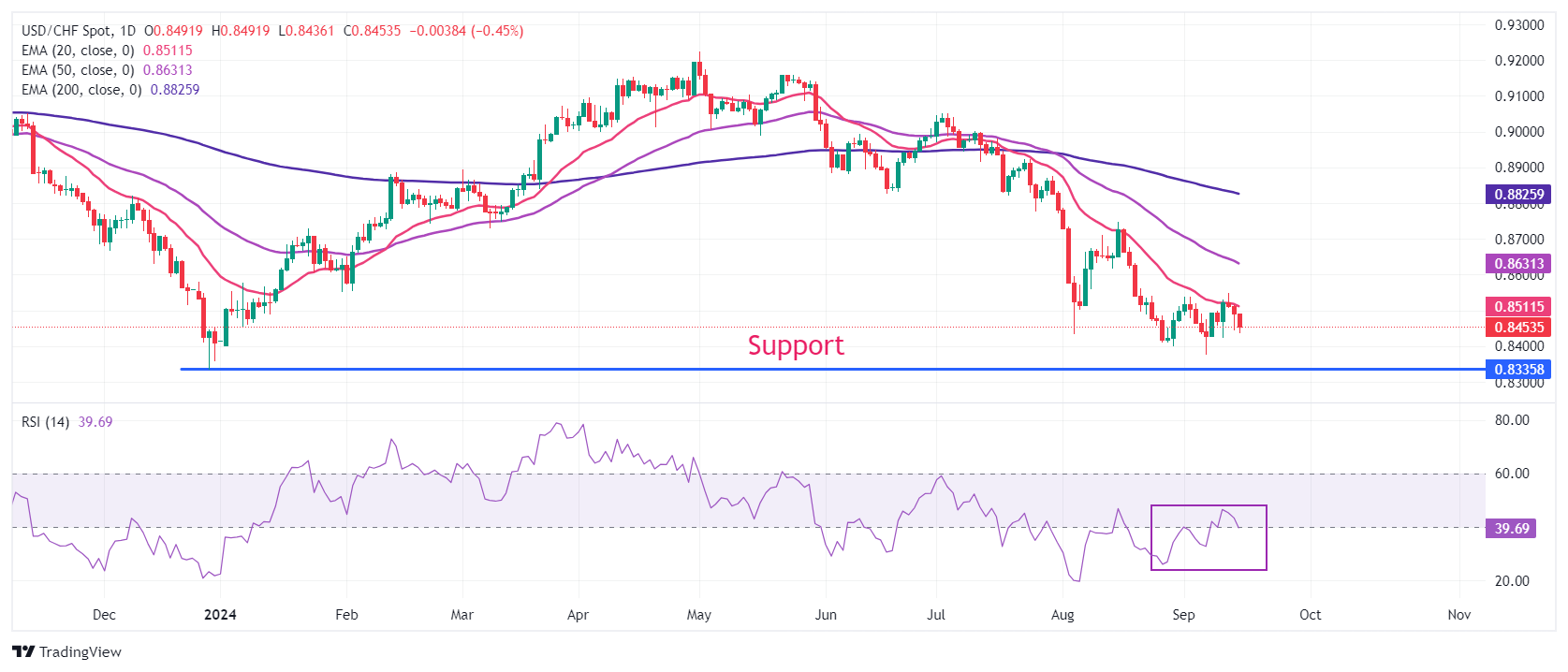
USD/CHF declines toward the horizontal support plotted from the 28 December 2023 low of 0.8333 on a daily timeframe. The near-term and broader-term outlooks of the pair remain bearish as all short-to-long-term Exponential Moving Averages (EMAs) are declining.
The 14-day Relative Strength Index (RSI) oscillates in the bearish range of 20.00-40.00, suggesting that a strong bearish momentum is intact.
More downside would appear if the asset breaks below the round-level support of 0.8400, which would drag the major towards the 28 December 2023 low of 0.8333 and round-level support of 0.8300.
On the flip side, a recovery move above the weekly high near 0.8540 will drive the asset toward the round-level resistance of 0.8600, followed by the August 20 high of 0.8632.
USD/CHF daily chart
Swiss Franc FAQs
The Swiss Franc (CHF) is Switzerland’s official currency. It is among the top ten most traded currencies globally, reaching volumes that well exceed the size of the Swiss economy. Its value is determined by the broad market sentiment, the country’s economic health or action taken by the Swiss National Bank (SNB), among other factors. Between 2011 and 2015, the Swiss Franc was pegged to the Euro (EUR). The peg was abruptly removed, resulting in a more than 20% increase in the Franc’s value, causing a turmoil in markets. Even though the peg isn’t in force anymore, CHF fortunes tend to be highly correlated with the Euro ones due to the high dependency of the Swiss economy on the neighboring Eurozone.
The Swiss Franc (CHF) is considered a safe-haven asset, or a currency that investors tend to buy in times of market stress. This is due to the perceived status of Switzerland in the world: a stable economy, a strong export sector, big central bank reserves or a longstanding political stance towards neutrality in global conflicts make the country’s currency a good choice for investors fleeing from risks. Turbulent times are likely to strengthen CHF value against other currencies that are seen as more risky to invest in.
The Swiss National Bank (SNB) meets four times a year – once every quarter, less than other major central banks – to decide on monetary policy. The bank aims for an annual inflation rate of less than 2%. When inflation is above target or forecasted to be above target in the foreseeable future, the bank will attempt to tame price growth by raising its policy rate. Higher interest rates are generally positive for the Swiss Franc (CHF) as they lead to higher yields, making the country a more attractive place for investors. On the contrary, lower interest rates tend to weaken CHF.
Macroeconomic data releases in Switzerland are key to assessing the state of the economy and can impact the Swiss Franc’s (CHF) valuation. The Swiss economy is broadly stable, but any sudden change in economic growth, inflation, current account or the central bank’s currency reserves have the potential to trigger moves in CHF. Generally, high economic growth, low unemployment and high confidence are good for CHF. Conversely, if economic data points to weakening momentum, CHF is likely to depreciate.
As a small and open economy, Switzerland is heavily dependent on the health of the neighboring Eurozone economies. The broader European Union is Switzerland’s main economic partner and a key political ally, so macroeconomic and monetary policy stability in the Eurozone is essential for Switzerland and, thus, for the Swiss Franc (CHF). With such dependency, some models suggest that the correlation between the fortunes of the Euro (EUR) and the CHF is more than 90%, or close to perfect.
Author

Sagar Dua
FXStreet
Sagar Dua is associated with the financial markets from his college days. Along with pursuing post-graduation in Commerce in 2014, he started his markets training with chart analysis.