USD/CHF Price Forecast: Continues to face pressure near 0.8850
- USD/CHF struggles to break above 0.8850 as the US Dollar faces pressure.
- US President Trump indicated that he may exempt a lot of countries from tariffs, which he will unveil on April 2.
- The SNB cut its interest rates by 25 bps to 0.25% last week.

The USD/CHF pair struggles to extend its upside above the key resistance of 0.8850 during European trading hours on Tuesday. The Swiss Franc pair ticks lower as the US Dollar (USD) struggles to gain further even though United States (US) President Donald Trump has signaled that come countries would manage to escape from tariffs, which he is scheduled to unveil on April 2. The US Dollar Index (DXY), which tracks the Greenback’s value against six major currencies, faces pressure while extending a four-day winning streak above 104.50
On Monday, US President Trump said at the White House that he may give a "lot of countries" breaks on tariffs. Trump reiterated that he is planning to announce tariffs on automobiles, lumber, and chips in a few days.
A trade war by the US with fewer nations would result in a lower impact on its economic growth than investors had feared initially. The US Dollar had a sharp fall in the last months as investors worried that Trump’s economic policies could expose the US economy to a recession.
Meanwhile, the Swiss Franc (CHF) is expected to remain under pressure as the outlook of the Swiss economy is uncertain due to external pressures. Last week, the Swiss National Bank (SNB) reduced interest rates by 25 basis points (bps) to 0.25% on Thursday.
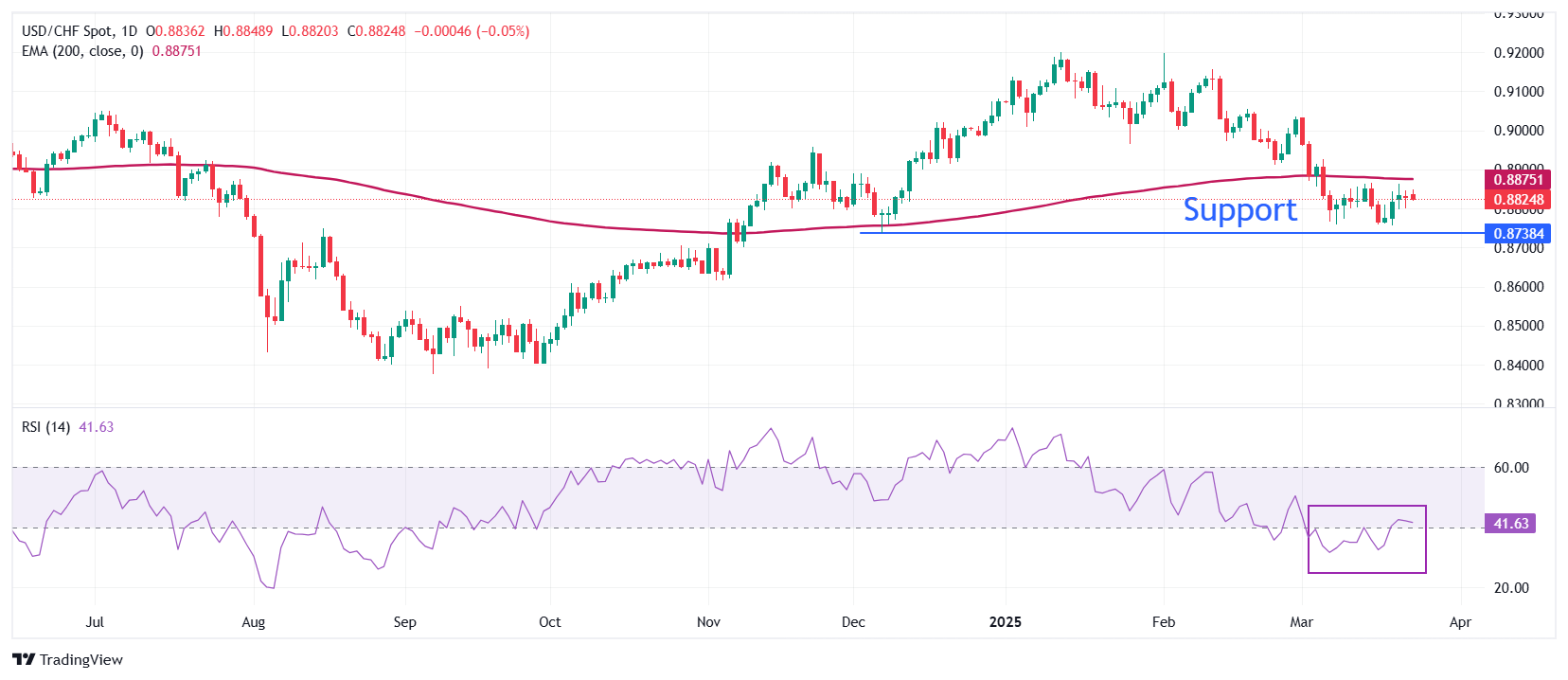
USD/CHF seems to revisit the four-month low of 0.8736 plotted from the December 6 low. The outlook of the pair is broadly bearish as it trades below the 200-day Exponential Moving Average (EMA), which is around 0.8875.
The 14-day Relative Strength Index (RSI) rises above 40.00, suggesting that bearish momentum is over. However, the bearish trend is intact.
The asset could face more downside towards the November 8 low of 0.8700 and the November 6 low of 0.8620 if it falls below the December 6 low of 0.8736.
On the flip side, a recovery move above the psychological support of 0.9000 would drive the asset towards the February 28 high of 0.9036, followed by the round-level resistance of 0.9100.
USD/CHF daily chart
US Dollar FAQs
The US Dollar (USD) is the official currency of the United States of America, and the ‘de facto’ currency of a significant number of other countries where it is found in circulation alongside local notes. It is the most heavily traded currency in the world, accounting for over 88% of all global foreign exchange turnover, or an average of $6.6 trillion in transactions per day, according to data from 2022. Following the second world war, the USD took over from the British Pound as the world’s reserve currency. For most of its history, the US Dollar was backed by Gold, until the Bretton Woods Agreement in 1971 when the Gold Standard went away.
The most important single factor impacting on the value of the US Dollar is monetary policy, which is shaped by the Federal Reserve (Fed). The Fed has two mandates: to achieve price stability (control inflation) and foster full employment. Its primary tool to achieve these two goals is by adjusting interest rates. When prices are rising too quickly and inflation is above the Fed’s 2% target, the Fed will raise rates, which helps the USD value. When inflation falls below 2% or the Unemployment Rate is too high, the Fed may lower interest rates, which weighs on the Greenback.
In extreme situations, the Federal Reserve can also print more Dollars and enact quantitative easing (QE). QE is the process by which the Fed substantially increases the flow of credit in a stuck financial system. It is a non-standard policy measure used when credit has dried up because banks will not lend to each other (out of the fear of counterparty default). It is a last resort when simply lowering interest rates is unlikely to achieve the necessary result. It was the Fed’s weapon of choice to combat the credit crunch that occurred during the Great Financial Crisis in 2008. It involves the Fed printing more Dollars and using them to buy US government bonds predominantly from financial institutions. QE usually leads to a weaker US Dollar.
Quantitative tightening (QT) is the reverse process whereby the Federal Reserve stops buying bonds from financial institutions and does not reinvest the principal from the bonds it holds maturing in new purchases. It is usually positive for the US Dollar.
Author

Sagar Dua
FXStreet
Sagar Dua is associated with the financial markets from his college days. Along with pursuing post-graduation in Commerce in 2014, he started his markets training with chart analysis.

















