USD/CAD Price Forecast: Recovers to near 20-day EMA
- USD/CAD extends its winning streak for the third trading day on Thursday, rising slightly above 1.3700.
- The possibility of the US attacking Iran has escalated Middle East tensions.
- BoC Macklem is hopeful that the US will revoke tariffs once both nations strike a trade deal.
The USD/CAD pair extends its two-day recovery move to near 1.3710 during Asian trading hours on Thursday. The Loonie pair attracts bids as the US Dollar (USD) gains further, while Middle East tensions have escalated amid the possibility of the United States (US) striking Iran, Bloomberg reported.
The demand for safe-haven assets, such as the US Dollar, increases amid heightening geopolitical tensions. At the press time, the US Dollar Index (DXY), which tracks the Greenback’s value against six major currencies, moves higher to near 99.10.
On the domestic front, the Fed left interest rates unchanged in the range of 4.25%-4.50% for the fourth consecutive policy meeting and warned of stagflation risks due to the imposition of the trade policy by US President Donald Trump.
Meanwhile, trade tensions between the US and Canada appear to be improving as both agreed to reach a bilateral agreement within 30 days during the G7 Summit.
On Wednesday, Bank of Canada Governor Tiff Macklem warned of upside inflation risks if tariffs imposed by the US remain in place. However, he was hopeful that additional import duties would be removed if both nations struck a trade deal.
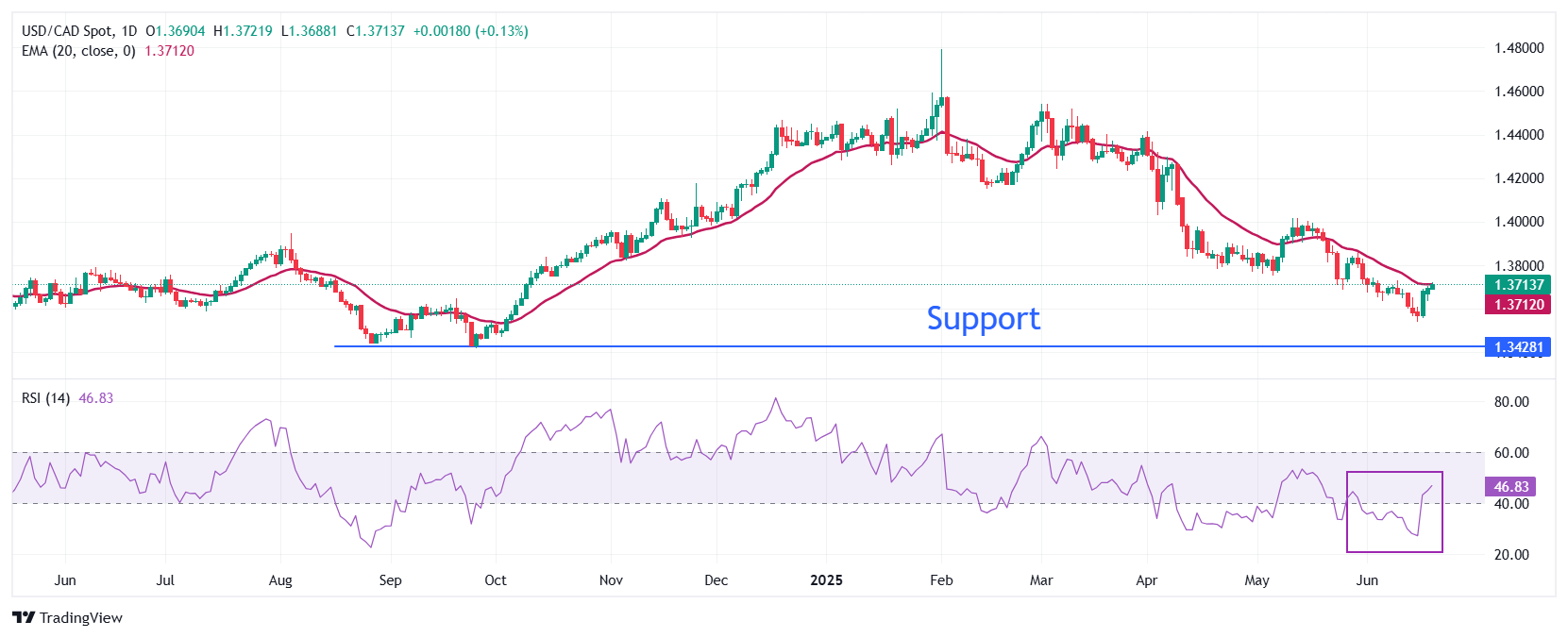
USD/CAD gains for three days in a row after posting a fresh eight-month low around 1.3540 on Monday. The Loonie pair recovers to near the 20-day Exponential Moving Average (EMA), which trades around 1.3715
The 14-day Relative Strength Index (RSI) returns above 40.00, suggesting that a bearish momentum has terminated for now. However, the bearish bias is intact.
The asset could slide towards the psychological level of 1.3500 and the September 25 low of 1.3420 if it breaks below Monday’s low of 1.3540.
On the contrary, a recovery move above the May 29 high of 1.3820 would open the door towards the May 21 high of 1.3920, followed by the My 15 high of 1.4000.
USD/CAD daily chart
US Dollar FAQs
The US Dollar (USD) is the official currency of the United States of America, and the ‘de facto’ currency of a significant number of other countries where it is found in circulation alongside local notes. It is the most heavily traded currency in the world, accounting for over 88% of all global foreign exchange turnover, or an average of $6.6 trillion in transactions per day, according to data from 2022. Following the second world war, the USD took over from the British Pound as the world’s reserve currency. For most of its history, the US Dollar was backed by Gold, until the Bretton Woods Agreement in 1971 when the Gold Standard went away.
The most important single factor impacting on the value of the US Dollar is monetary policy, which is shaped by the Federal Reserve (Fed). The Fed has two mandates: to achieve price stability (control inflation) and foster full employment. Its primary tool to achieve these two goals is by adjusting interest rates. When prices are rising too quickly and inflation is above the Fed’s 2% target, the Fed will raise rates, which helps the USD value. When inflation falls below 2% or the Unemployment Rate is too high, the Fed may lower interest rates, which weighs on the Greenback.
In extreme situations, the Federal Reserve can also print more Dollars and enact quantitative easing (QE). QE is the process by which the Fed substantially increases the flow of credit in a stuck financial system. It is a non-standard policy measure used when credit has dried up because banks will not lend to each other (out of the fear of counterparty default). It is a last resort when simply lowering interest rates is unlikely to achieve the necessary result. It was the Fed’s weapon of choice to combat the credit crunch that occurred during the Great Financial Crisis in 2008. It involves the Fed printing more Dollars and using them to buy US government bonds predominantly from financial institutions. QE usually leads to a weaker US Dollar.
Quantitative tightening (QT) is the reverse process whereby the Federal Reserve stops buying bonds from financial institutions and does not reinvest the principal from the bonds it holds maturing in new purchases. It is usually positive for the US Dollar.
Author

Sagar Dua
FXStreet
Sagar Dua is associated with the financial markets from his college days. Along with pursuing post-graduation in Commerce in 2014, he started his markets training with chart analysis.


![How Wall Street rigs the game [Video]](https://editorial.fxsstatic.com/images/i/market-chaos-01.jpg)