USD/CAD holding steady on Wednesday just above 1.3300
- USD/CAD is backsliding in thin pre-holiday markets.
- The Canadian Dollar is finding support from rebounding Crude Oil bids.
- BoC rhetoric about the need for higher rates disappears from latest meeting minutes.

The USD/CAD is getting pushed lower as broader markets see a healthy risk bid that is forcing down the US Dollar (USD) and a bump in Crude Oil bids is propping up the Canadian Dollar (CAD) while the Bank of Canada (BoC) sees lower odds of inflation risks making a reappearance.
BoC minutes: Members concluded that recent data pointed in the right direction
The BoC’s latest Summary of Deliberations revealed that, prior to the Bank of Canada’s December 6 rate call, policymakers felt that higher rates are less likely moving forward as inflationary risks remain subdued. The current trajectory of inflation, while pointing steadily downward, still sees some potential risks, specifically from shelter prices and rents still running hot, helping to keep inflation overall above the BoC’s targets.
The BoC dropped language about some policymakers seeing a need for higher rates, which was present at the October 26 rate call, suggesting an underlying shift in BoC expectations, though the Canadian central bank remains willing to hike rates even further if inflationary pressures reappear in the data.
Crude Oil markets caught a bounce on Wednesday with markets continuing to be concerned over rebel attacks on container ships in the Yemen region, which could destabilize Crude Oil supply routes between Asia and Europe. West Texas Intermediate (WTI) US Crude Oil is back over $74 per barrel, helping to bolster the Canadian Dollar into one of the best-performing currencies of the major bloc.
US Existing Home Sales rose unexpectedly in November with 3.82 million housing units changing hands for the month, rebounding from October’s 13-year low of 3.79 million, handily beating the market forecast of a further decline to 3.77 million.
Read More: US Existing Home Sales rise 0.8% in November
The rest of the trading week, which will see declining trade volumes as investors wrap up for the holidays, will close out with Canadian Retail Sales and US Annualized Gross Domestic Product (GDP) on Thursday, with Canadian Gross Domestic Product and US Personal Consumption Expenditure (PCE) Price Index numbers on Friday.
USD/CAD Technical Outlook
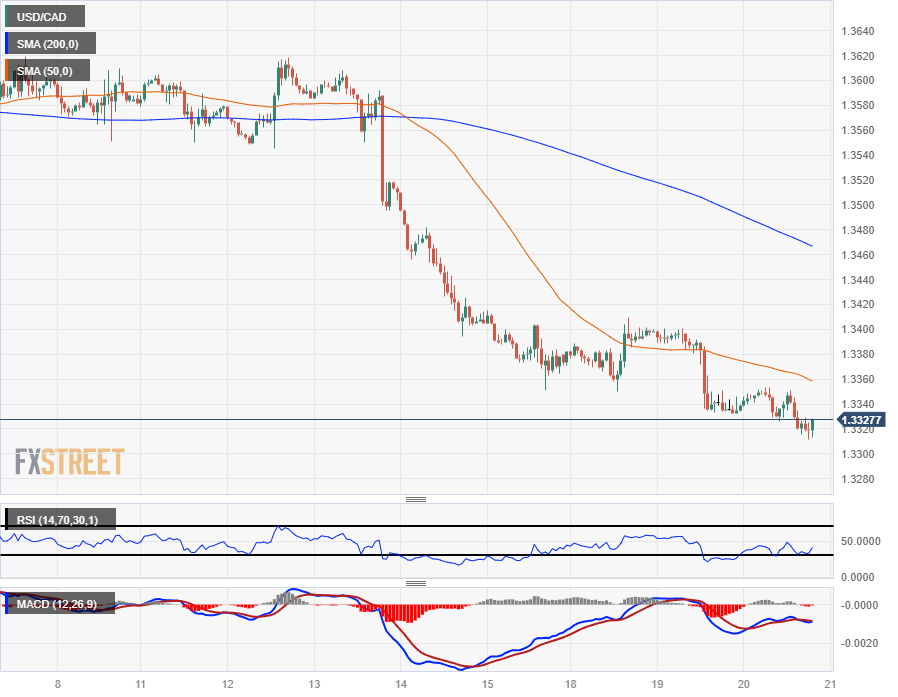
The USD/CAD is looking to establish a foothold just above the 1.3300 handle in Wednesday trading, planting itself and looking for a rebound from 1.3320 after last week’s backslide that took the pair down from the 1.3600 region.
The 200-hour Simple Moving Average (SMA) is falling into 1.3460 as the moving average struggles to keep up with recent declines, capping off any near-term bullish momentum above the 1.3400 handle.
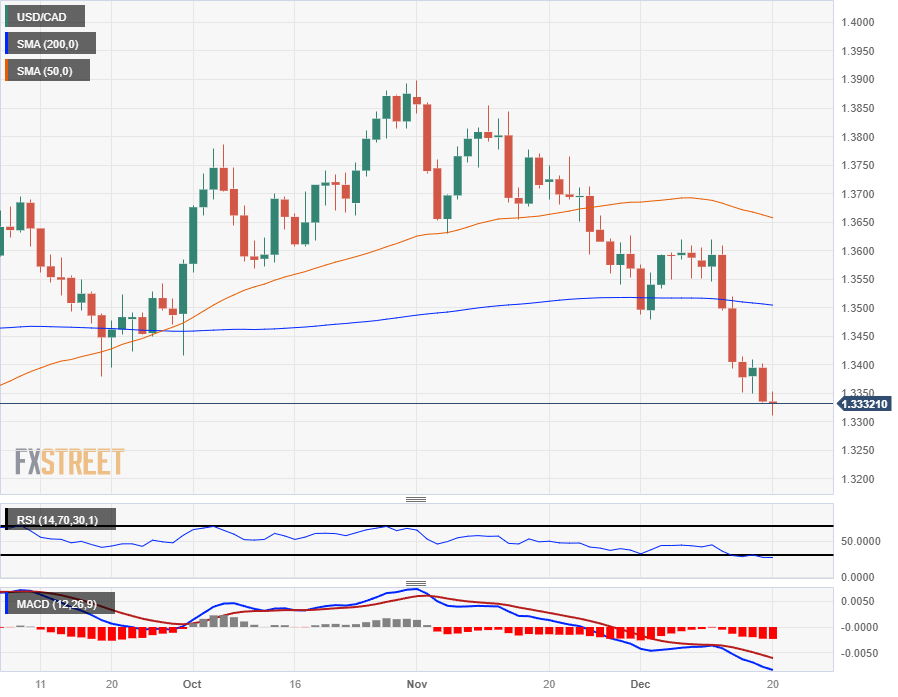
The USD/CAD has dropped away from the 200-day SMA on the daily candlesticks, trading into its lowest bids since early August.
USD/CAD Hourly Chart
USD/CAD Daily Chart
USD/CAD Technical Levels
Author

Joshua Gibson
FXStreet
Joshua joins the FXStreet team as an Economics and Finance double major from Vancouver Island University with twelve years' experience as an independent trader focusing on technical analysis.

















