USD/CAD edges higher toward 1.3590s amidst a robust US Dollar, risk aversion
- USD/CAD rebounds from weekly lows around 1.3520s and closes to the 1.3600 mark.
- Overall, US Dollar strength and falling oil prices keep the USD/CAD rallying.
- USD/CAD Price Analysis: Upward biased, and a daily close above 1.3600, could pave the way to 1.3700.

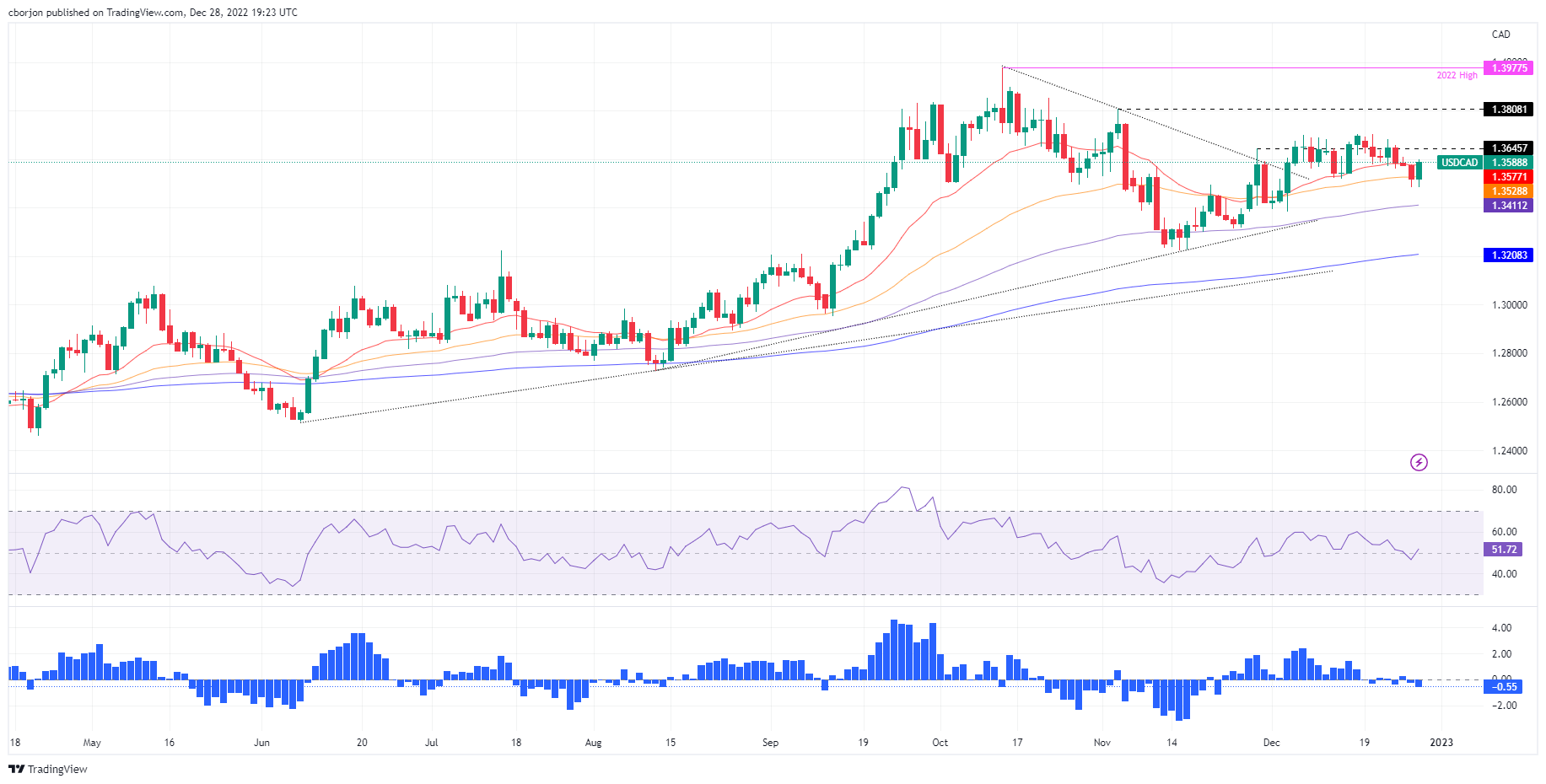
The USD/CAD erases Tuesday’s losses and forms a tweezers bottom candle pattern, as it failed to crack the 50-day Exponential Moving Average (EMA) at 1.3583. Also, a sudden shift in market mood increased appetite for the US Dollar (USD) due to its safe-haven status. At the time of writing, the USD/CAD is trading at 1.3590 after hitting a low of 1.3485.
US Pending Home Sales plummets, though sentiment lifts the US Dollar
Wall Street extends its losses for the second straight day. The National Association of Realtors reported that Pending Home Sales for the United States (US) dropped 4% MoM vs. expectations for a 4.6% contraction, which was better than estimated. However, it fell to its lowest level outside the pandemic, in data back to 2001. On an annual basis, Pending Sales plunged to 37.8% YoY, below a 37% fall.
In the meantime, the Richmond Fed Manufacturing Index improved to 1, exceeding the previous month’s contraction to -9.
Although sentiment improved throughout the Asian and European sessions, courtesy of China’s relaxing Covid-19 restrictions, of late, shifted sour. Fears that the full reopening of China could unleash another virus outbreak weighed on Wall Street, which turned red. Chinese authorities began to issue travel permits to Hong Kong residents and passports as it prepares to reopen borders on January 8.
A strong American Dollar keeps the Canadian Dollar (CAD) pressured. The US Dollar Index (DXY), a gauge of the greenback’s value against a basket of its rivals, advances 0.18%, at 104.454, underpinned by higher US Treasury bond yields. The 10-year benchmark note rate edges up three and a half bps at 3.879%.
Another reason that keeps the Loonie under pressure is the oil price, with WTI’s extending its losses below $80.00 a barrel, after failing to clear the 200-day Exponential Moving Average (EMA) at $81.54.
In the week ahead, the US economic docket will feature Initial Jobless Claims for the week ending on December 23, while the Canadian calendar will unveil the CFIB Business Barometer on Friday.
USD/CAD Price Analysis: Technical outlook
From a technical perspective, the USD/CAD continues to advance, and it’s approaching the 1.3600 mark. The Relative Strength Index (RSI) shifted bullish above the 50-midline, while the Rate of Change (RoC) is still flashing signs that selling pressure is beginning to wane. Another reason to expect further upside is the bounce at the 50-day EMA at 1.3528 and a break above the 1.3600 mark.
If the USD/CAD clears the 1.3600 mark, the following resistance would be the December 23 high of 1.3658, followed by the December 22 pivot high at 1.3684. Once those levels are cleared, the next stop would be 1.3700.
Author

Christian Borjon Valencia
FXStreet
Markets analyst, news editor, and trading instructor with over 14 years of experience across FX, commodities, US equity indices, and global macro markets.
















