USD/CAD edges higher as US-Japan trade deal offers support to US Dollar
- USD/CAD bulls recover above 1.3600 support, firms at 1.3540.
- USD/CAD remains cautious as US political and trade uncertainty weigh on the Greenback.
- US-Japan trade deal limits USD losses as Canada braces for steep 35% tariffs as the August deadline nears.

USD/CAD is trading slightly higher on Wednesday, hovering just above the 1.3600 level, as a US-Japan trade agreement offers the Greenback some short-term relief.
Despite this uptick, the broader picture for the US Dollar remains fragile amid persistent political uncertainty surrounding the Federal Reserve (Fed) and rising trade tensions.
US-Japan trade deal limits USD losses as Canada braces for 35% hefty tariffs
Looking ahead, the Loonie may face elevated volatility as the August 1 deadline for US tariffs on Canadian goods approaches.
Negotiations between the two countries appear to have stalled, and US officials have confirmed that the deadline will not be extended.
The proposed measures include a blanket 35% tariff on Canadian imports not covered under the USMCA trade agreement.
This would be in addition to several sector-specific tariffs already in place, including a 50% tariff on steel and aluminum, a 25% tariff on auto parts, and a 10% tariff on energy exports such as oil, gas, and potash.
While these risks present a clear headwind for the Canadian Dollar, the currency has so far shown resilience, supported by firm domestic fundamentals and weakness in the US Dollar.
USD/CAD bulls find temporary support above 1.3600
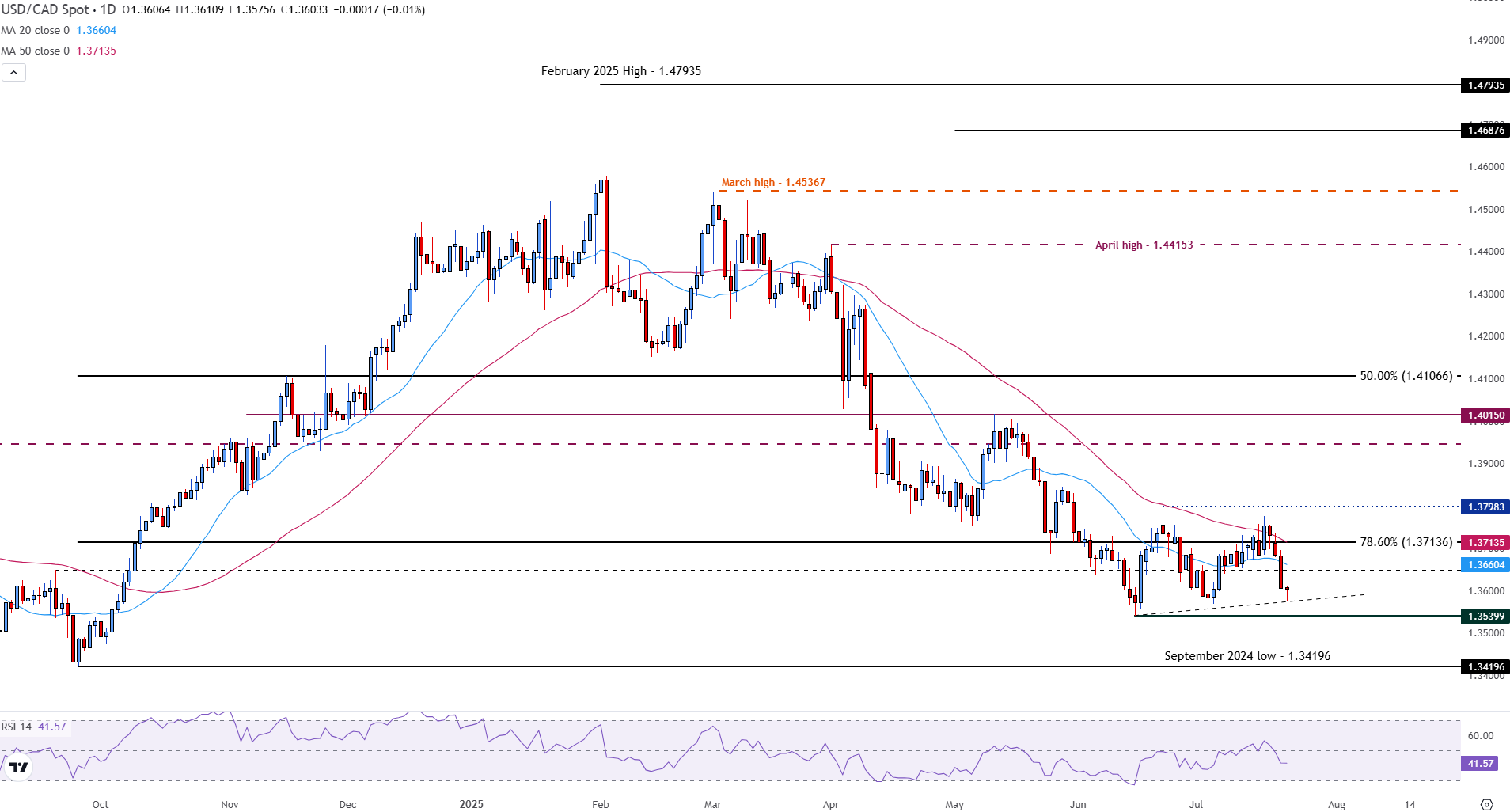
From a technical standpoint, USD/CAD has slipped below key levels, signaling a potential shift in market sentiment.
The pair is now trading beneath both the 20-day Simple Moving Average (SMA) at 1.3660 and the 50-day SMA at 1.3713.
This confluence zone has been firmly rejected, underscoring the fading bullish momentum. Immediate support at 1.3540 is now in focus, a level that previously acted as a short-term floor.
A confirmed break below this threshold would open the door toward the September 2024 low at 1.3420, marking the next significant downside target. On the upside, resistance is stacked at 1.3661 and 1.3714, and only a sustained move above this zone would challenge the prevailing bearish bias.
Meanwhile, the Relative Strength Index (RSI) sits at 43, indicating softening momentum but not yet signaling oversold conditions. This suggests that there may still be room for further losses if bearish pressure intensifies.
Tariffs FAQs
Tariffs are customs duties levied on certain merchandise imports or a category of products. Tariffs are designed to help local producers and manufacturers be more competitive in the market by providing a price advantage over similar goods that can be imported. Tariffs are widely used as tools of protectionism, along with trade barriers and import quotas.
Although tariffs and taxes both generate government revenue to fund public goods and services, they have several distinctions. Tariffs are prepaid at the port of entry, while taxes are paid at the time of purchase. Taxes are imposed on individual taxpayers and businesses, while tariffs are paid by importers.
There are two schools of thought among economists regarding the usage of tariffs. While some argue that tariffs are necessary to protect domestic industries and address trade imbalances, others see them as a harmful tool that could potentially drive prices higher over the long term and lead to a damaging trade war by encouraging tit-for-tat tariffs.
During the run-up to the presidential election in November 2024, Donald Trump made it clear that he intends to use tariffs to support the US economy and American producers. In 2024, Mexico, China and Canada accounted for 42% of total US imports. In this period, Mexico stood out as the top exporter with $466.6 billion, according to the US Census Bureau. Hence, Trump wants to focus on these three nations when imposing tariffs. He also plans to use the revenue generated through tariffs to lower personal income taxes.
Author

Tammy Da Costa, CFTe®
FXStreet
Tammy is an economist and market analyst with a deep passion for financial markets, particularly commodities and geopolitics.