USD/CAD climbs as traders await BoC risk report, Trump trade deal announcement
- USD/CAD nears 1.3900 as the Canadian Dollar softens ahead of key risk events.
- US–Canada tariff tensions linger, with markets watching for trade-related signals.
- The Loonie pair edges higher, awaiting the BoC’s risk review and Trump’s US-UK trade deal announcement.

The Canadian Dollar (CAD) is weakening against the US Dollar (USD) on Thursday as investors brace for a pivotal day of policy and trade headlines that could redefine North American market sentiment.
At the time of writing, USD/CAD is trading at 1.3880, up 0.34% on the day, with the pair strengthening as markets await the Bank of Canada (BoC) Financial System Review (FSR) and a speech by US President Donald Trump, who is expected to unveil a new UK–US trade agreement, both scheduled at 14:00 GMT.
Bank of Canada risk review in spotlight as markets assess financial vulnerabilities
The BoC’s Financial System Review, published twice a year, offers a detailed assessment of systemic vulnerabilities within Canada’s financial infrastructure.
While it is not a monetary policy document, the FSR holds relevance for market participants by shedding light on financial stability risks, including household debt, credit conditions, and housing market exposure, that could influence future rate guidance or regulatory responses. With Canada’s economy facing slowing growth and moderating inflation, any indication of tightening financial conditions or external risk exposure could weigh on the Canadian Dollar.
BoC Governor Tiff Macklem holds a press conference to discuss the contents of the FSR findings following the release, with markets closely watching his tone for any policy-relevant signals.
US–UK trade deal and Carney meeting shift spotlight to North American trade policy
Simultaneously, President Trump is expected to announce the completion of a new US–UK trade agreement, the first after the “Liberation Day.”
Markets are eyeing the terms of this deal for broader implications, particularly if it sets a precedent for bilateral arrangements that bypass traditional multilateral frameworks.
The agreement may also open the door for secondary trade alignments that benefit commodity-linked currencies like the Canadian Dollar, especially if it improves transatlantic logistics and demand for North American intermediate goods.
The twin policy developments follow heightened political friction earlier this week after Canadian Prime Minister Mark Carney met with President Trump in the Oval Office on Tuesday. While the meeting was described as “cordial but firm,” Carney dismissed Trump’s remarks that Canada could “become the 51st state,” stating: “Canada is not for sale, it won’t be for sale, ever.”
Despite the tension, the two leaders discussed the future of the United States-Mexico-Canada Agreement (USMCA) and trade terms affecting the North American supply chain. Trump reiterated that non-compliance with USMCA provisions would “not go unanswered,” suggesting possible reviews of sector-specific tariffs.
USD/CAD recovers from support with range-bound bias ahead of key catalysts
USD/CAD edges higher on Thursday, recovering above the 10-day Simple Moving Average (SMA), currently at 1.3832. At the same time, the broader structure for the pair remains capped below a key psychological resistance zone at 1.3900–1.3944. This resistance band includes a round level and the 61.8% Fibonacci retracement of the September–February rally and has limited upside breakouts throughout May.
USD/CAD daily chart
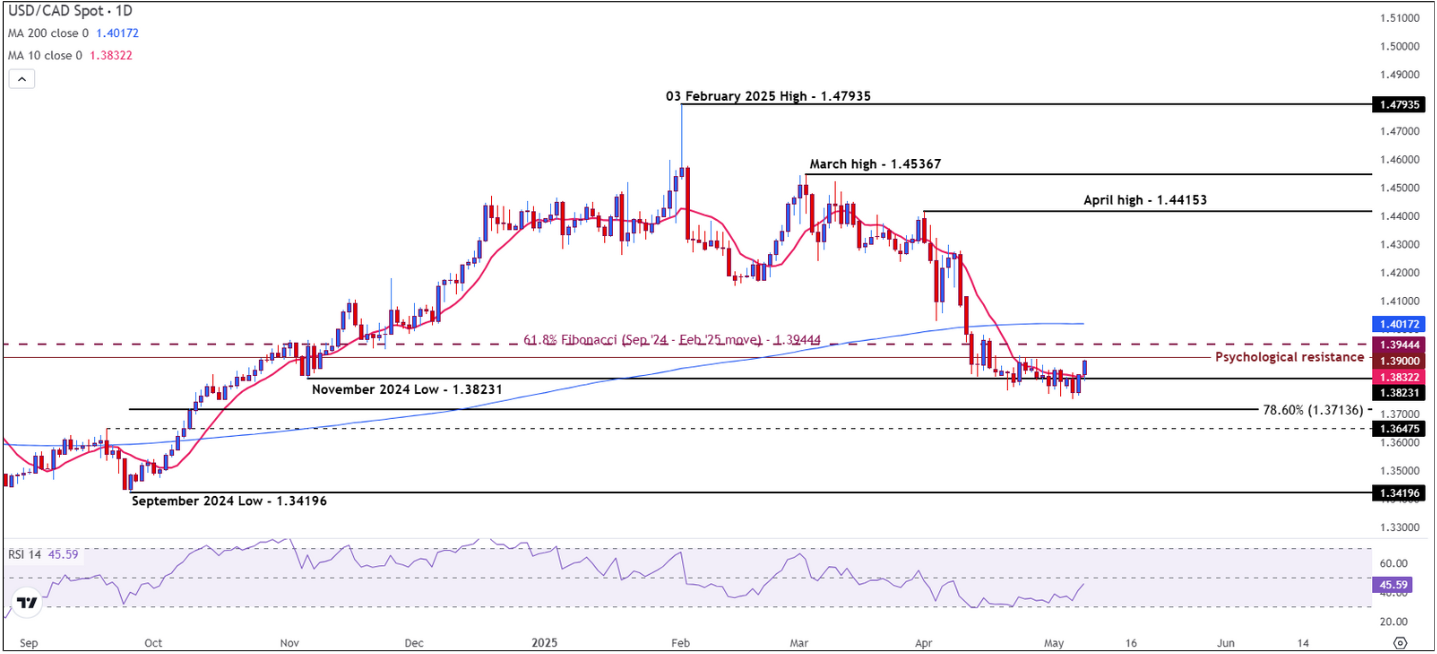
The pair remains above the November low at 1.3823, which has provided a firm floor over recent days. A daily close below this level would expose deeper support at the 78.6% Fibonacci retracement near 1.3713.
On the upside, sustained strength above 1.3944 could trigger renewed buying pressure toward the 200-day moving average at 1.4017, with a breakout potentially paving the way toward the April high at 1.4415.
The Relative Strength Index (RSI) has edged up to 45.59 in the daily chart, indicating fading bearish momentum but lacking a clear directional bias as it closes in on the mid-line at 50.
Canadian Dollar FAQs
The key factors driving the Canadian Dollar (CAD) are the level of interest rates set by the Bank of Canada (BoC), the price of Oil, Canada’s largest export, the health of its economy, inflation and the Trade Balance, which is the difference between the value of Canada’s exports versus its imports. Other factors include market sentiment – whether investors are taking on more risky assets (risk-on) or seeking safe-havens (risk-off) – with risk-on being CAD-positive. As its largest trading partner, the health of the US economy is also a key factor influencing the Canadian Dollar.
The Bank of Canada (BoC) has a significant influence on the Canadian Dollar by setting the level of interest rates that banks can lend to one another. This influences the level of interest rates for everyone. The main goal of the BoC is to maintain inflation at 1-3% by adjusting interest rates up or down. Relatively higher interest rates tend to be positive for the CAD. The Bank of Canada can also use quantitative easing and tightening to influence credit conditions, with the former CAD-negative and the latter CAD-positive.
The price of Oil is a key factor impacting the value of the Canadian Dollar. Petroleum is Canada’s biggest export, so Oil price tends to have an immediate impact on the CAD value. Generally, if Oil price rises CAD also goes up, as aggregate demand for the currency increases. The opposite is the case if the price of Oil falls. Higher Oil prices also tend to result in a greater likelihood of a positive Trade Balance, which is also supportive of the CAD.
While inflation had always traditionally been thought of as a negative factor for a currency since it lowers the value of money, the opposite has actually been the case in modern times with the relaxation of cross-border capital controls. Higher inflation tends to lead central banks to put up interest rates which attracts more capital inflows from global investors seeking a lucrative place to keep their money. This increases demand for the local currency, which in Canada’s case is the Canadian Dollar.
Macroeconomic data releases gauge the health of the economy and can have an impact on the Canadian Dollar. Indicators such as GDP, Manufacturing and Services PMIs, employment, and consumer sentiment surveys can all influence the direction of the CAD. A strong economy is good for the Canadian Dollar. Not only does it attract more foreign investment but it may encourage the Bank of Canada to put up interest rates, leading to a stronger currency. If economic data is weak, however, the CAD is likely to fall.
Author

Tammy Da Costa, CFTe®
FXStreet
Tammy is an economist and market analyst with a deep passion for financial markets, particularly commodities and geopolitics.

















