US Dollar slides with JOLTS contracting firmly as job market tightens
- The US Dollar falls lower against all major currencies.
- JOLTS Job Openings for December point to further job cooling in opening.
- The US Dollar Index (DXY) sees pressure at 108.00 for a break lower.

The US Dollar Index (DXY), which tracks the performance of the US Dollar against six major currencies, is dipping lower in immediate reaction to the US Jolts Job Openings report for December. The actual number came in far lower, at 7.6 million against the expected 8 million. Clearly the US job market is starting to see lower demand for workforce as the JOLTS numbers is steadly starting to shrink month over month.
The DXY trades around 108.00 at the time of writing. Markets are reacting as well to a mixture of headlines with a sigh of relief from Mexico and Canada, which saw the imposition of US tariffs delayed. Meanwhile, China has retaliated against US President Trump’s tariffs by issuing its own levies over US imported goods. In addition to the geopolitical headlines and the US data, two Federal Reserve (Fed) speakers, Atlanta Fed President Raphael Bostic and San Francisco Fed President Mary Daly, will speak and might leave comments for markets to consider.
Daily digest market movers: JOLTS shrinks substantially
- China has announced this Tuesday a 15% levy on less than $5 billion in US energy imports, such as Coal and Liquified Natural Gas (LNG), and a 10% fee on American Oil and agricultural equipment, and it will also investigate Google for alleged antitrust violations, Bloomberg reports. Meanwhile, Canada and Mexico are seeing US-imposed tariffs being delayed thanks to their actions to comply with US President Donald Trump.
- The monthly Factory Orders for December falls to -0.9%, below the estimate of -0.7% and deeper than the -0.4% in the previous month.
- The US JOLTS Job Openings for December faced a bigger decreased to 7.6 million openings, from the 8 million expected, down from 8.098 million in November.
- The Federal Reserve has two speakers lined up as well:
- Atlanta Fed President Raphael Bostic moderates a conversation with Atlanta Mayor Andre Dickens at a National Housing Crisis Task Force meeting at Atlanta at 16:00 GMT.
- San Francisco Fed President Mary Daly will participate in the Walter E. Hoadley Annual Economic Forecast panel, hosted by the Commonwealth Club World Affairs of California at 19:00 GMT.
- Equities pop higher with expectations for another Fed rate cut growing a touch after this tighter JOLTS Job Openings report.
- The CME FedWatch tool projects an 86.5% chance of keeping interest rates unchanged in the Fed’s next meeting on March 19.
- The US 10-year yield is trading around 4.555%, up from its fresh yearly low at 4.46% seen Monday.
US Dollar Index Technical Analysis: US Job market turns
The US Dollar Index (DXY) is all over the place, though zooming out, actually going nowhere. A range is defined as 107.00 on the downside and 110.00 on the upside. Expect to see the DXY keeping range trading between these two bigger levels for now.
On the upside, the first barrier at 109.30 (July 14, 2022, high and rising trendline) was briefly surpassed but did not hold on Monday. Once that level is reclaimed, the next level to hit before advancing further remains at 110.79 (September 7, 2022, high).
On the downside, the 55-day Simple Moving Average (SMA) at 107.75 and the October 3, 2023, high at 107.35 acts as a double support to the DXY price. For now, that looks to be holding, though the Relative Strength Index (RSI) still has some room for the downside. Hence, look for 106.52 or even 105.89 as better levels.
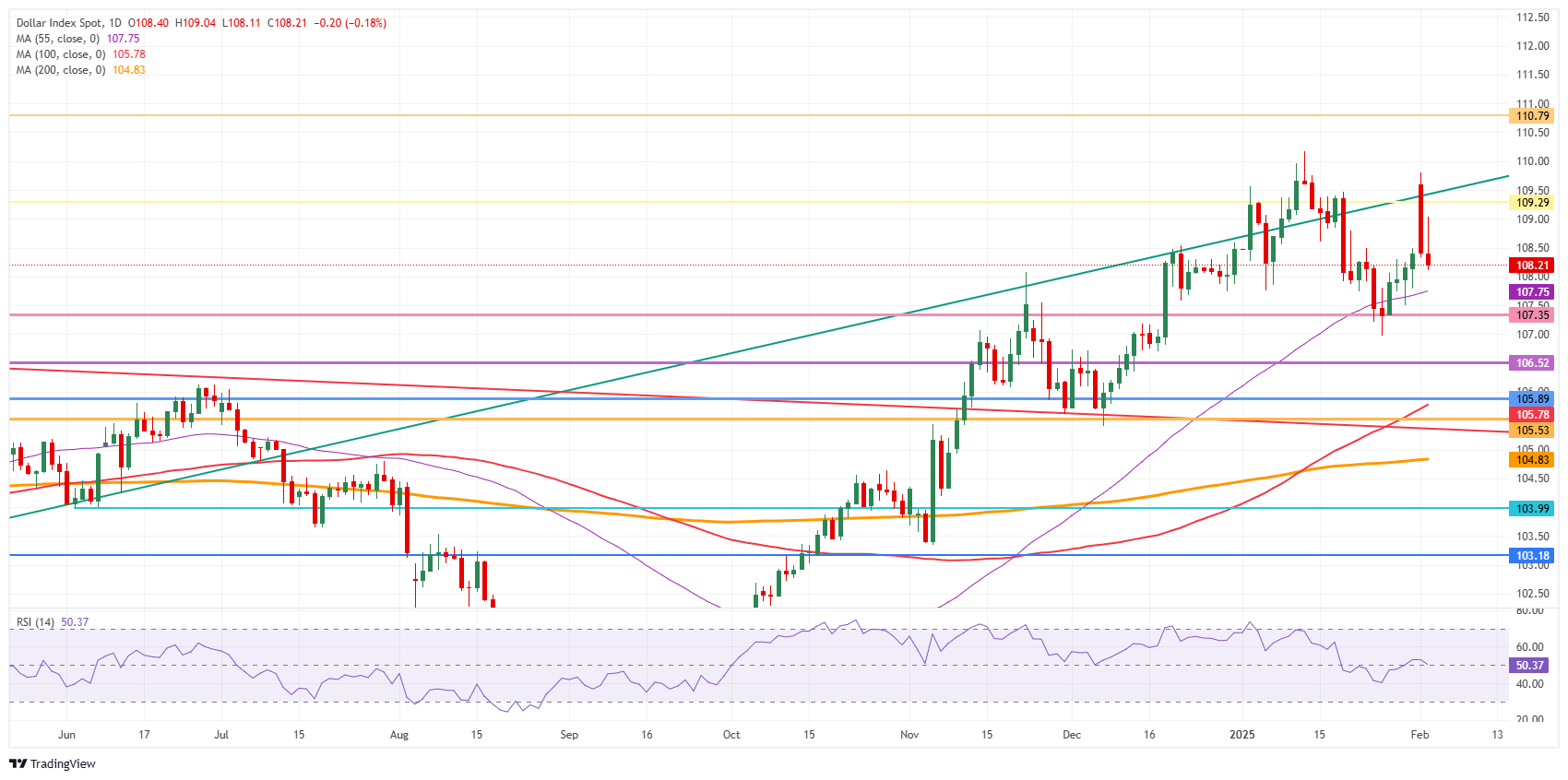
US Dollar Index: Daily Chart
Employment FAQs
Labor market conditions are a key element to assess the health of an economy and thus a key driver for currency valuation. High employment, or low unemployment, has positive implications for consumer spending and thus economic growth, boosting the value of the local currency. Moreover, a very tight labor market – a situation in which there is a shortage of workers to fill open positions – can also have implications on inflation levels and thus monetary policy as low labor supply and high demand leads to higher wages.
The pace at which salaries are growing in an economy is key for policymakers. High wage growth means that households have more money to spend, usually leading to price increases in consumer goods. In contrast to more volatile sources of inflation such as energy prices, wage growth is seen as a key component of underlying and persisting inflation as salary increases are unlikely to be undone. Central banks around the world pay close attention to wage growth data when deciding on monetary policy.
The weight that each central bank assigns to labor market conditions depends on its objectives. Some central banks explicitly have mandates related to the labor market beyond controlling inflation levels. The US Federal Reserve (Fed), for example, has the dual mandate of promoting maximum employment and stable prices. Meanwhile, the European Central Bank’s (ECB) sole mandate is to keep inflation under control. Still, and despite whatever mandates they have, labor market conditions are an important factor for policymakers given its significance as a gauge of the health of the economy and their direct relationship to inflation.
Author

Filip Lagaart
FXStreet
Filip Lagaart is a former sales/trader with over 15 years of financial markets expertise under its belt.
















