US Dollar goes nowhere with markets still unsure on the size of the upcoming Fed rate cut
- The US Dollar steady while analysts are still debating on the size of the upcoming rate cut.
- Traders will sit on their hands until the decision is out, followed by the Fed’s Chair Powell press conference.
- The US Dollar Index retraces on Wednesday after the prior day’s small bounce.

The US Dollar (USD) retraces and trades below 101.00, as measured by the US Dollar Index (DXY), ahead of the US Federal Reserve (Fed) interest rate decision on Wednesday. The DXY is under pressure near the yearly lows and faces a key moment, with the Federal Open Market Committee (FOMC) ready to answer how much the Fed needs to cut interest rates. Besides Fed Chairman Jerome Powell’s speech and press conference, the focus will be on the Summary of Economic Projections (SEP), or the Fed’s Dot Plot or Philips curve, where every FOMC member gets a chance to communicate where they see the Fed policy rate move to in the near future. The number of projected rate cuts could be vital in guiding markets in their expectations.
On the economic data front, some relatively light data points are not set to move the needle ahead of the Fed decision on Wednesday. Markets are still split between a 25 or 50 basis points interest rate cut, so guidance from Fed Chairman Jerome Powell during his speech could shed a completely different light on the matter and might result in a knee-jerk reaction.
Daily digest market movers: Powell's speech could deliver knee jerk reaction
- The main set of economic data on Wednesday were the monthly Building Permits and Housing Starts data. Monthly Building Permits jumped to 1.475 million in August from 1.406 million in July. Monthly Housing Starts were a beat on estimate with 1.356 million in August against 1.238 million previously.
- At 18:00 GMT, the Fed will release its Interest Rate Decision, the Monetary Policy Statement, and the Summary of Economic Projections.
- At 18:30 GMT, Fed Chairman Jerome Powell will take the stage with a statement followed by a Q&A session.
- Asian equities closed off positive for this Wednesday. European equities are a bit less shure on the Fed and are trading at minor losses. US futures are flat ahead of the opening bell.
- The CME Fedwatch Tool shows it will be a very close call this Wednesday with a 25 basis points (bps) interest rate cut probability at 37.0%. Meanwhile, the chances of a 50 bps cut are at 63%. For the November 7 meeting, another 25 bps cut (if this Wednesday is a 25 bps cut) is expected by 22.4%, while there is a 51.6% chance that rates will be 75 bps (25 bps + 50 bps) and a 26.0% probability of rates being 100 (25 bps + 75 bps) basis points lower compared to current levels.
- The US 10-year benchmark rate trades at 3.68%, bounces off the 15-month low of 3.60%.
Economic Indicator
Fed Interest Rate Decision
The Federal Reserve (Fed) deliberates on monetary policy and makes a decision on interest rates at eight pre-scheduled meetings per year. It has two mandates: to keep inflation at 2%, and to maintain full employment. Its main tool for achieving this is by setting interest rates – both at which it lends to banks and banks lend to each other. If it decides to hike rates, the US Dollar (USD) tends to strengthen as it attracts more foreign capital inflows. If it cuts rates, it tends to weaken the USD as capital drains out to countries offering higher returns. If rates are left unchanged, attention turns to the tone of the Federal Open Market Committee (FOMC) statement, and whether it is hawkish (expectant of higher future interest rates), or dovish (expectant of lower future rates).
Read more.Next release: Wed Sep 18, 2024 18:00
Frequency: Irregular
Consensus: 5.25%
Previous: 5.5%
Source: Federal Reserve
US Dollar Index Technical Analysis: Do not get caught
The US Dollar Index (DXY) is set to either stick to its range for quite a time longer or finally break out of this rud it has been for nearly a month. The Fed rate decision on Wednesday is the catalyst that markets seek to finally break out of a certain consolidation phase. With the split conviction on the size of the interest rate cut, the risk is that a knee-jerk reaction could end up with the DXY opening Thursday still in the same tight range between 100.62 and 101.90.
The upper level of the recent range is 101.90. Further up, a steep 1.2% uprising would be needed to get the index to 103.18, with the 55-day Simple Moving Average (SMA) at 102.82 on the way. The next tranche up is very misty, with the 200-day SMA at 103.80 and the 100-day SMA at 103.84, just ahead of the big 104.00 round level.
On the downside, 100.62 (the low from December 28, 2023) holds strong and has already made the DXY rebound two times in recent weeks. Should it break, the low from July 14, 2023, at 99.58, will be the next level to look out for. If that level gives way, early levels from 2023 are coming in near 97.73.
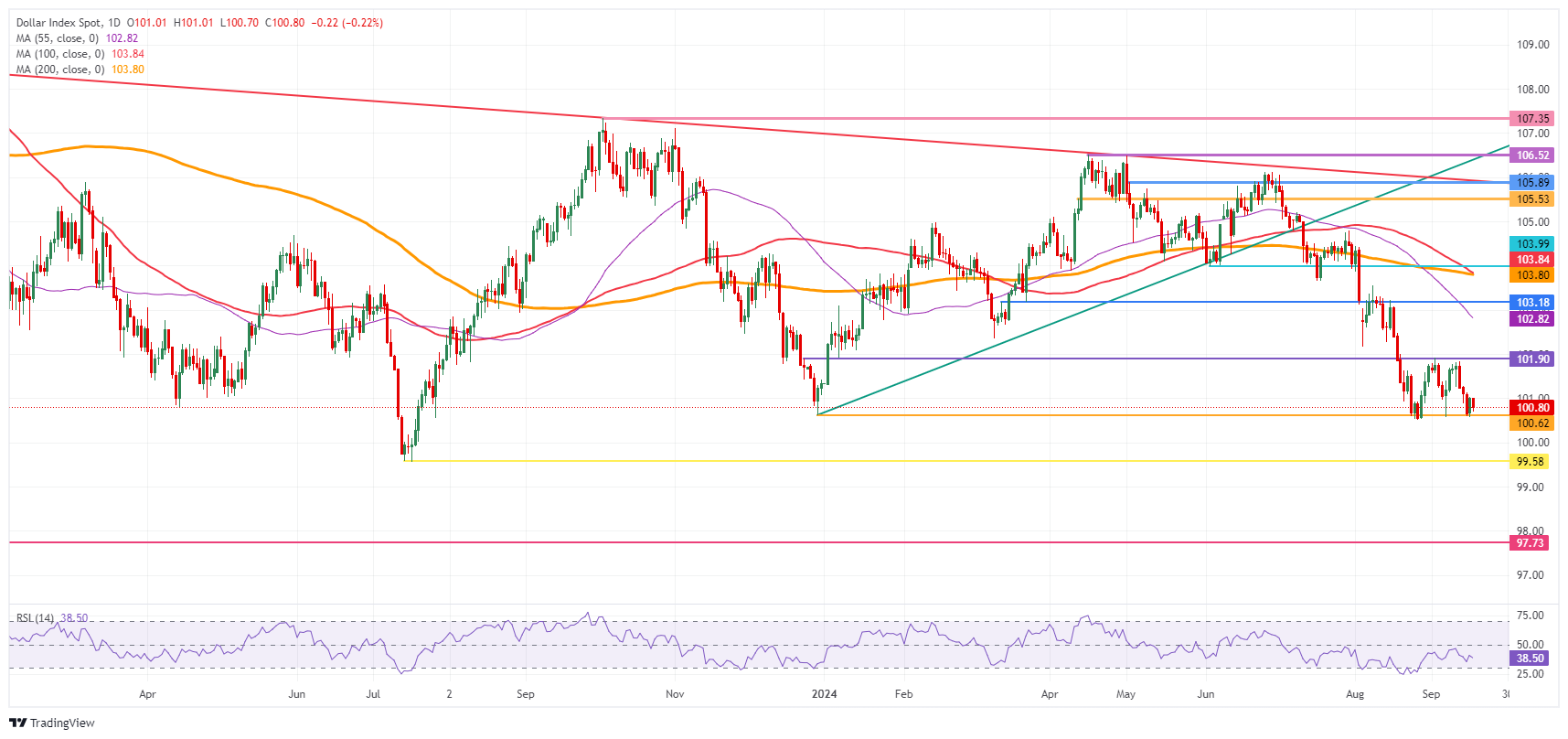
US Dollar Index: Daily Chart
Fed FAQs
Monetary policy in the US is shaped by the Federal Reserve (Fed). The Fed has two mandates: to achieve price stability and foster full employment. Its primary tool to achieve these goals is by adjusting interest rates. When prices are rising too quickly and inflation is above the Fed’s 2% target, it raises interest rates, increasing borrowing costs throughout the economy. This results in a stronger US Dollar (USD) as it makes the US a more attractive place for international investors to park their money. When inflation falls below 2% or the Unemployment Rate is too high, the Fed may lower interest rates to encourage borrowing, which weighs on the Greenback.
The Federal Reserve (Fed) holds eight policy meetings a year, where the Federal Open Market Committee (FOMC) assesses economic conditions and makes monetary policy decisions. The FOMC is attended by twelve Fed officials – the seven members of the Board of Governors, the president of the Federal Reserve Bank of New York, and four of the remaining eleven regional Reserve Bank presidents, who serve one-year terms on a rotating basis.
In extreme situations, the Federal Reserve may resort to a policy named Quantitative Easing (QE). QE is the process by which the Fed substantially increases the flow of credit in a stuck financial system. It is a non-standard policy measure used during crises or when inflation is extremely low. It was the Fed’s weapon of choice during the Great Financial Crisis in 2008. It involves the Fed printing more Dollars and using them to buy high grade bonds from financial institutions. QE usually weakens the US Dollar.
Quantitative tightening (QT) is the reverse process of QE, whereby the Federal Reserve stops buying bonds from financial institutions and does not reinvest the principal from the bonds it holds maturing, to purchase new bonds. It is usually positive for the value of the US Dollar.
Author

Filip Lagaart
FXStreet
Filip Lagaart is a former sales/trader with over 15 years of financial markets expertise under its belt.