US Dollar steamrolls traders as markets struggle for direction
- The US Dollar appreciates throughout the day and ekes out big gains.
- Traders see the Fed confirming market projections on cutting cycle for 2025.
- The US Dollar Index breaks out of its 103.00 - 104.00 range for the first time in weeks.

The US Dollar Index (DXY), which tracks the performance of the US Dollar (USD) against six major currencies, rallies above 104.00 on Thursday after the weekly jobcless claims data. Borrowing costs were kept unchanged overnight by the Federal Reserve (Fed), and projected two interest rate cuts for 2025. During Wednesday’s Fed meeting, Chairman Jerome Powell said that any tariff-driven bump in inflation will be “transitory.” However, he added later that it will be very challenging to say with confidence how much inflation stems from tariffs versus other factors. He also said recession odds have moved up, though are not high, Bloomberg reports.
Meanwhile US yields are plunging lower with investors heading into US bonds. The prospects of yields set to decline once the Fed starts cutting, sees a flight into the safe haven asset. That together with the geopolitical uncertainty as clearly a quick ceasefire for Ukraine is out of the cards and geopolitical tensions are heightened in Turkey and Gaza, makes sense that the safe haven US bonds are favoured again.
Daily digest market movers: Bonds push US yields lower
- At 12:30 GMT, the most important data for this Thursday was released:
- US Initial Jobless Claims ticekd up to 223,000, coming from 221,000. The US Continuing Jobless Claims came in at 1,892 million against 1,859million last week.
- The Philadelphia Fed Manufacturing Survey for March fell to 12.5, better than the expected 8.5 and from the previous 18.1.
- At 14:00 GMT, US Existing Home Sales month-on-month for February will be released. Expectations are for a contraction to 3.95 million compared to 4.08 million the previous month.
- Equities are struggling with European indices facing big profit-taking. The German Dax is down over 1%. US equities are trying to brush off the negative tone and turn higher on the day.
- According to the CME Fedwatch Tool, the probability of interest rates remaining at the current range of 4.25%-4.50% in May’s meeting is at 80.5%. For June, the odds for borrowing costs being lower stand at 71.1%.
- The US 10-year yield trades around 4.22%, heading back to its five-month low of 4.10% printed on March 4.
US Dollar Index Technical Analysis: Keep calm
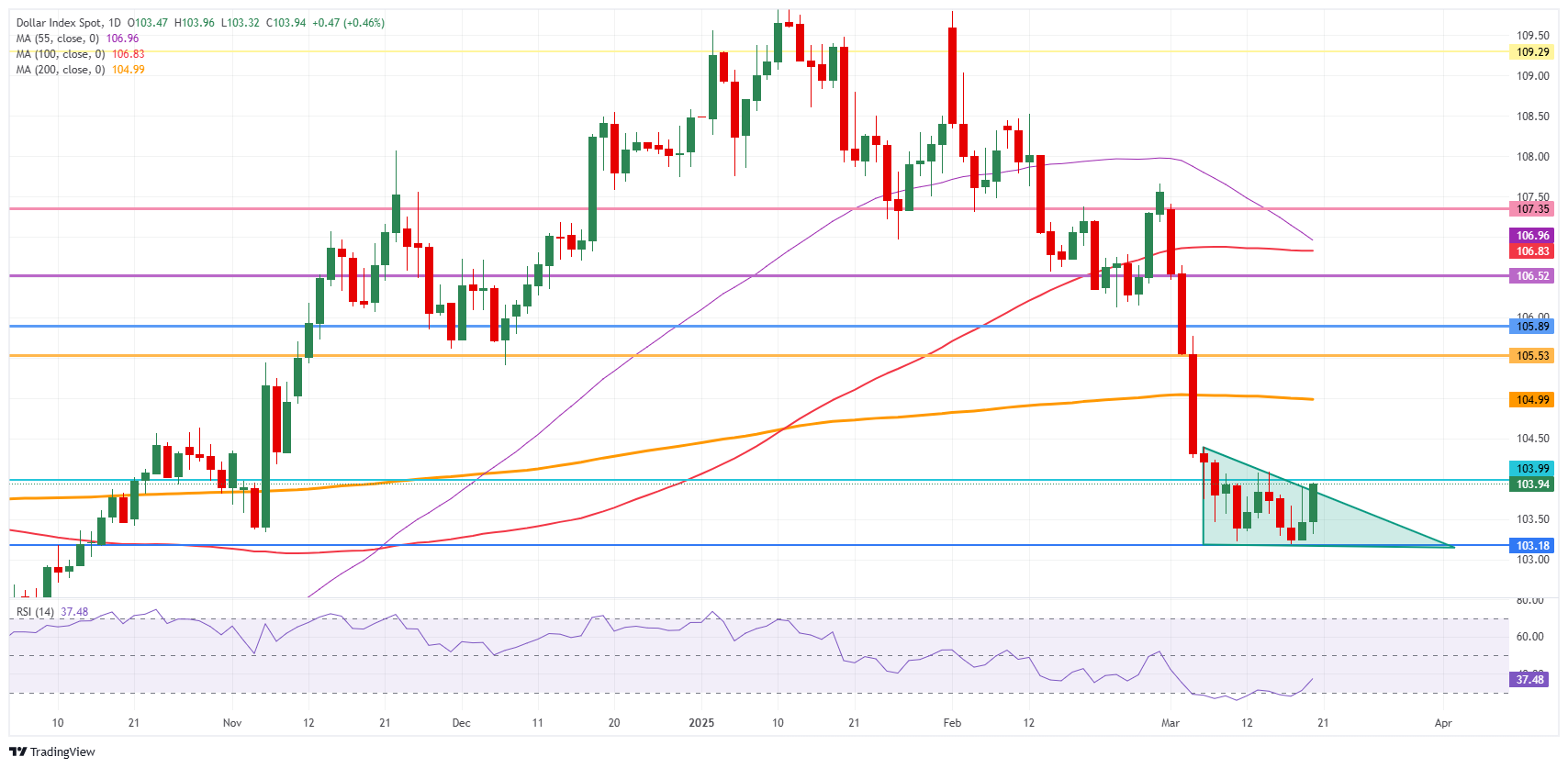
The US Dollar Index (DXY) is trying to break out of a short-term technical descending triangle pattern. The tilted side of a triangle should act as strong resistance while the flat base of the triangle at 103.18 should act as strong support. Normally, the textbook logic is that sellers will build up positions alongside the tilted descending trend line in order to break through that flat base, which will result in more downturn.
The fact that currently the DXY is trying to break out of that pattern could be a sign for a turnaround, though heavy resistance is awaiting just around the corner at 104.00.
If bulls can avoid a technical rejection at 104.00, a large sprint higher towards the 105.00 round level could happen, with the 200-day Simple Moving Average (SMA) converging at that point and reinforcing this area as a strong resistance. Once broken through that zone, a string of pivotal levels, such as 105.53 and 105.89, could limit the upward momentum.
On the downside, the 103.00 round level could be considered a bearish target in case US yields roll off on deteriorating US data, with even 101.90 on the table if markets further capitulate on their long-term US Dollar holdings.
US Dollar Index: Daily Chart
Fed FAQs
Monetary policy in the US is shaped by the Federal Reserve (Fed). The Fed has two mandates: to achieve price stability and foster full employment. Its primary tool to achieve these goals is by adjusting interest rates. When prices are rising too quickly and inflation is above the Fed’s 2% target, it raises interest rates, increasing borrowing costs throughout the economy. This results in a stronger US Dollar (USD) as it makes the US a more attractive place for international investors to park their money. When inflation falls below 2% or the Unemployment Rate is too high, the Fed may lower interest rates to encourage borrowing, which weighs on the Greenback.
The Federal Reserve (Fed) holds eight policy meetings a year, where the Federal Open Market Committee (FOMC) assesses economic conditions and makes monetary policy decisions. The FOMC is attended by twelve Fed officials – the seven members of the Board of Governors, the president of the Federal Reserve Bank of New York, and four of the remaining eleven regional Reserve Bank presidents, who serve one-year terms on a rotating basis.
In extreme situations, the Federal Reserve may resort to a policy named Quantitative Easing (QE). QE is the process by which the Fed substantially increases the flow of credit in a stuck financial system. It is a non-standard policy measure used during crises or when inflation is extremely low. It was the Fed’s weapon of choice during the Great Financial Crisis in 2008. It involves the Fed printing more Dollars and using them to buy high grade bonds from financial institutions. QE usually weakens the US Dollar.
Quantitative tightening (QT) is the reverse process of QE, whereby the Federal Reserve stops buying bonds from financial institutions and does not reinvest the principal from the bonds it holds maturing, to purchase new bonds. It is usually positive for the value of the US Dollar.
Author

Filip Lagaart
FXStreet
Filip Lagaart is a former sales/trader with over 15 years of financial markets expertise under its belt.