US Dollar extends losses as risk appetite improves on trade hopes
- The US Dollar stabilizes on Wednesday after a sharp three-day decline.
- US President Donald Trump announces a $550B trade deal with Japan, easing trade tensions.
- Political pressure mounts on Fed Chair Powell; Trump calls him a “numbskull.”

The US Dollar (USD) is edging lower on Wednesday, extending its three-day slide as traders continue to tread cautiously ahead of the August 1 tariff deadline. Market sentiment has improved slightly following news of a trade agreement between the US and Japan. However, gains in the Greenback remain limited as political pressure mounts on the Federal Reserve (Fed). Fresh criticism aimed at Chair Jerome Powell has reignited concerns about the central bank’s independence, keeping investors on edge and the USD under pressure.
The US Dollar Index (DXY), which tracks the Greenback’s performance against a basket of six major currencies, is trading around 97.20 in the American session, slipping further after a failed attempt to push above 97.50. The index has now lost roughly 1.30% so far this week, marking a sharp retreat from near four-week highs.
US President Donald Trump fueled cautious optimism on Tuesday after announcing what he called a “massive” trade deal with Japan, describing it as “perhaps the largest deal ever made.” The United States and Japan have reached a new trade agreement that reduces the previously proposed 25% tariffs on a wide range of Japanese goods to a lower 15% rate. According to Trump, Japan will invest $550 billion in the United States, with 90% of the profits expected to return to American industries. He also claimed the agreement would create “hundreds of thousands of jobs” and open up Japanese markets to US exports, including cars, trucks, rice and agricultural products.
There’s growing optimism that the US and European Union (EU) are close to reaching a trade agreement. According to EU officials, both sides are discussing a plan to apply a flat 15% tariff on certain good — similar to the recent US-Japan deal. Key sectors like aircraft, medical equipment, and spirits may be excluded from the new duties. The news lifted European stock markets on Wednesday, especially auto shares. Still, the EU is preparing backup tariffs worth €93 billion, which could kick in by August 7 if the talks don’t lead to a final deal.
Market movers: Global trade deals take shape as tariff deadline nears
- Data released today showed that Existing Home Sales in the US fell 2.7% in June to an annualized rate of 3.93 million units, missing expectations of 4.01 million. It’s the slowest pace since September 2024, as rising mortgage rates and a record-high June median price of $435,300 continue to sideline buyers. This marks the 24th straight year-over-year increase in home prices, underscoring persistent affordability challenges in the housing market.
- On Tuesday, President Trump announced a 19% tariff on imports from the Philippines. In return, the US secured zero tariff access for a wide range of American goods.
- Under a new framework, the US has agreed to lower tariffs on Indonesian goods to 19% from the previously proposed 32%. However, goods suspected of being "transshipped" to avoid higher duties from other countries will be subject to a 40% tariff. In return, Indonesia has committed to eliminating tariffs on over 99% of US products exported to Indonesia and scrapping non-tariff barriers.
- EU Trade Commissioner Maros Sefcovic arrived in Washington on Wednesday for talks aimed at negotiating sweeping US tariffs of up to 30% on European goods. With the August 1 deadline fast approaching, Brussels is pushing for a trade deal to avoid high tariffs, while preparing retaliatory measures in case the talks fail to progress.
- Trade Secretary Scott Bessent is expected to meet with Chinese officials next week in Stockholm. He also signaled that the current tariff truce with China is likely to be extended ahead of its expiration on August 12.
- President Trump said earlier that a trade deal with India is close, but talks remain stalled. According to Reuters, hopes for a smaller agreement between the US and India before the tariff deadline have faded with major differences over agricultural and dairy products. While US representatives are expected to visit India later in July, the delay raises the risk of fresh tariffs on Indian exports.
- Fed Chair Jerome Powell remains under fire after President Trump renewed public attacks, calling him a "numbskull" and suggesting he will be gone in eight months. Meanwhile, Scott Bessent stated in an interview on Tuesday that there is nothing that suggests he should resign. He acknowledged Powell as a good public servant and indicated that Powell should continue his term, which ends in May 2026.
- All eyes turn to Thursday’s flash Purchasing Managers Index (PMI) releases from the US, Eurozone, and UK, with investors watching closely for signs of resilience or weakness in the global economy. The data will offer fresh insight into manufacturing and services activity for July, and could influence rate expectations heading into August. A softer US print may weigh on the Dollar, while a stronger-than-expected reading could reinforce hopes of a soft landing.
Technical Analysis:
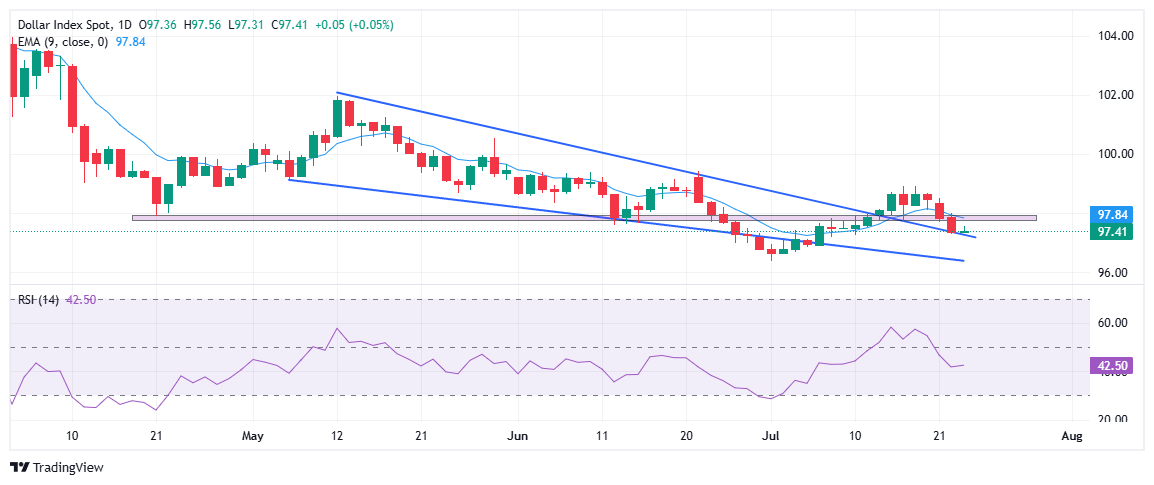
The US Dollar Index (DXY) is trading around 97.20 after a sharp pullback from its recent highs. Price is currently hovering just below the upper boundary of a falling wedge pattern, which had previously been breached to the upside but is now being retested as potential support-turned-resistance. This kind of wedge retest is often pivotal. If bulls fail to reclaim the broken structure with conviction, it could signal a false breakout and shift the technical tone back to bearish. The 9-day Exponential Moving Average (EMA), now trending slightly above at 97.84, adds to the pressure capping the upside.
The Relative Strength Index (RSI) has dipped to 42.50, indicating a fading of momentum and a lack of strong buying conviction. If the index can bounce from current levels and reclaim both the wedge and the 98.00 psychological barrier, bullish momentum may resume. However, a clean rejection from this zone could expose the DXY to a deeper drop toward the next support band around 96.70-96.50.
Economic Indicator
S&P Global Composite PMI
The S&P Global Composite Purchasing Managers Index (PMI), released on a monthly basis, is a leading indicator gauging US private-business activity in the manufacturing and services sector. The data is derived from surveys to senior executives. Each response is weighted according to the size of the company and its contribution to total manufacturing or services output accounted for by the sub-sector to which that company belongs. Survey responses reflect the change, if any, in the current month compared to the previous month and can anticipate changing trends in official data series such as Gross Domestic Product (GDP), industrial production, employment and inflation. The index varies between 0 and 100, with levels of 50.0 signaling no change over the previous month. A reading above 50 indicates that the private economy is generally expanding, a bullish sign for the US Dollar (USD). Meanwhile, a reading below 50 signals that activity is generally declining, which is seen as bearish for USD.
Read more.Next release: Thu Jul 24, 2025 13:45 (Prel)
Frequency: Monthly
Consensus: -
Previous: 52.9
Source: S&P Global
Author

Vishal Chaturvedi
FXStreet
I am a macro-focused research analyst with over four years of experience covering forex and commodities market. I enjoy breaking down complex economic trends and turning them into clear, actionable insights that help traders stay ahead of the curve.

















