US Dollar steadies after US Services PMI contracts against all odds
- The US Dollar holds on to small gains after rather disappointing US PMI release.
- The US economy is no longer outperforming or outpacing the Eurozone.
- The US Dollar Index (DXY) heads back to the mid-106.00 region.

The US Dollar Index (DXY), which tracks the performance of the US Dollar (USD) against six major currencies, is trading around 106.60 at the time of writing after a rather disappointing United States (US) preliminary Purchase Manager's Index (PMI) release for February. Main element which stood out was the Services sector that fell into contraction at 49.7, missing the 53.0 estimate and below the January 52.9 reading. The uptick in the Manufacturing sector helped to give some counterweight to the otherwise rather disappointing Services number.
With all US data out of the way for this week, from here all eyes will shift to Sunday when German elections are due to take place.
Daily digest market movers: Inflation expectations
- In the early European trading session, the preliminary Purchasing Managers Index (PMI) data for February was already released in several European countries. What stood out:
- French HCOB Services PMI fell further into contraction to 44.5, missing the 48.9 estimate and contracting further from the previous 48.2.
- European HCOB Services PMI fell to 50.7, missing the 51.5 estimate and below the previous 51.3 reading.
- German HCOB PMIs beat estimates despite the Services component that came in at 52.2, missing the 52.5 estimate and below the January 52.5 reading.
- The US preliminary S&P Global PMI data for February is out:
- The manufacturing sector came in at 51.6, beating the 51.5 consensus and beating the January 51.2.
- The services sector fell into contraction at 49.7, a big miss on the estimate 53.0, and far below the January 52.9.
- The University of Michigan had some surprises as well:
- The Consumer Sentiment Index fell to 64.7, missing the 67.8 estimate and previous reading.
- The 5-year Consumer Inflation Expectation index jumped to 3.5%, above the 3.3% estimate and previous reading.
- Equities are sinking lower with nearly all US equity indices down by 0.50%.
- The CME FedWatch tool shows a 47.5% chance that interest rates will remain unchanged at current levels in June.
- The US 10-year yield trades around 4.45%, slipping further and further away from its Wednesday’s high of 4.574%.
US Dollar Index Technical Analysis: Steady for now
The US Dollar Index (DXY) is able to reclaim a little bit of room after another downbeat performance this week. The Euro (EUR) is helping out, with the partial recovery in the DXY index this Friday after some disappointing PMI releases, especially from France. If the US preliminary S&P Global PMI data for February, due this afternoon, shows some resilience for the country’s activity, the DXY could quickly be back up at 107.00.
On the upside, the previous support at 107.35 has now turned into a firm resistance. Further up, the 55-day SMA at 107.96 must be regained before reclaiming 108.00.
On the downside, 106.60 (100-day SMA) and 106.52 (April 16, 2024, high) have acted as an alert for buyers to step in and push the DXY back up. Further down, 105.89 (resistance in June 2024) will still hold as the next firm support level. The Relative Strength Index (RSI) momentum indicator in the daily chart still has not touched the oversold barrier. Therefore, the 200-day SMA at 104.98 could be a possible outcome if a firm catalyst emerges.
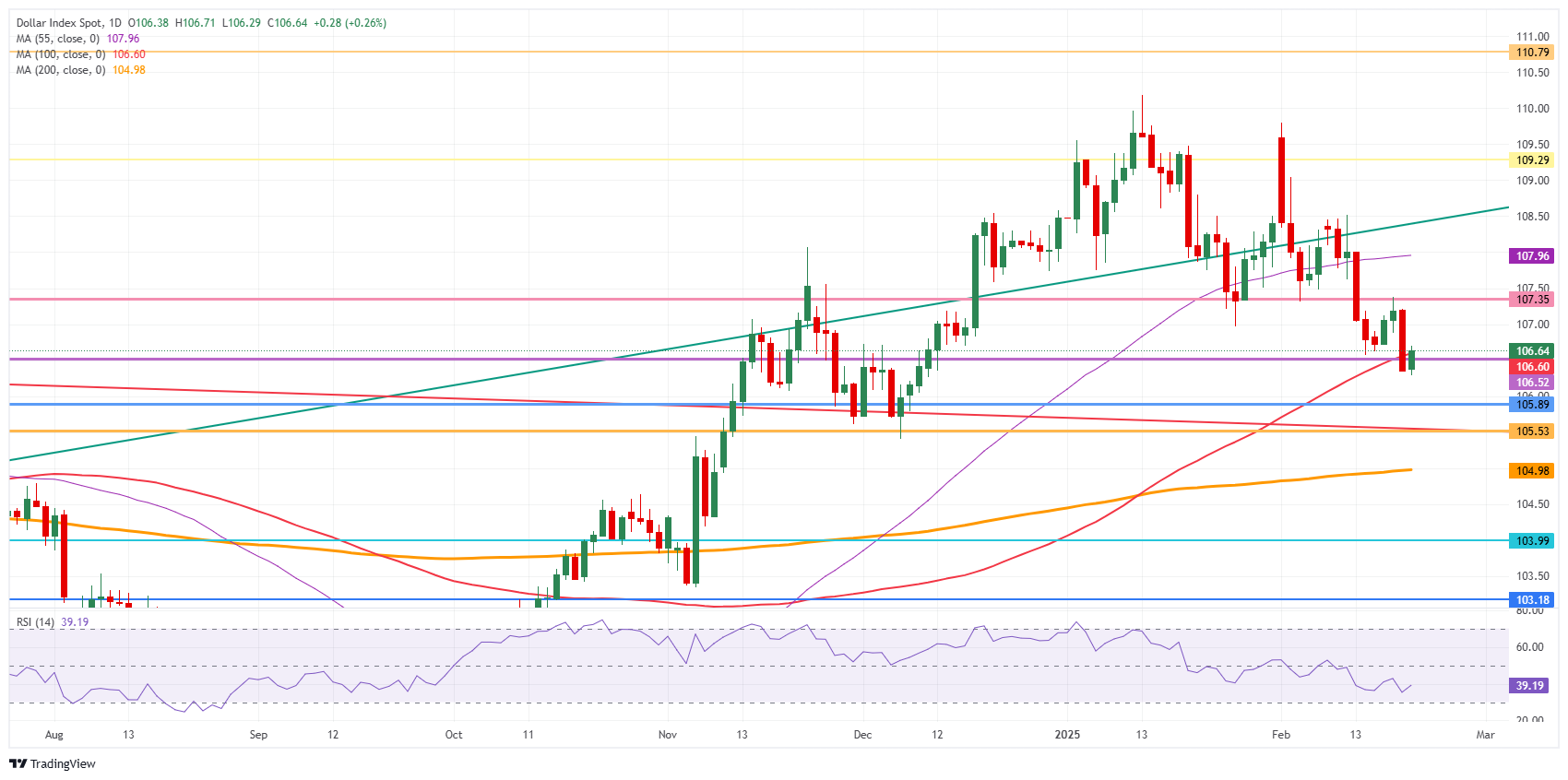
US Dollar Index: Daily Chart
German economy FAQs
The German economy has a significant impact on the Euro due to its status as the largest economy within the Eurozone. Germany's economic performance, its GDP, employment, and inflation, can greatly influence the overall stability and confidence in the Euro. As Germany's economy strengthens, it can bolster the Euro's value, while the opposite is true if it weakens. Overall, the German economy plays a crucial role in shaping the Euro's strength and perception in global markets.
Germany is the largest economy in the Eurozone and therefore an influential actor in the region. During the Eurozone sovereign debt crisis in 2009-12, Germany was pivotal in setting up various stability funds to bail out debtor countries. It took a leadership role in the implementation of the 'Fiscal Compact' following the crisis – a set of more stringent rules to manage member states’ finances and punish ‘debt sinners’. Germany spearheaded a culture of ‘Financial Stability’ and the German economic model has been widely used as a blueprint for economic growth by fellow Eurozone members.
Bunds are bonds issued by the German government. Like all bonds they pay holders a regular interest payment, or coupon, followed by the full value of the loan, or principal, at maturity. Because Germany has the largest economy in the Eurozone, Bunds are used as a benchmark for other European government bonds. Long-term Bunds are viewed as a solid, risk-free investment as they are backed by the full faith and credit of the German nation. For this reason they are treated as a safe-haven by investors – gaining in value in times of crisis, whilst falling during periods of prosperity.
German Bund Yields measure the annual return an investor can expect from holding German government bonds, or Bunds. Like other bonds, Bunds pay holders interest at regular intervals, called the ‘coupon’, followed by the full value of the bond at maturity. Whilst the coupon is fixed, the Yield varies as it takes into account changes in the bond's price, and it is therefore considered a more accurate reflection of return. A decline in the bund's price raises the coupon as a percentage of the loan, resulting in a higher Yield and vice versa for a rise. This explains why Bund Yields move inversely to prices.
The Bundesbank is the central bank of Germany. It plays a key role in implementing monetary policy within Germany, and central banks in the region more broadly. Its goal is price stability, or keeping inflation low and predictable. It is responsible for ensuring the smooth operation of payment systems in Germany and participates in the oversight of financial institutions. The Bundesbank has a reputation for being conservative, prioritizing the fight against inflation over economic growth. It has been influential in the setup and policy of the European Central Bank (ECB).
Author

Filip Lagaart
FXStreet
Filip Lagaart is a former sales/trader with over 15 years of financial markets expertise under its belt.