US Dollar on the backfoot with markets having sigh of relief on French voting outcome
- The US Dollar has a volatile start of the week, though it is on the back foot early on Monday.
- Talk of the town is the surprise gain of the left coalition in France.
- The US Dollar index hovers around 105.00, testing a vital level of support.

The US Dollar (USD) whipsaws on Monday with a lot of technical gap-fills after market openings were very choppy on the outcome of the second round of elections in France. In a surprise move, the left-wing coalition New Popular Front of Jean-Luc Mélenchon won and claimed victory, while the current ruling French President Emmanuel Macron’s centrist Ensemble alliance came in second. This is a surprise blow to the far-right National Rally of Marine Le Pen, who had a landslide victory in the first election round last week. With no one holding an absolute majority and political agendas being very dispersed and barely having any common ground, a hung parliament or a minority government seems to be the only possible outcome for now. Still, the far-right movement appears to be halted.
On Monday, all eyes will be on the bond market and the spreads between France and Germany. On the US economic front, it is a very calm start to the week. US Federal Reserve (Fed) Chairman Jerome Powell is heading to Capitol Hill on Tuesday and Wednesday for its semi-annual testimony on the economic outlook and recent monetary policy actions before the Joint Economic Committee. That is just ahead of the US Consumer Price Index (CPI) data for June, which is scheduled for Thursday.
Daily digest market movers: Equites are happy
- Hungarian Minister-President Viktor Orban, who is currently at the helm for a six-month rotating term as President of the European Union, has made another suprise visit. This time he caught up with Chinese President Xi Jin Ping, after earlier last week Orban paid a visit to Ukrainian President Volodymyr Zelensky and Russian President Vladimir Putin. Orban is expected to head to the United States next.
- As mentioned above, a hung parliament looks likely in France, still the far-right movement appears to be halted. This translates into a drop in yield spreads between France and Germany. Last week, the spread between the two 10-year sovereign bond yields rose towards 81 basis points when Marine Le Pen’s far-right party was in the lead. The gap now narrows to 65 basis points, with, on average, the spread being around 50 basis points in normal conditions.
- Markets are applauding the stalemate situation because the far left party has no majority to pass its extensive and excessive spending agenda. Actually, not any party will be able to push through any sort of reform until the next elections, which will be the Presidential ones, on April 11, 2027.
- Over the weekend, more democratic key people in the US came out to ask President Joe Biden to resign and pave the way for someone else.
- At 15:30 GMT, the US Treasury Department will auction a 3-month and a 6-month bill.
- The US Consumer Credit Change for May is expected to rise to $8.65 billion from $6.4 billion.
- Quite the turnaround in equities with both European and US equities turning green ahead of the US opening bell.
- The CME Fedwatch Tool is broadly backing a rate cut in September despite recent comments from Fed officials. The odds now stand at 69% for a 25-basis-point cut. A rate pause stands at a 26.1% chance, while a 50-basis-point rate cut has a slim 4.8% possibility.
- The US 10-year benchmark rate trades at 4.27%, and turns volatile after hitting 4.31% earlier just ahead of the US session.
US Dollar Index Technical Analysis: Expect this to fade
The US Dollar Index (DXY) fell out of bed on Monday in early trading, with markets scrambling to look for direction on the back of the French election outcome in the second round. Expect this news to get digested by the US markets as no changes are taking place in France on the international forum, with no additional spending packages or reforms to be pushed through with a non-majority government. All eyes will be on the bond markets because the declines in European yields are also spilling over into US bonds, where a further decline could drive the DXY lower.
On the upside, the 55-day Simple Moving Average (SMA) at 105.18 has now turned into resistance after an early test during the Asian session received a firm rejection and pushed the DXY further down again to test the 105.00 level. Should that 55-day SMA be reclaimed again, 105.53 and 105.89 are the next nearby pivotal levels. In case Fed Chairman Powell delivers some hawkish comments before Congress later this week or the US CPI print points to a pickup in inflation again, the red descending trend line in the chart around 106.23 and April’s peak at 106.52 could come into play.
On the downside, the risk of a nosedive move is increasing, with double support at 104.77, the confluence of the 100-day SMA and the green ascending trend line from December 2023. Should that double layer give way, the 200-day SMA at 104.43 is the gatekeeper that should catch the DXY and avoid further declines. Further down, the correction could head to 104.00 as an initial stage.
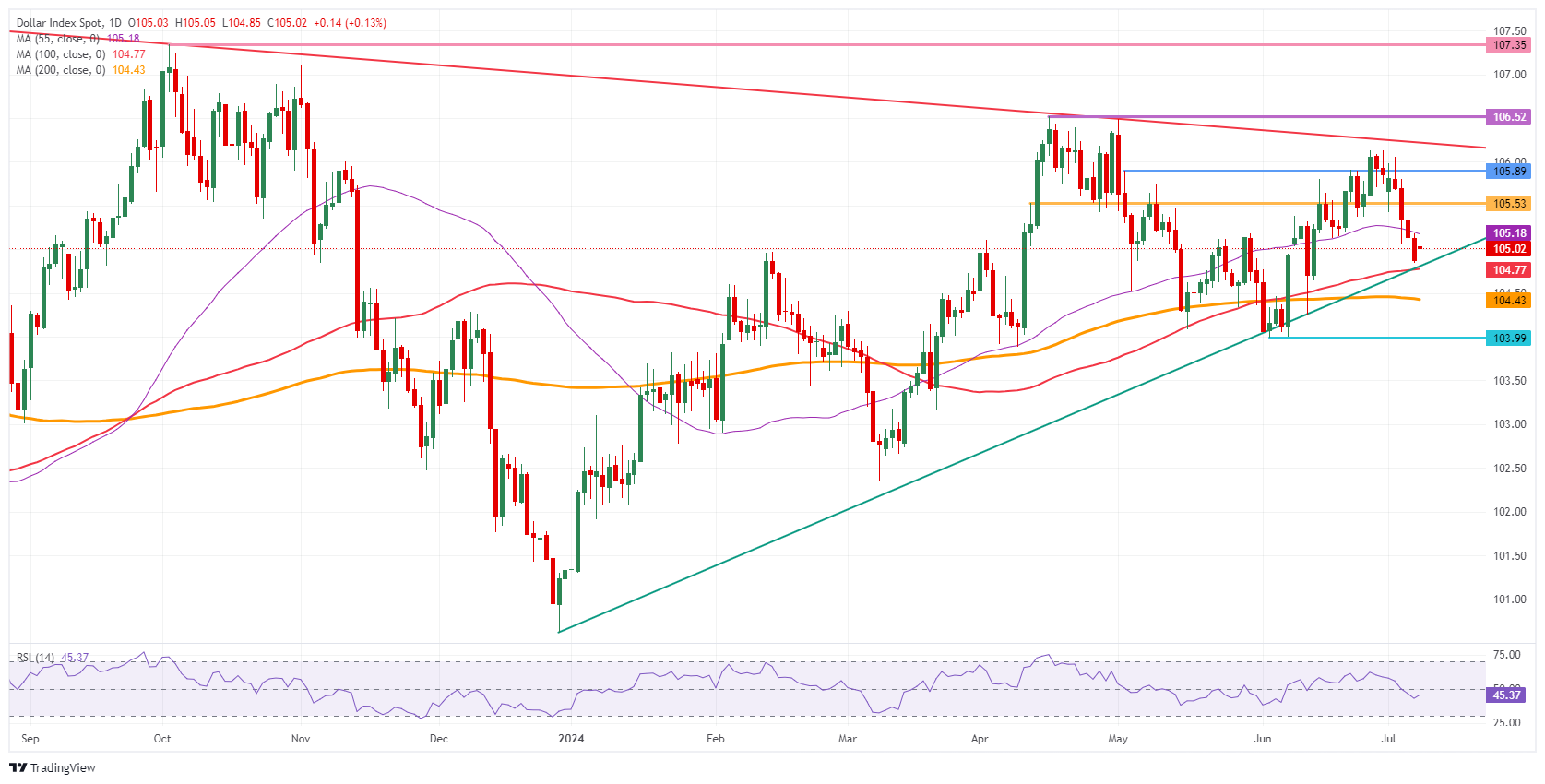
US Dollar Index: Daily Chart
Central banks FAQs
Central Banks have a key mandate which is making sure that there is price stability in a country or region. Economies are constantly facing inflation or deflation when prices for certain goods and services are fluctuating. Constant rising prices for the same goods means inflation, constant lowered prices for the same goods means deflation. It is the task of the central bank to keep the demand in line by tweaking its policy rate. For the biggest central banks like the US Federal Reserve (Fed), the European Central Bank (ECB) or the Bank of England (BoE), the mandate is to keep inflation close to 2%.
A central bank has one important tool at its disposal to get inflation higher or lower, and that is by tweaking its benchmark policy rate, commonly known as interest rate. On pre-communicated moments, the central bank will issue a statement with its policy rate and provide additional reasoning on why it is either remaining or changing (cutting or hiking) it. Local banks will adjust their savings and lending rates accordingly, which in turn will make it either harder or easier for people to earn on their savings or for companies to take out loans and make investments in their businesses. When the central bank hikes interest rates substantially, this is called monetary tightening. When it is cutting its benchmark rate, it is called monetary easing.
A central bank is often politically independent. Members of the central bank policy board are passing through a series of panels and hearings before being appointed to a policy board seat. Each member in that board often has a certain conviction on how the central bank should control inflation and the subsequent monetary policy. Members that want a very loose monetary policy, with low rates and cheap lending, to boost the economy substantially while being content to see inflation slightly above 2%, are called ‘doves’. Members that rather want to see higher rates to reward savings and want to keep a lit on inflation at all time are called ‘hawks’ and will not rest until inflation is at or just below 2%.
Normally, there is a chairman or president who leads each meeting, needs to create a consensus between the hawks or doves and has his or her final say when it would come down to a vote split to avoid a 50-50 tie on whether the current policy should be adjusted. The chairman will deliver speeches which often can be followed live, where the current monetary stance and outlook is being communicated. A central bank will try to push forward its monetary policy without triggering violent swings in rates, equities, or its currency. All members of the central bank will channel their stance toward the markets in advance of a policy meeting event. A few days before a policy meeting takes place until the new policy has been communicated, members are forbidden to talk publicly. This is called the blackout period.
Author

Filip Lagaart
FXStreet
Filip Lagaart is a former sales/trader with over 15 years of financial markets expertise under its belt.

















