|

US Dollar Index Price Analysis: Trims intraday losses but buyers are less hopeful below 91.00

  • DXY recovers from the day’s low after the week-start gap-down.
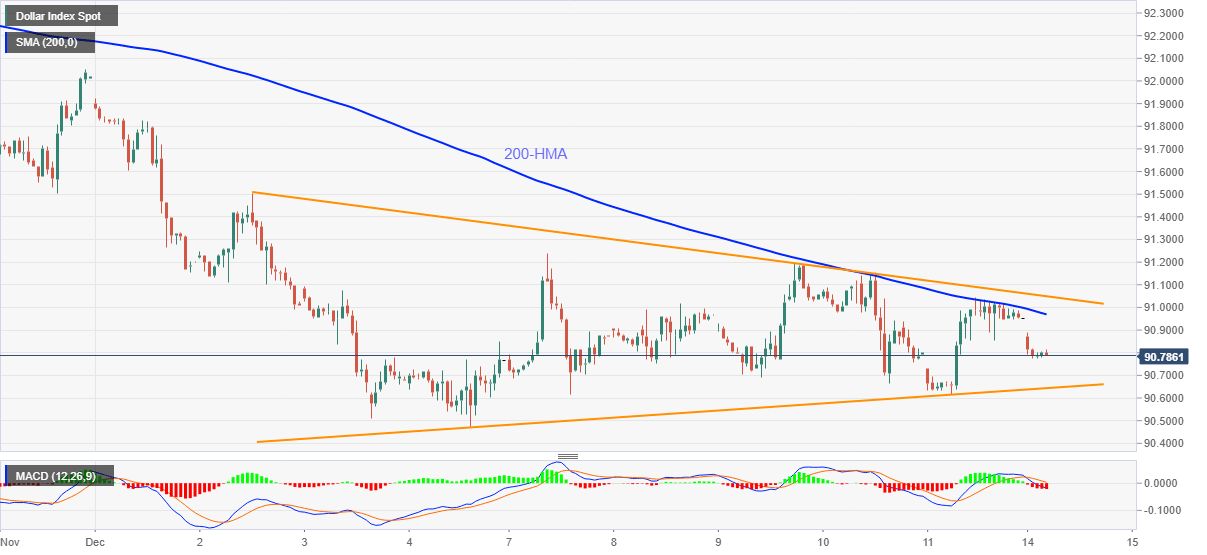
  • Short-term symmetrical triangle restricts immediate moves.
  • Bearish MACD, sustained trading below 200-HMA favor sellers.

US dollar index (DXY) marks a corrective pullback from 90.77 while taking rounds to 90.80 during the pre-European session on Monday. Even so, the greenback gauge prints 0.16% intraday losses while keeping the early-Asian gap to the south.

Not only the failure to fill the downside gap but sustained trading below 200-HMA amid bearish MACD also favor the sellers. However, the support line of an immediate triangle pattern, established from December 02, around 90.64, can challenge the US dollar bears.

In a case where the DXY sellers dominate past-90.64, the monthly bottom around 90.47 and the 90.00 psychological magnet can grab the market’s attention.

On the upside, the 200-HMA level of 90.96, followed by the stated triangle’s resistance, at 91.05 now, will keep the DXY bulls chained.

Though, a clear break to the north of 91.05 will not hesitate to challenge 91.50 before eyeing the monthly top near 91.90.

DXY hourly chart
Trend: Bearish

Additional important levels

Overview
Today last price90.8
Today Daily Change-0.15
Today Daily Change %-0.16%
Today daily open90.95
 
Trends
Daily SMA2091.64
Daily SMA5092.61
Daily SMA10092.94
Daily SMA20095.69
 
Levels
Previous Daily High91.04
Previous Daily Low90.62
Previous Weekly High91.24
Previous Weekly Low90.61
Previous Monthly High94.31
Previous Monthly Low91.5
Daily Fibonacci 38.2%90.88
Daily Fibonacci 61.8%90.78
Daily Pivot Point S190.7
Daily Pivot Point S290.44
Daily Pivot Point S390.27
Daily Pivot Point R191.12
Daily Pivot Point R291.3
Daily Pivot Point R391.55

Author

Anil Panchal

Anil Panchal

FXStreet

Anil Panchal has nearly 15 years of experience in tracking financial markets. With a keen interest in macroeconomics, Anil aptly tracks global news/updates and stays well-informed about the global financial moves and their implications.


More from Anil Panchal
Share:

Editor's Picks

GBP/USD retreats from weekly high vs firmer USD as focus shifts to BoE, US data

The GBP/USD pair struggles to capitalize on the previous day's strong move up to the weekly high and drifts lower during the Asian session on Thursday. Spot prices currently trade around mid-1.3300s, down over 0.10% for the day, and, for now, seem to have stalled the recovery move from a nearly four-week low, touched on Tuesday.

EUR/USD edges lower to near 1.1450 ahead of German/ EU GDP

EUR/USD trades with mild losses around 1.1450 in the early European hours on Thursday. The US Dollar recovers ground on renewed Mideast hostilities, despite a cautious Fed hold. Traders now brace for preliminary readings of the second-quarter Gross Domestic Product (GDP) from Germany, the Eurozone and the US. 


Gold extends intraday rejection slide from $4,100

Gold extends its intraday rejection slide from the $4,100 mark and moves further away from a one-week high, touched the previous day. The US Dollar regains positive traction following Wednesday's post-FOMC decline and is seen as a key factor weighing on the commodity. 

Mixed signals leave XRP and XLM at crossroads

Ripple and Stellar are trading at critical technical levels on Thursday. XRP has stabilized above the psychological $1.00 support, while XLM is testing support at $0.173. Traders should be cautious as mixed derivatives metrics keep the outlook uncertain for both altcoins. Derivatives data shows mixed sentiment among traders. CoinGlass’ long-to-short ratio for XRP reads 1.02 on Thursday.

Fed review: Reversing course (?)
At face value, the FOMC's 9-3 split decision hold was exactly in line with the expectations we laid out in our Fed preview - a divided hold, 22 July. We also named the three dissenters - Hammack, Logan and Kashkari - as the most likely hawks to support rapid tightening.
US Dollar mid-year outlook: Exceptional currency, exceptional risks?
The US Dollar enters the second half of 2026 in a markedly different position from a year ago. The King currency has recovered, reflecting persistent US inflation, changing expectations for Fed policy, geopolitical tensions and renewed demand for defensive assets.















