|

US Dollar Index Price Analysis: Rounding top on 4H portrays DXY bears’ dominance

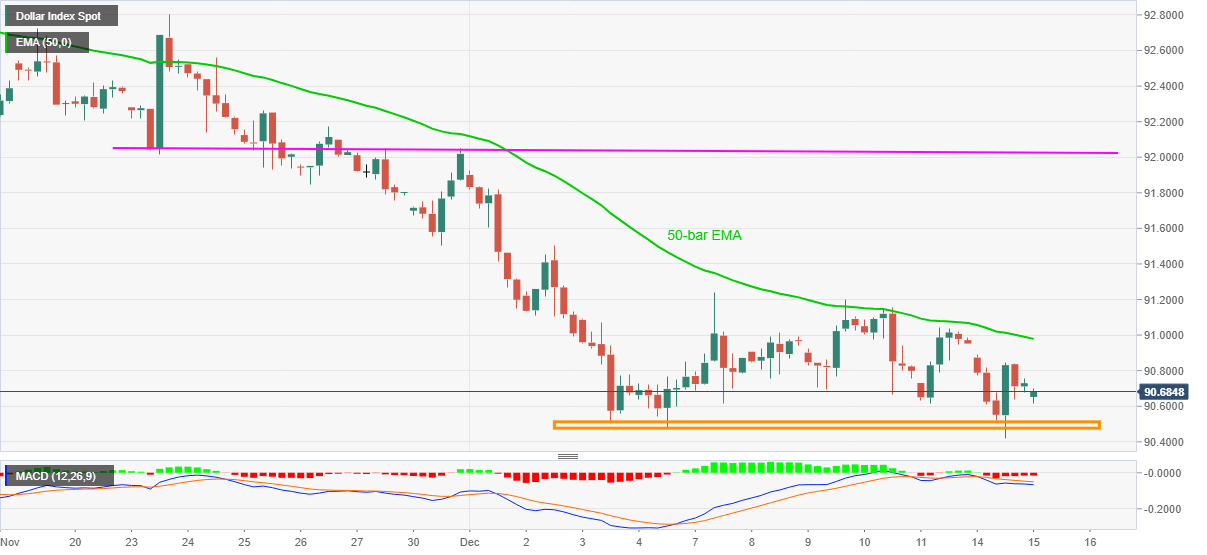
  • DXY fails to keep the bounce off April 2018 low.
  • Bearish MACD, sustained trading below 50-bar EMA favor sellers.
  • Bulls can eye three-week-old horizontal resistance above key EMA resistance.

US dollar index (DXY) prints mild losses, currently down 0.06% around 90.67, during the early Tuesday. The greenback gauge dropped to the fresh low since April 2018 before bouncing off 90.42. However, the corrective pullback faded around 90.84.

Not only the inability to recover but sustained trading below 50-bar SMA, amid bearish MACD, joins the eight-day-old rounding top formation on the four-hour (4H) chart to keep the DXY bears hopeful.

While multiple downside barriers around 90.50/45 can challenge the greenback sellers, the 90.00 threshold is likely attracting the offers before the April 2018 monthly bottom close to 89.22.

On the contrary, the recent high of 90.85 can guard the immediate upside of DXY ahead of the 50-day EMA level of 90.97.

The last Wednesday’s top near 91.20 and 91.50 are likely extra hurdles to the north ahead of a short-term horizontal resistance line near 92.03.

DXY four-hour chart
Trend: Bearish

Additional important levels

Overview
Today last price90.67
Today Daily Change-0.06
Today Daily Change %-0.07%
Today daily open90.73
 
Trends
Daily SMA2091.55
Daily SMA5092.55
Daily SMA10092.91
Daily SMA20095.67
 
Levels
Previous Daily High90.73
Previous Daily Low90.7
Previous Weekly High91.24
Previous Weekly Low90.61
Previous Monthly High94.31
Previous Monthly Low91.5
Daily Fibonacci 38.2%90.72
Daily Fibonacci 61.8%90.71
Daily Pivot Point S190.71
Daily Pivot Point S290.7
Daily Pivot Point S390.69
Daily Pivot Point R190.74
Daily Pivot Point R290.74
Daily Pivot Point R390.76

Author

Anil Panchal

Anil Panchal

FXStreet

Anil Panchal has nearly 15 years of experience in tracking financial markets. With a keen interest in macroeconomics, Anil aptly tracks global news/updates and stays well-informed about the global financial moves and their implications.


More from Anil Panchal
Share:

Editor's Picks

GBP/USD hovers around 1.3300 after flirting with monthly lows

GBP/USD trades mildly on the defensive on Wednesday, barely holding above a multi-week trough around 1.3280. Indeed, Cable struggles to gain traction as the Greenback remains resilient ahead of the Federal Reserve announcement. Moving forward, the British Pound should remain under the microscope in light of the BoE meeting on Thursday.

EUR/USD stays offered below 1.1400 pre-Fed

EUR/USD trades in a narrow range below 1.1400 on Wednesday. The pair’s slight decline comes as the US Dollar benefits from risk aversion amid the deepening crisis in the Middle East. In the meantime, investors remain exclusively focused on the imminent FOMC event and the press conference by Chair Warsh.

Gold: The $4,000 mark holds the downside ahead of the Fed

Gold remains on the back foot on Wednesday, navigating the area just above the psychological $4,000 mark per troy ounce amid the US Dollar’s marginal advance. In the meantime, escalating tensions in the US-Iran conflict weigh on the precious metal, while investors await the FOMC event later in the day.

Bitcoin slips below support, Ethereum and XRP flash bearish signals

Bitcoin, Ethereum and Ripple remain under pressure on Wednesday after a mild correction earlier this week. BTC slips below a key support zone, and ETH is testing a key resistance zone. Meanwhile, XRP is drifting toward the psychologically important $1.00 support level.

Bitcoin muted as markets fret over Fed, crypto bill
There are two main drivers for crypto this week, keeping Bitcoin trapped within its $58,000-$65,000 summer consolidation range. The cautious tone is being set by the Fed's policy decision scheduled later on Wednesday, a key catalyst for risk assets.
US Dollar mid-year outlook: Exceptional currency, exceptional risks?
The US Dollar enters the second half of 2026 in a markedly different position from a year ago. The King currency has recovered, reflecting persistent US inflation, changing expectations for Fed policy, geopolitical tensions and renewed demand for defensive assets.















