|

US Dollar Index Price Analysis: DXY bears keep 93.20 on radar

  • DXY remains pressured around three-week low after a two-day downtrend.
  • Clear break of 21-DMA, two-month-old horizontal area favor sellers.
  • 50-DMA, five-month-old support line offer a tough nut to crack for the bears.

US Dollar Index (DXY) fades bounce off multi-day low, retreating to 93.60 during Thursday’s Asian session.

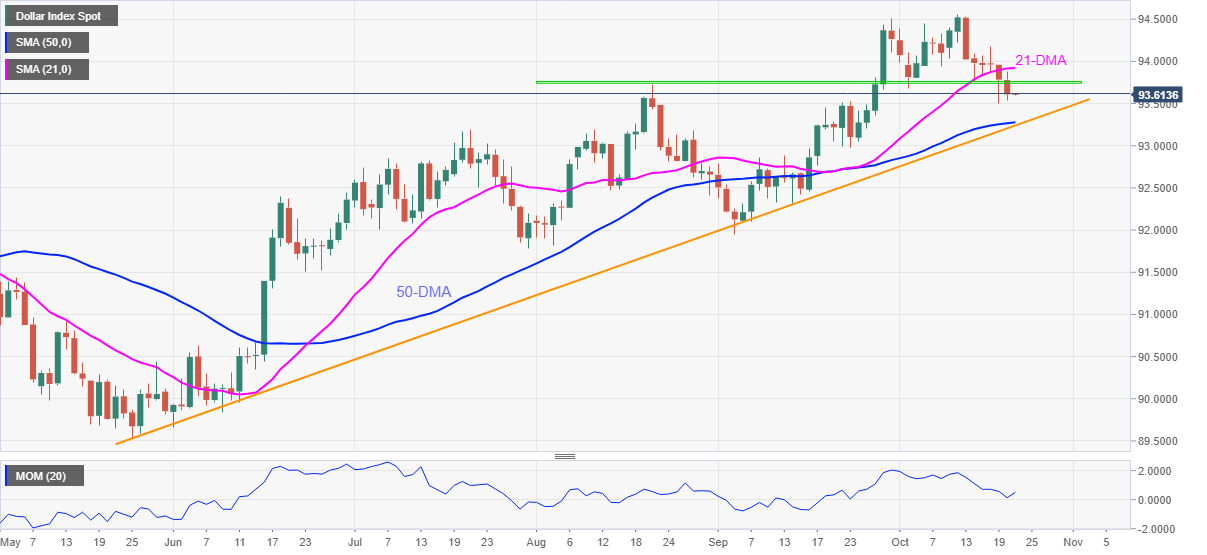
The greenback gauge dropped in the last two days following the downside break of 21-DMA and a horizontal area comprising levels marked since August.

Given the firmer Momentum backing the current south-run, US Dollar Index is likely staying on the sellers’ list.

However, a confluence of 50-DMA and an ascending support line from late May, around 93.20, will be a tough nut to crack for the DXY bears.

Should the quote drops below 93.20, September’s low near 91.94 will be in focus.

Alternatively, the stated horizontal area close to 93.75 precedes 21-DMA level near 93.92 to restrict short-term recovery moves of the US Dollar Index.

In a case where DXY bulls manage to conquer 93.92 hurdle, also cross the 94.00 threshold, the yearly top of 94.56 should gain the market’s attention.

DXY: Daily chart
Trend: Further weakness expected

Additional important levels

Overview
Today last price93.6
Today Daily Change-0.18
Today Daily Change %-0.19%
Today daily open93.78
 
Trends
Daily SMA2093.93
Daily SMA5093.25
Daily SMA10092.59
Daily SMA20091.83
 
Levels
Previous Daily High93.96
Previous Daily Low93.5
Previous Weekly High94.56
Previous Weekly Low93.76
Previous Monthly High94.51
Previous Monthly Low91.95
Daily Fibonacci 38.2%93.68
Daily Fibonacci 61.8%93.79
Daily Pivot Point S193.54
Daily Pivot Point S293.29
Daily Pivot Point S393.08
Daily Pivot Point R193.99
Daily Pivot Point R294.2
Daily Pivot Point R394.45

Author

Anil Panchal

Anil Panchal

FXStreet

Anil Panchal has nearly 15 years of experience in tracking financial markets. With a keen interest in macroeconomics, Anil aptly tracks global news/updates and stays well-informed about the global financial moves and their implications.


More from Anil Panchal
Share:

Editor's Picks

GBP/USD clings to gains near 1.3400

GBP/USD retreats after reaching a three-week high above 1.3430, challenging the 1.3400 yardstick on Thursday. Although easing political uncertainty in the UK helps the quid limit its downside, escalating tensions in the Middle East support the Greenback, keeping Cable under scrutiny.

EUR/USD faces resistance around 1.1450

EUR/USD keeps the bid bias although it seems to have met a tough hurdle around 1.1450 on Thursday. The pair’s advance follows the bearish tone in the US Dollar despite escalating tensions in the Middle East and a broad-based cautious stance from market participants.

Gold flirts with two-day highs, approaches $4,130

Gold stages a modest rebound on Thursday, setting aside a three-day losing streak and managing to surpass the $4,100 mark per troy ounce. However, steady geopolitical tensions have revived concerns over persistently high global inflation, reinforcing expectations of higher rates across the board and somewhat curtailing the yellow metal’s upside potential.

Bitcoin stalls as mixed ETF flows, renewed US-Iran tensions cap upside

Bitcoin trades at $63,000 on Thursday, recovering slightly after facing rejection near $64,000. Renewed geopolitical uncertainty has dampened risk appetite, limiting BTC upside potential.

Japan may be changing its Yen strategy, but markets don’t look scared
Japan may be changing its intervention playbook, but that might not be enough to rescue the battered Yen. With USD/JPY hovering at four-decade highs, the currency’s weakness is being driven less by speculative pressure and more by a powerful structural force: the wide US-Japan rate gap.
Bye, forward guidance: How to trade when central banks choose silence

Central banks have spent years telling markets what might come next. Now, traders face the possibility that they say a lot less. From the Federal Reserve to the European Central Bank and the Bank of England, policymakers are pushing back against forward guidance.















