US Dollar goes nowhere while G20 is set to meet on Ukraine this week
- The Greenback goes nowhere after a rather soft start in Asia on Monday.
- All eyes are on geopolitics after the Biden Administration delivered the green light for Ukraine to use long-range US missiles for targets in Russia.
- The US Dollar index holds ground above 106.50 for now while the economic calendar is rather flat for this Monday.

The US Dollar (USD) holds ground at rather elevated levels on Monday with a very calm start of the week, with the US Dollar Index (DXY), which gauges the Greenback’s value against six major currencies, slightly in the red near a fresh year-to-date high reached last Thursday above 106.50. The main driver for the currency on Monday is the green light from the Biden Administration on Sunday for Ukraine to use long-range US missiles to target Russian infrastructures within Russian borders, just ahead of the G20 meeting in Rio De Janeiro this Monday.
The US response comes after Moscow deployed nearly 50,000 troops to Kursk, the southern Russian region. Reporting on that, “the change comes largely in response to Russia's deployment of North Korean ground troops to supplement its own forces, a development that has caused alarm in Washington and Kyiv,” Reuters said.,.
The US economic calendar is very light this Monday. Besides a speech by Federal Reserve Bank of Chicago President Austan Goolsbee, nothing really market moving on the docket. Markets will instead look out for the G20 meeting and comments around Ukraine.
Daily digest market movers: Looking for a solution
- It is a very calm start to the week, and all eyes will shift to Rio de Janeiro in Brazil for the G20 summit, where Ukraine will be high on the calendar. Headlines around Ukraine started to pick up again last Friday when German Chancellor Olaf Schultz had a phone call with Russian President Vladimir Putin after nearly two years of radio silence. Over the weekend, Russia launched its biggest missile and drone attack thus far in this conflict. In response, the US Biden administration provided a green light for Ukraine to use long-range US missiles to target tactical infrastructure within Russia.
- At 15:00 GMT, Federal Reserve Bank of Chicago President Austan Goolsbee delivers welcome remarks at the Financial Markets Group annual conference in Chicago.
- The National Association of Home Builders (NAHB) has released its monthly Housing Market Index for November. An uptick to 46 beated the 44 estimate and came in better than the previous 43.
- Equities in Europe remain sluggish while US equities are heading into positive territory after the US Opening Bell.
- The CME FedWatch Tool is pricing in another 25 basis points (bps) rate cut by the Fed at the December 18 meeting by 61.9%. A 38.1% chance is for rates to remain unchanged. While the rate-cut scenario is the most probable, traders have significantly pared back some of the rate-cut bets compared with a week ago.
- The US 10-year benchmark rate trades at 4.45%, just off the high printed on Friday at 4.50%
US Dollar Index Technical Analysis: Looking for support
The US Dollar Index (DXY) has undergone market repricing on President-elect Donald Trump having secured his presidential victory and gaining control of the House of Representatives and the Senate. For now, it looks like the past weeks’ moves have topped out and will start to ease a touch. levels seen before heading into the US Presidential Elections two weeks ago.
After a brief test and a firm rejection last Thursday, the 107.00 round level remains in play. A fresh yearly high has already been reached at 107.07, which is the static level to beat. Further up, a fresh two-year high could be reached if 107.35 gets taken out.
On the downside, a fresh set of support is coming live. The first support is 105.93, the closing level on November 12. A touch lower, the pivotal 105.53 (April 11 high) should avoid any downturns towards 104.00.
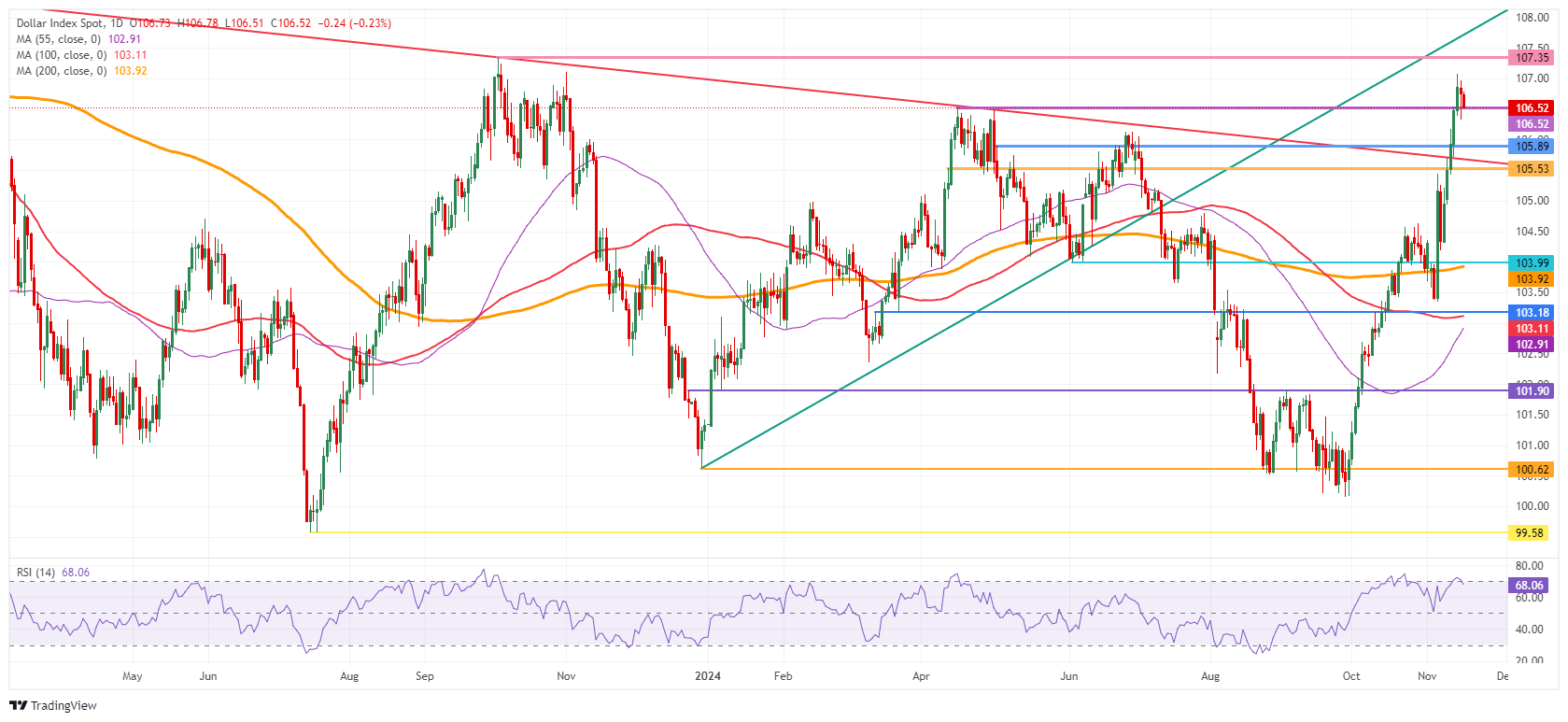
US Dollar Index: Daily Chart
Fed FAQs
Monetary policy in the US is shaped by the Federal Reserve (Fed). The Fed has two mandates: to achieve price stability and foster full employment. Its primary tool to achieve these goals is by adjusting interest rates. When prices are rising too quickly and inflation is above the Fed’s 2% target, it raises interest rates, increasing borrowing costs throughout the economy. This results in a stronger US Dollar (USD) as it makes the US a more attractive place for international investors to park their money. When inflation falls below 2% or the Unemployment Rate is too high, the Fed may lower interest rates to encourage borrowing, which weighs on the Greenback.
The Federal Reserve (Fed) holds eight policy meetings a year, where the Federal Open Market Committee (FOMC) assesses economic conditions and makes monetary policy decisions. The FOMC is attended by twelve Fed officials – the seven members of the Board of Governors, the president of the Federal Reserve Bank of New York, and four of the remaining eleven regional Reserve Bank presidents, who serve one-year terms on a rotating basis.
In extreme situations, the Federal Reserve may resort to a policy named Quantitative Easing (QE). QE is the process by which the Fed substantially increases the flow of credit in a stuck financial system. It is a non-standard policy measure used during crises or when inflation is extremely low. It was the Fed’s weapon of choice during the Great Financial Crisis in 2008. It involves the Fed printing more Dollars and using them to buy high grade bonds from financial institutions. QE usually weakens the US Dollar.
Quantitative tightening (QT) is the reverse process of QE, whereby the Federal Reserve stops buying bonds from financial institutions and does not reinvest the principal from the bonds it holds maturing, to purchase new bonds. It is usually positive for the value of the US Dollar.
Author

Filip Lagaart
FXStreet
Filip Lagaart is a former sales/trader with over 15 years of financial markets expertise under its belt.