US Dollar turns flat with markets digesting upbeat Durable Goods numbers
- Recent announcements on Copper tariffs and stalling Russia-Ukraine negotiations are triggering some flight into USD.
- US February Durable Goods was a big beat on expectations and upward revisions on the previous reading.
- The US Dollar Index sees support at 104.00 and bounces higher towards 104.50

The US Dollar Index (DXY), which tracks the performance of the US Dollar (USD) against six major currencies, is steady around 104.30 on Wednesday after the US Durable Goods Orders data release for February.
On one hand, the DXY sees some selling pressure from a Black Sea ceasefire deal brokered by the United States (US), where Ukraine is willing to commit and Russia backtracks and demands a lift in all sanctions on banks and agricultural companies.
On the other hand, the buying pressure comes from comments from US President Donald Trump, who said Copper tariffs are coming in a couple of weeks, much sooner than markets anticipated.
On the economic data front, the February Durable Goods Orders are driving the Greenback higher. Expectations were quite bearish, with a 1% contraction for the forecast number compared to the previous month’s 3.2% increase. Instead a surprise positive number and upward revision of the previous reading are making the US Dollar appreciate. On the Federal Reserve (Fed) front, Minneapolis Fed President Neel Kashkarai and St Louis Fed President Alberto Musalem are due to speak later this Wednesday.
Daily digest market movers: A dramatic shift in confidence
- At 11:00 GMT, the Mortgage Bankers Association (MBA) released the weekly Mortgage Applications number. This week’s number came in at -2% compared to the previous contraction of 6.2%.
- At 12:30 GMT, the February Durable Goods Orders data were due:
- The headline Orders jumped to 0.9%, a big beat on the estimate of -1%, with a revision as well of the previous 3.2% to 3.3%.
- Durable Goods excluding Transportation came in upbeat at 0.7%, surpassing the 0.2% survey number. The 0.0% in the previous month got revised up to 0.1%.
- Around 14:00 GMT, the President of the Federal Reserve Bank of Minneapolis, Neel Kashkari, has hosted a Fed Listens event and conversation at the Detroit Lakes Regional Chamber of Commerce Economic Summit of Detroit Lakes, Minnesota. Fed's Kashkari warned that tariffs are creating a dramatic shift in confidence.
- Just 10 minutes after Fed's Kashkari, St. Louis Fed President Alberto Musalem will speak at the Paducah Area Chamber of Commerce/Greater Paducah Economic Development Luncheon.
- Equities are not breaking any pots this Wednesday, with slim gains in Asia while losses in Europe and US starting to tick up towards 1% on the day.
- According to the CME Fedwatch Tool, the probability of interest rates remaining at the current range of 4.25%-4.50% in May’s meeting is 88.4%. For June, the odds for borrowing costs being lower stand at 65.6%.
- The US 10-year yield trades around 4.35%, with bond traders seeing yields creeping higher as the rate differential between the US and other main countries widens again.
US Dollar Index Technical Analysis: Bounce starts to wear off
The US Dollar Index (DXY) consolidates this Wednesday. Technically, support at 104.00 is good for a bounce, while concerns on tariffs and the impact on the US economy are supporting the US Dollar’s strength. On the contrary, the ongoing talks for a Russia-Ukraine peace deal mean that a sigh of relief could ripple through markets, weighing on the US Dollar.
With the weekly close above 104.00 last week, a large sprint higher towards the 105.00 round level could still occur, with the 200-day Simple Moving Average (SMA) converging at that point and reinforcing this area as a strong resistance at 104.96. Once broken through that zone, a string of pivotal levels, such as 105.53 and 105.89, could limit the upward momentum.
On the downside, the 104.00 round level is the first nearby support after a successful bounce on Tuesday. If that does not hold, the DXY risks falling back into that March range between 104.00 and 103.00. Once the lower end at 103.00 gives way, watch out for 101.90 on the downside.
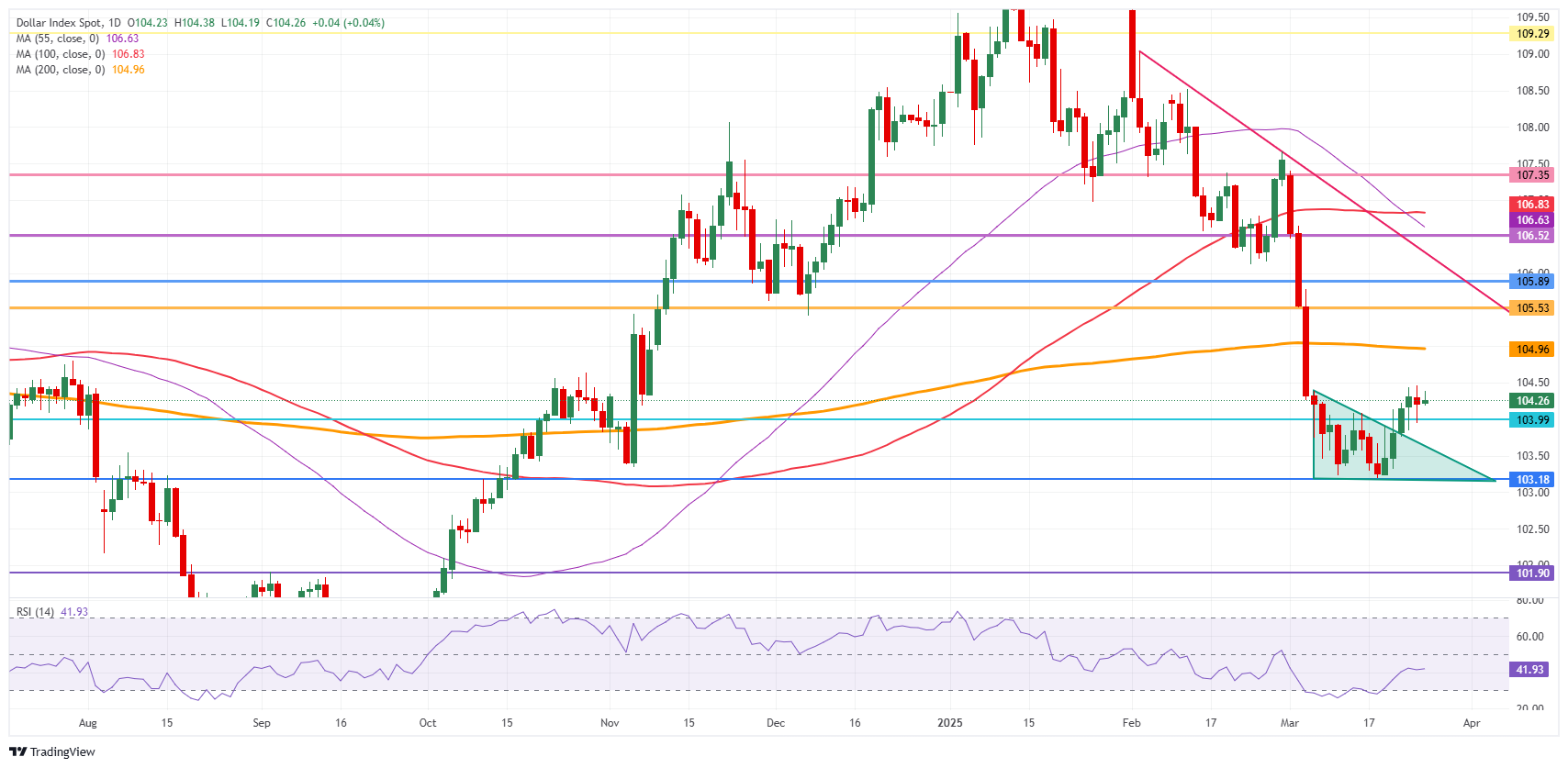
US Dollar Index: Daily Chart
Fed FAQs
Monetary policy in the US is shaped by the Federal Reserve (Fed). The Fed has two mandates: to achieve price stability and foster full employment. Its primary tool to achieve these goals is by adjusting interest rates. When prices are rising too quickly and inflation is above the Fed’s 2% target, it raises interest rates, increasing borrowing costs throughout the economy. This results in a stronger US Dollar (USD) as it makes the US a more attractive place for international investors to park their money. When inflation falls below 2% or the Unemployment Rate is too high, the Fed may lower interest rates to encourage borrowing, which weighs on the Greenback.
The Federal Reserve (Fed) holds eight policy meetings a year, where the Federal Open Market Committee (FOMC) assesses economic conditions and makes monetary policy decisions. The FOMC is attended by twelve Fed officials – the seven members of the Board of Governors, the president of the Federal Reserve Bank of New York, and four of the remaining eleven regional Reserve Bank presidents, who serve one-year terms on a rotating basis.
In extreme situations, the Federal Reserve may resort to a policy named Quantitative Easing (QE). QE is the process by which the Fed substantially increases the flow of credit in a stuck financial system. It is a non-standard policy measure used during crises or when inflation is extremely low. It was the Fed’s weapon of choice during the Great Financial Crisis in 2008. It involves the Fed printing more Dollars and using them to buy high grade bonds from financial institutions. QE usually weakens the US Dollar.
Quantitative tightening (QT) is the reverse process of QE, whereby the Federal Reserve stops buying bonds from financial institutions and does not reinvest the principal from the bonds it holds maturing, to purchase new bonds. It is usually positive for the value of the US Dollar.
Author

Filip Lagaart
FXStreet
Filip Lagaart is a former sales/trader with over 15 years of financial markets expertise under its belt.