US Dollar at 104.00 in the DXY while markest undergo quadruple witching
- The US Dollar pops for third day on geopolitical concerns.
- The Greenback appreciates despite a drop in US yields and the Fed’s commitment to cut rates.
- The US Dollar Index tries for a second day in a row to break out of the March low range.
The US Dollar Index (DXY), which tracks the performance of the US Dollar (USD) against six major currencies, is able to print a third consecutive day of gains, trading around 104.00 at the time of writing on Friday. The DXY tries to move away from the 2025 low at 103.20 reached on Tuesday, after the Financial Times reported European countries are drawing up plans to take on responsibilities for the continent’s defence from the United States (US), including a pitch to the Trump administration for a managed transfer over the next five to 10 years, which would reshape the North Atlantic Treaty Organisation (NATO). The European bloc wants to avoid a disorganised exit from the US in the treaty.
Meanwhile, pressure is mounting with April 2 as the deadline for the US to impose reciprocal tariffs. Several traders and analysts are trying to grasp the impact the tariffs might have on markets, though for now, this remains unclear. US Federal Reserve (Fed) Chairman Jerome Powell said in the press conference following the latest Fed meeting on Wednesday that levies should have a transitory effect on inflation.
Markets seem to believe those words, however, traders remain doubtful. The last time Powell said effects were transitory, the Fed had to hike from 0.25% to 5.5% its policy rate in the post-covid era when inflation appeared to be sticky, not transitory. It took the central bank more than a year to confirm that.
Daily digest market movers: A clean slate next week
- This Friday will be marked as Quadruple Witching day. Quadruple Witching is an event in financial markets when four different sets of futures and options expire on the same day, and investors need to decide whether to sell and buy back their positions or just sell them.
- At 13:05, Federal Reserve Bank of New York President John Williams delivered keynote remarks at the 2nd Biennial Macroeconometric Caribbean Conference in Nassau, Bahamas.Fed's Williams said neutral rates are the best position right now to assess the impact of tariffs.
- At 15:00 GMT, US President Donald Trump will give a speech from the Oval Office.
- Equities are dropping lower on Friday. In China, the Hang Seng and the Shanghai Shenzhen indexes both dropped over 1.50%. This fueled another rout in European and US equities, which are also down over 1%. Concerns are mounting as US corporate profit earnings look bleak, and several central banks – including the Federal Reserve, the Bank of Japan and the Bank of England – have expressed uncertainty about the economy due to tariffs, affecting their policy-making.
- According to the CME Fedwatch Tool, the probability of interest rates remaining at the current range of 4.25%-4.50% in May’s meeting is at 83.1%. For June, the odds for borrowing costs being lower stand at 70.0%.
- The US 10-year yield trades around 4.22%, heading back to its five-month low of 4.10% printed on March 4.
US Dollar Index Technical Analysis: Could go both ways
The US Dollar Index (DXY) is ticking up for a third day in a row and is already trading positive for this week’s performance. The seismic shift that materialised at the start of March is still present. With the US reciprocal tariff deadline on April 2 approaching, either a full swing trade back to 106.82 or another leg lower towards 101.90 or even 100.62 could occur as markets are having a hard time reading and understanding the possible effects of these tariffs on the global economy.
Should the DXY close above 104.00 this week, a large sprint higher towards the 105.00 round level could happen, with the 200-day Simple Moving Average (SMA) converging at that point and reinforcing this area as a strong resistance. Once broken through that zone, a string of pivotal levels, such as 105.53 and 105.89, could limit the upward momentum.
On the downside, the 103.00 round level could be considered a bearish target in case US yields roll off further on deteriorating US data, with even 101.90 on the table if markets further capitulate on their long-term US Dollar holdings.
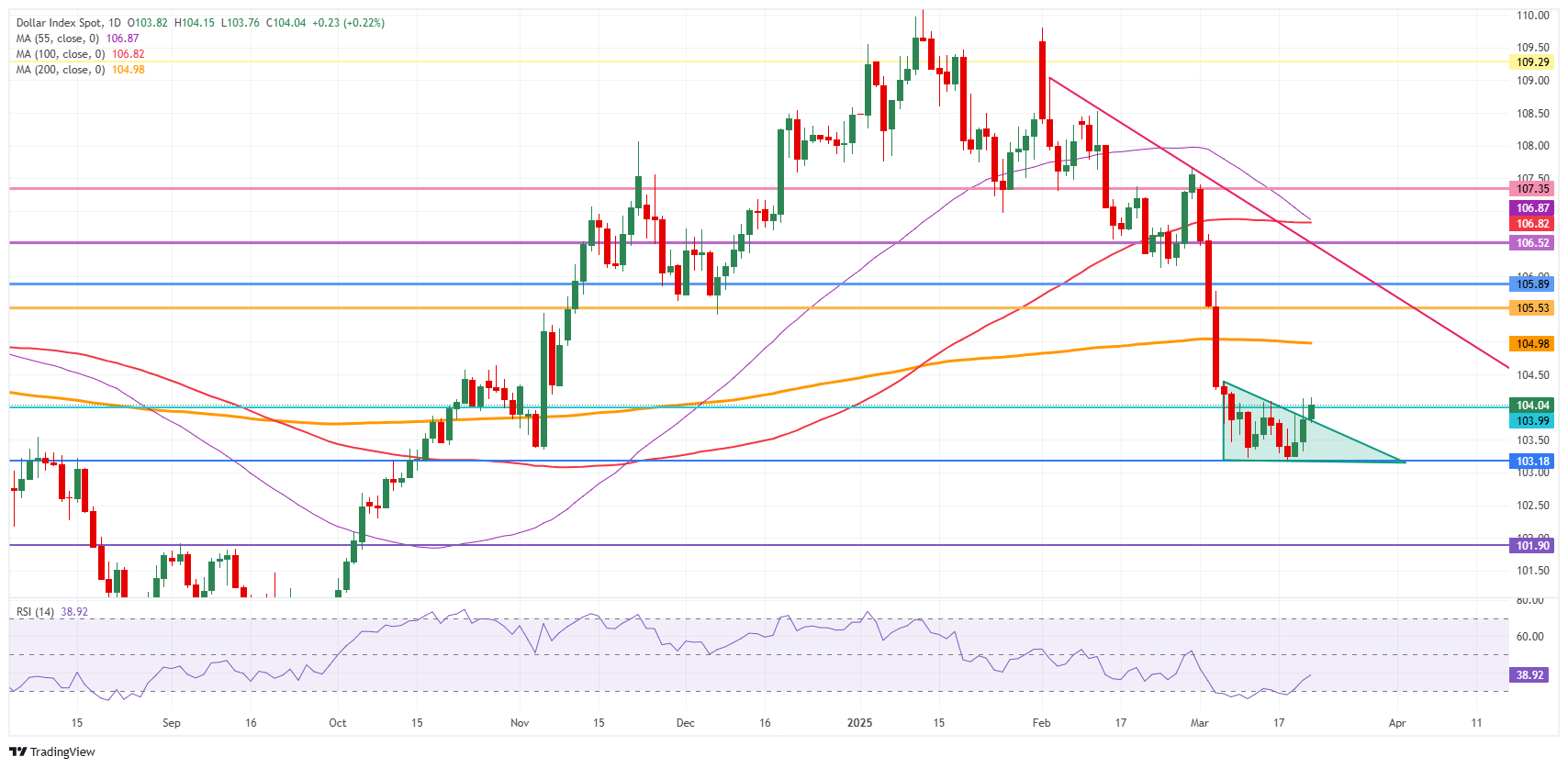
US Dollar Index: Daily Chart
Central banks FAQs
Central Banks have a key mandate which is making sure that there is price stability in a country or region. Economies are constantly facing inflation or deflation when prices for certain goods and services are fluctuating. Constant rising prices for the same goods means inflation, constant lowered prices for the same goods means deflation. It is the task of the central bank to keep the demand in line by tweaking its policy rate. For the biggest central banks like the US Federal Reserve (Fed), the European Central Bank (ECB) or the Bank of England (BoE), the mandate is to keep inflation close to 2%.
A central bank has one important tool at its disposal to get inflation higher or lower, and that is by tweaking its benchmark policy rate, commonly known as interest rate. On pre-communicated moments, the central bank will issue a statement with its policy rate and provide additional reasoning on why it is either remaining or changing (cutting or hiking) it. Local banks will adjust their savings and lending rates accordingly, which in turn will make it either harder or easier for people to earn on their savings or for companies to take out loans and make investments in their businesses. When the central bank hikes interest rates substantially, this is called monetary tightening. When it is cutting its benchmark rate, it is called monetary easing.
A central bank is often politically independent. Members of the central bank policy board are passing through a series of panels and hearings before being appointed to a policy board seat. Each member in that board often has a certain conviction on how the central bank should control inflation and the subsequent monetary policy. Members that want a very loose monetary policy, with low rates and cheap lending, to boost the economy substantially while being content to see inflation slightly above 2%, are called ‘doves’. Members that rather want to see higher rates to reward savings and want to keep a lit on inflation at all time are called ‘hawks’ and will not rest until inflation is at or just below 2%.
Normally, there is a chairman or president who leads each meeting, needs to create a consensus between the hawks or doves and has his or her final say when it would come down to a vote split to avoid a 50-50 tie on whether the current policy should be adjusted. The chairman will deliver speeches which often can be followed live, where the current monetary stance and outlook is being communicated. A central bank will try to push forward its monetary policy without triggering violent swings in rates, equities, or its currency. All members of the central bank will channel their stance toward the markets in advance of a policy meeting event. A few days before a policy meeting takes place until the new policy has been communicated, members are forbidden to talk publicly. This is called the blackout period.
Author

Filip Lagaart
FXStreet
Filip Lagaart is a former sales/trader with over 15 years of financial markets expertise under its belt.