US Dollar Index at fresh low for May after German Chancellor Merz secures majority
- The US Dollar Index edges lower, testing a fresh low for this week.
- Traders are starting to get nervous on the duration before an initial trade deal can be announced.
- The US Dollar Index remains capped below 100.00, still stuck in a wait-and-see range.

The US Dollar Index (DXY), which tracks the performance of the US Dollar (USD) against six major currencies, is sliding lower on Tuesday with market nervousness picking up again. Market participants are assessing the recent sharp move in the Taiwan Dollar (TWD), which appreciated by more than 5% against the Greenback on Monday before retreating somewhat on Tuesday. Markets are trying to assess if a spillover effect could occur, affecting bigger Asian currencies such as the South Korean Won (KRW), the Japanese Yen (JPY) or the Chinese Renminbi (CNH).
Meanwhile, on the geopolitical front, a swarm of headlines are making its way to the markets, with the most recent the upcoming German Chancellor Friedrich Merz, who initially fell short of a majority in the German parliament vote to become the new Chancellor, though secured the votes in a second round later this Tuesday. On the other side of the Atlantic, US Commerce Secretary Howard Lutnick jacked up stakes for the Trump administration to deliver an initial trade deal soon by saying that the first deal needs to be with a “top ten” economy, he said on Fox News. In Europe, the war between Russia and Ukraine is heating up with drone attacks on both sides, while Israel is further preparing a ground offensive with the goal of fully controlling the Gaza Strip.
Daily digest market movers: A lot of visits
- Mayhem in German Parliament, the Bundestag, this Tuesday where a formal vote to swear in new Chancellor Friedrich Merz was set on the agenda. Though, Merz failed to secure enough votes and apparently already lost trust in his own majority coalition before even becoming Chancellor. A lot of questions arise now in this never-before-seen political impasse. A second vote could take place later this, or either a new Chancellor can be chosen while even new snap elections could be under consideration.
- In a second vote after the US Opening Bell, German Chancellor Merz secured enough votes in order to become the next German Chancellor.
- Newly elected Canadian Prime Minister Mark Carney is on his way to the White House to meet with US President Donald Trump to discuss a possible trade deal.
- The US Goods and Services Trade Balance for March fell to a wider-than-expected deficit of 140.5 billion against the expected $129 billion, with the previous reading being a $122.7 billion deficit in February.
- Equities dropped lower across the board on the back of the German political news. The German Dax slips 0.5%. US futures are all down as well with the Nasdaq leading the decline, down by 1%.
- The CME FedWatch tool shows the chance of an interest rate cut by the Federal Reserve in May's meeting stands at 3.2% against a 96.8% probability of no change. The June meeting sees a 31.8% chance of a rate cut.
- The US 10-year yields trade around 4.36%, erasing past weeks’ softening as traders have even priced out the chances for a June rate cut further, with even July starting to look doubtful.
US Dollar Index Technical Analysis: Tipping its toes
The US Dollar Index (DXY) is facing some headwinds after US Commerce Secretary Lutnick ramped up pressure from within the Trump administration to get an initial trade deal done. Lutnick added that the initial deal should be with a top ten economy, in order to set an example. Despite several claims from US President Donald Trump and several cabinet members that deals are imminent, no real signed trade deals have been announced.
On the upside, the DXY’s first resistance comes in at 100.22, which supported the DXY back in September 2024, with a break back above the 100.00 round level as a bullish signal. A firm recovery would be a return to 101.90, which acted as a pivotal level throughout December 2023 and again as a base for the inverted head-and-shoulders (H&S) formation during the summer of 2024.
On the other hand, the 97.73 support could quickly be tested on any substantial bearish headline. Further below, a relatively thin technical support comes in at 96.94 before looking at the lower levels of this new price range. These would be at 95.25 and 94.56, meaning fresh lows not seen since 2022.
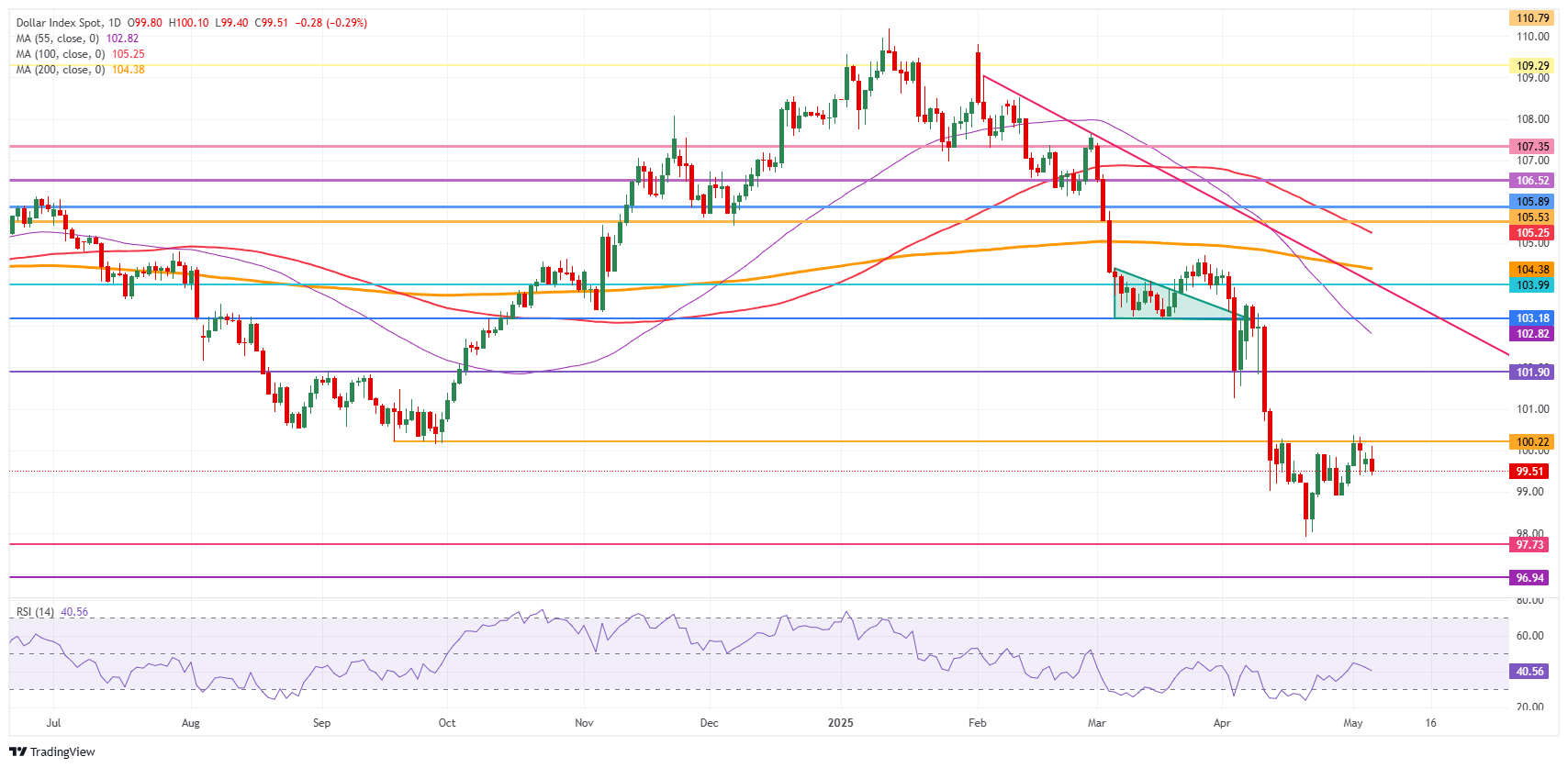
US Dollar Index: Daily Chart
German economy FAQs
The German economy has a significant impact on the Euro due to its status as the largest economy within the Eurozone. Germany's economic performance, its GDP, employment, and inflation, can greatly influence the overall stability and confidence in the Euro. As Germany's economy strengthens, it can bolster the Euro's value, while the opposite is true if it weakens. Overall, the German economy plays a crucial role in shaping the Euro's strength and perception in global markets.
Germany is the largest economy in the Eurozone and therefore an influential actor in the region. During the Eurozone sovereign debt crisis in 2009-12, Germany was pivotal in setting up various stability funds to bail out debtor countries. It took a leadership role in the implementation of the 'Fiscal Compact' following the crisis – a set of more stringent rules to manage member states’ finances and punish ‘debt sinners’. Germany spearheaded a culture of ‘Financial Stability’ and the German economic model has been widely used as a blueprint for economic growth by fellow Eurozone members.
Bunds are bonds issued by the German government. Like all bonds they pay holders a regular interest payment, or coupon, followed by the full value of the loan, or principal, at maturity. Because Germany has the largest economy in the Eurozone, Bunds are used as a benchmark for other European government bonds. Long-term Bunds are viewed as a solid, risk-free investment as they are backed by the full faith and credit of the German nation. For this reason they are treated as a safe-haven by investors – gaining in value in times of crisis, whilst falling during periods of prosperity.
German Bund Yields measure the annual return an investor can expect from holding German government bonds, or Bunds. Like other bonds, Bunds pay holders interest at regular intervals, called the ‘coupon’, followed by the full value of the bond at maturity. Whilst the coupon is fixed, the Yield varies as it takes into account changes in the bond's price, and it is therefore considered a more accurate reflection of return. A decline in the bund's price raises the coupon as a percentage of the loan, resulting in a higher Yield and vice versa for a rise. This explains why Bund Yields move inversely to prices.
The Bundesbank is the central bank of Germany. It plays a key role in implementing monetary policy within Germany, and central banks in the region more broadly. Its goal is price stability, or keeping inflation low and predictable. It is responsible for ensuring the smooth operation of payment systems in Germany and participates in the oversight of financial institutions. The Bundesbank has a reputation for being conservative, prioritizing the fight against inflation over economic growth. It has been influential in the setup and policy of the European Central Bank (ECB).
(This story was corrected on May 6 at 14:46 GMT to say "with the most recent the upcoming German Chancellor Friedrich Merz, who initially fell short of a majority in the German parliament vote to become the new Chancellor, though secured the votes in a second round later this Tuesday." in stead of "with the most recent the upcoming German Chancellor Friedrich Merz falling short of a majority in the German parliament vote to become the new Chancellor." )
Author

Filip Lagaart
FXStreet
Filip Lagaart is a former sales/trader with over 15 years of financial markets expertise under its belt.